
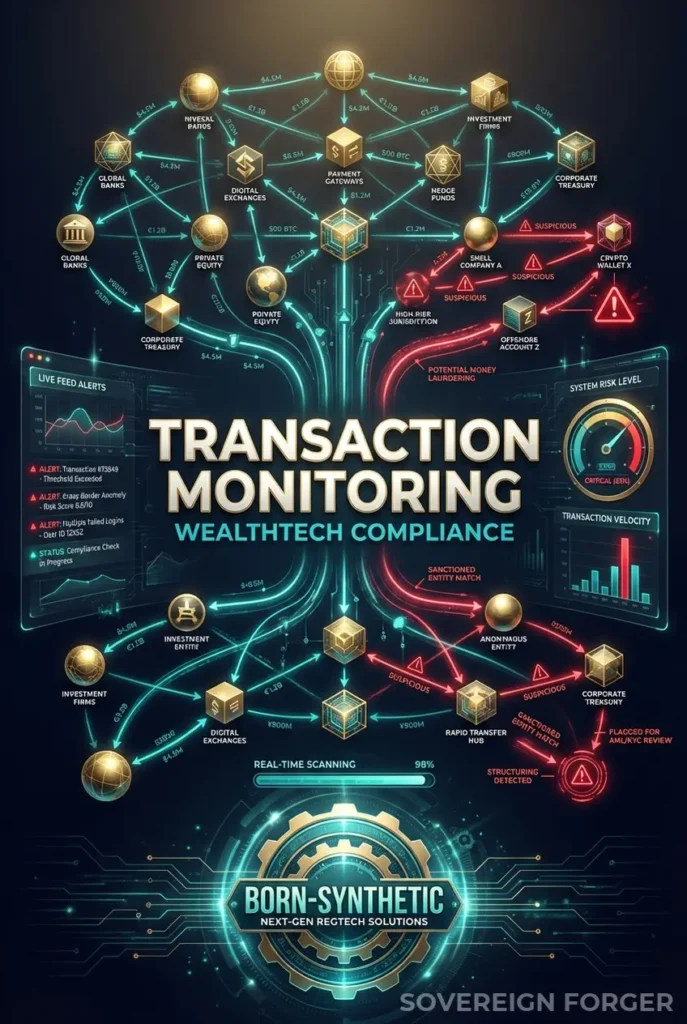
This transaction monitoring data is built for exactly this scenario. Credit Suisse: billions in cumulative fines. UBS: $5.1B in France alone. Julius Baer: $79.7M to the DoJ. These were not scrappy startups cutting corners — they were wealth management institutions with dedicated compliance teams, sophisticated monitoring systems, and regulatory budgets most fintechs can only dream of. Their transaction monitoring still failed. The reason is always the same: the systems were tuned on data that looked nothing like the clients whose money actually moved through them.
Your Transaction Monitoring Is Tuned to the Wrong Population
I have spent years watching WealthTech platforms build transaction monitoring systems that work perfectly — until a real client uses them.
Here is what happens. A platform like Avaloq, Broadridge, or FNZ integrates a transaction monitoring engine. The compliance team needs test data to calibrate detection thresholds — what counts as a suspicious transfer, what volume triggers an alert, what jurisdictional pattern warrants review. They generate synthetic profiles or pull a sanitized sample. The profiles are clean: single jurisdiction, domestic holdings, straightforward income sources. The system learns what “normal” looks like from these profiles.
Then the platform goes live with actual wealth management clients. A family office in Zurich moves $14M from a Cayman-domiciled LP to a Singapore trust as part of a routine quarterly rebalancing. The monitoring system has never seen a legitimate transfer of that size between those two jurisdictions. It flags it. An analyst reviews it, clears it, and closes the alert.
The next day, forty-three similar transfers arrive. All flagged. All legitimate. All requiring manual review. Within a week, the compliance team is buried in false positives. They start raising alert thresholds to survive the volume. Two months later, an actually suspicious transaction — same jurisdictions, similar amount, but structurally different in ways the system was never taught to detect — sails through unnoticed.
I have watched this exact pattern play out at three different wealth management platforms. The monitoring system was never broken. It was mis-calibrated from day one because the test data contained zero representation of how ultra-high-net-worth clients actually structure and move their wealth.
The structural problem is specific to WealthTech. Neobanks serve millions of retail customers. Their transaction monitoring deals primarily with volume — thousands of small payments, a handful of outliers. WealthTech platforms serve hundreds or low thousands of UHNWI clients. Every single client is an outlier by retail standards. Multi-jurisdictional holdings are the norm. Offshore vehicles are standard wealth architecture, not red flags. PEP-adjacent connections through board seats, advisory roles, or family members are routine.
When your transaction monitoring is trained on profiles that treat a $500K wire transfer as exceptional and a cross-border movement as inherently suspicious, every legitimate UHNWI transaction becomes an alert. Your compliance team drowns in noise. Your true positive rate collapses. And the regulator — FINMA, FCA, or SEC — does not care that the false positive rate was the root cause. They see a system that failed to detect the transactions that mattered.
The numbers tell the story. Julius Baer paid $79.7M to the DoJ not because they lacked a monitoring system, but because their system failed to flag the transactions that were actually suspicious — while their analysts were buried reviewing the ones that were not. Credit Suisse’s cascade of compliance failures — Greensill, Archegos, Mozambique — each traced back to monitoring systems that could not distinguish between the legitimate complexity of ultra-high-net-worth wealth flows and the structural patterns that indicate actual financial crime.
This is not a technology problem. It is a data problem. If the training data does not contain realistic multi-jurisdictional UHNWI profiles with offshore structures, trust layers, and cross-border holdings, the monitoring system has no frame of reference for what “normal” looks like in wealth management. Everything looks suspicious. Or nothing does. Either way, the system fails.
Three Approaches That Don’t Work for WealthTech Transaction Monitoring
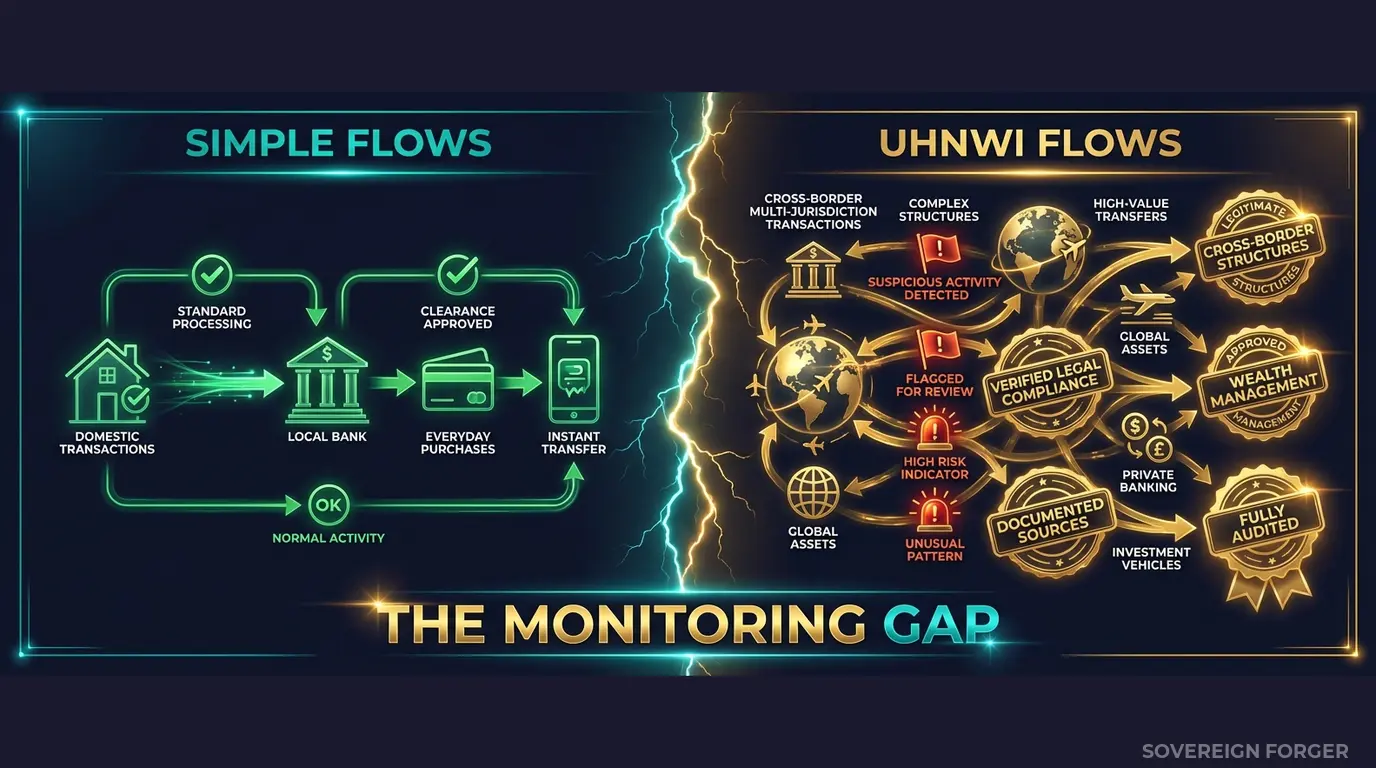
I have evaluated the test data infrastructure at wealth management platforms ranging from $5B to $200B AUM. The approaches fall into three categories, and none of them solve the calibration problem.
Using copies of production client data. Some platforms extract real client transaction histories into test environments to tune their monitoring thresholds. For wealth management, this is not merely a GDPR Article 25 violation — it is an existential risk. UHNWI clients have specific contractual confidentiality protections. A data breach in a test environment exposing the transaction patterns of a family office or a sovereign wealth fund’s investment arm does not just trigger a regulatory fine — it triggers client departures that can wipe out years of AUM growth. And under the EU AI Act Article 10, if your monitoring model trains on this data, you need to document its provenance and demonstrate governance. Real client data in a test environment is ungovernable by definition.
Using anonymized client data. With roughly 265,000 UHNWIs globally, anonymizing transaction data from wealth management clients is a statistical exercise in futility. The combination of transaction volume, jurisdictional footprint, asset class mix, and counterparty patterns can uniquely identify individuals even without names attached. A regulator — or worse, a plaintiff in a breach lawsuit — can reconstruct identity from the structural signature of wealth flows. What you call “anonymized,” a court may call “pseudonymized,” and GDPR applies in full. For WealthTech platforms specifically, the re-identification risk is amplified because the client population is small and the data patterns are highly distinctive.
Using generic synthetic generators. This is the most common approach, and it produces the most dangerous outcome. Platform-based synthetic data generators create profiles that look like retail banking customers with inflated numbers. Single jurisdiction. No offshore vehicles. No entity layering. No PEP connections. When you tune your transaction monitoring on these profiles, “normal” means domestic transfers of moderate size. The system then encounters a client with holdings in four jurisdictions, a family trust in Liechtenstein, and quarterly distributions from a Singapore LP — and treats every transaction as an anomaly. Your false positive rate explodes. Your analysts burn out. Your true positives hide in the noise.
Real Data vs. Anonymized vs. Born-Synthetic
| Dimension | Real Data | Anonymized | Born-Synthetic |
|---|---|---|---|
| PII present | Yes | Residual | None |
| Re-identification risk | Certain | Probable (UHNWI) | Impossible |
| GDPR Art. 25 compliant | No | Disputed | Yes |
| EU AI Act Art. 10 | Violation | Unclear | Compliant |
| Certifiable for auditors | No | No | Yes (Certificate of Origin) |
| Fine exposure | Up to 4% global revenue | Up to 4% global revenue | Zero |
| UHNWI wealth complexity | Realistic but illegal | Realistic but re-identifiable | Realistic and safe |
| Transaction monitoring calibration | Accurate but ungovernable | Degraded by stripping | Structurally accurate |
Born-Synthetic KYC Data Built for WealthTech Transaction Monitoring Calibration
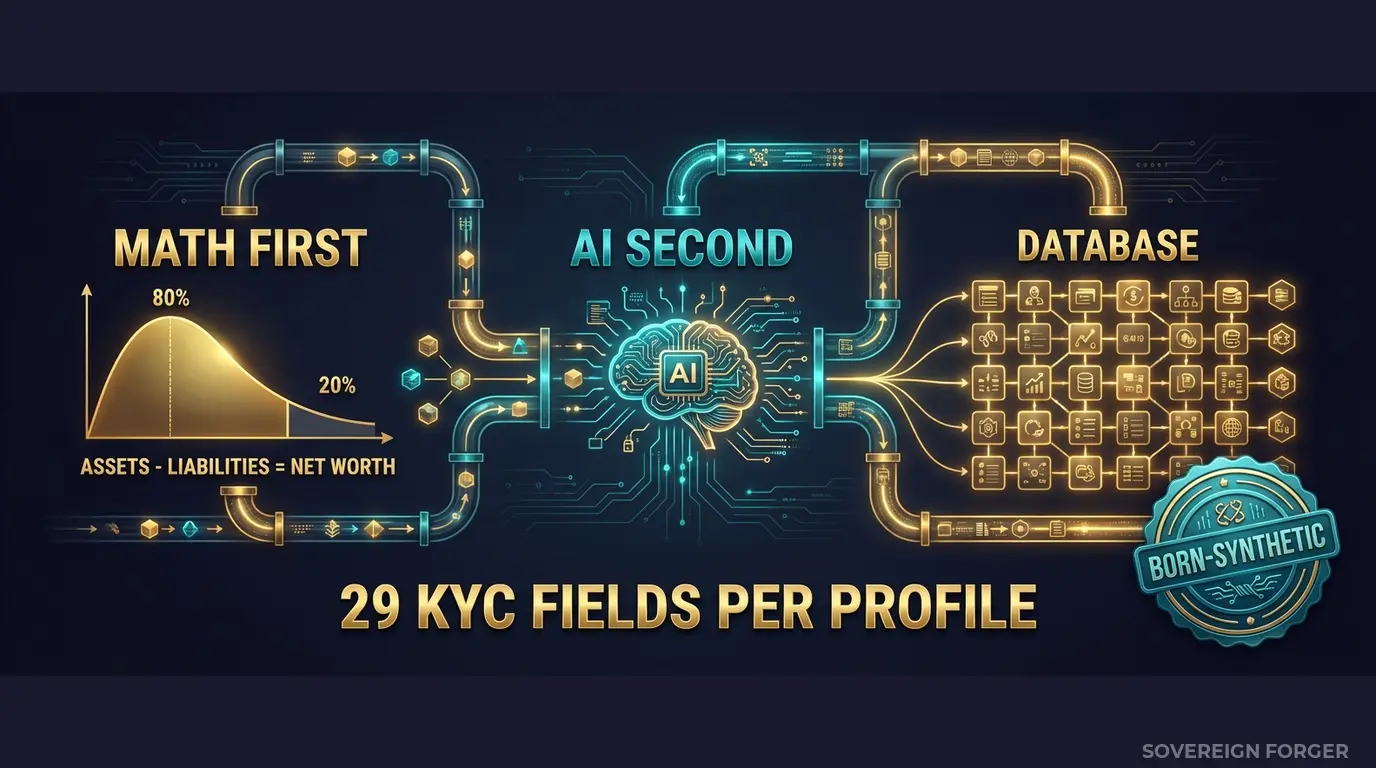
I built the Sovereign Forger pipeline to solve a specific problem I watched repeat across the wealth management industry: compliance teams that could not get test data complex enough to calibrate their monitoring systems without breaking privacy law. The solution is born-synthetic — data generated entirely from mathematical constraints and domain knowledge, with zero lineage to any real person.
Every profile in the Sovereign Forger KYC dataset is generated in two stages:
Math First. Net worth follows a Pareto distribution — the actual statistical shape of real wealth concentration, not a Gaussian bell curve. This is critical for transaction monitoring calibration. If your test data distributes wealth normally, most profiles cluster around the mean and outliers are rare. Real UHNWI wealth follows a power law: a small number of clients hold dramatically more than the rest, and their transaction patterns scale accordingly. The Pareto shape ensures your monitoring system trains on the right distribution from day one.
Asset allocations are computed within algebraic constraints: Assets – Liabilities = Net Worth, by construction. Every balance sheet balances on every record. When your monitoring system needs to assess whether a $8M transfer is consistent with a client’s overall wealth structure, the underlying financial architecture has to be internally coherent — not randomly assembled numbers that happen to be large.
AI Second. A local AI model — running offline, on-premises, never touching the internet — adds narrative context after the financial figures are locked. Biography, profession, philanthropic focus, cultural details coherent with the geographic niche and wealth archetype. The AI never modifies the numbers. It provides the qualitative enrichment that makes each profile feel like a complete client record rather than a row of figures.
How This Solves the Transaction Monitoring Problem
The reason transaction monitoring fails in WealthTech is not algorithmic — it is that the calibration data lacks the structural complexity that characterizes real UHNWI wealth flows. Sovereign Forger profiles address each dimension that generic test data misses:
Multi-jurisdictional exposure. Every profile includes a `tax_domicile` and, where architecturally appropriate, an `offshore_jurisdiction` and `offshore_vehicle`. A Swiss-Singapore family office manager with a Cayman LP is not an anomaly — it is a standard archetype in the dataset. When your monitoring system trains on profiles where cross-border structures are normal for certain wealth tiers, it stops flagging every international transfer as suspicious.
Wealth composition that drives transaction patterns. The `assets_composition` and `liabilities_composition` fields break down each profile’s financial structure — property, equity, cash liquidity, offshore holdings. Your monitoring system can learn that a client with 40% of assets in core equity and 25% in property will generate different transaction patterns than a client with 60% in cash liquidity and an offshore LP. The composition is not random — it is derived from the archetype and niche, reflecting how different types of wealth are actually structured.
KYC risk signals for threshold calibration. Each profile carries deterministically derived KYC signals: `kyc_risk_rating`, `pep_status`, `sanctions_screening_result`, `adverse_media_flag`, `source_of_wealth_verified`, and `high_risk_jurisdiction_flag`. These are not randomly assigned — they are computed from the profile’s archetype, niche, net worth, and jurisdiction using SHA-256 hash-based pseudo-randomness. A Middle East sovereign family profile gets different risk distributions than a Silicon Valley tech founder, because the underlying compliance exposure is structurally different.
This means your transaction monitoring can calibrate against profiles where legitimate UHNWI activity coexists with appropriate risk signals — exactly the mix your system encounters in production. High-risk jurisdiction exposure does not automatically mean suspicious activity. PEP status does not automatically mean corrupt transactions. Your monitoring thresholds need to learn these distinctions from the training data, not from painful false positive experience in production.
Built for WealthTech Transaction Monitoring at Scale
6 Geographic Niches: Silicon Valley, Old Money Europe, Middle East, LatAm, Pacific Rim, Swiss-Singapore — each with the jurisdiction mix, offshore structures, and wealth architecture that your monitoring system will encounter from clients in that region. These are not localized retail profiles with different names. They are structurally distinct wealth patterns with different transaction monitoring implications.
31 Wealth Archetypes: Family office principals, private bankers, commodity traders, real estate developers, tech founders, generational dynasty managers, merchant house operators — the actual client types that Broadridge, Avaloq, FNZ, Addepar, and SEI Investments serve. Each archetype has a distinct wealth composition that produces distinct transaction patterns. Your monitoring system needs to train on all of them.
KYC Signal Distribution by Niche: Risk ratings, PEP statuses, sanctions screening results, and source-of-wealth verification methods are distributed with realistic frequencies specific to each geographic niche. Middle East profiles carry higher PEP rates (~29%) because sovereign and political families are a structural feature of wealth in that region. LatAm profiles carry higher risk ratings (~84%) reflecting jurisdictional exposure. These distributions are not arbitrary — they reflect the compliance landscape your monitoring team navigates.
Offshore Architecture Representation: Trust structures, LPs, LLCs, foundations, and nominee arrangements appear at realistic frequencies within each niche. Your monitoring system learns that a Cayman LP held by an Old Money Europe profile is architecturally normal — while the same structure attached to a retail banking profile would warrant investigation. This contextual understanding is what separates a well-calibrated monitoring system from one that flags everything.
Pricing
| Tier | Records | Price | Best For |
|---|---|---|---|
| Compliance Starter | 1,000 | $999 | Threshold calibration proof of concept |
| Compliance Pro | 10,000 | $4,999 | Full monitoring regression suite |
| Compliance Enterprise | 100,000 | $24,999 | AI model training + production calibration |
No SDK. No API key. No sales call. Download a file, open it in Python or your analytics platform, and feed it into your transaction monitoring pipeline. Every record is JSONL and CSV — compatible with any system that ingests structured data.
Why This Matters Now for WealthTech
Regulators are targeting wealth management specifically. FINMA fined Credit Suisse repeatedly for transaction monitoring failures across its wealth management division. The FCA’s enforcement against Julius Baer and ongoing scrutiny of UK-based wealth platforms signals that transaction monitoring in the HNW/UHNW space is a priority, not an afterthought. The SEC’s examination priorities for 2025-2026 explicitly include transaction surveillance at wealth management firms. If your platform serves wealth managers, your monitoring infrastructure is under the microscope.
The EU AI Act changes the compliance equation. Fully applicable from August 2026, the AI Act classifies financial crime detection AI as high-risk under Annex III. Article 10 requires documented governance of training data — provenance, bias assessment, representativeness, and GDPR compliance. If your monitoring model trains on real client data, you need to prove GDPR compliance on the training data itself. If it trains on anonymized data, you need to prove the anonymization is sufficient (for UHNWIs, it almost certainly is not). Born-synthetic data eliminates this entire compliance surface: zero PII by construction, fully documented provenance, certifiable for any auditor.
False positive costs are compounding. Industry research consistently shows that 95%+ of transaction monitoring alerts in wealth management are false positives. Each false positive costs analyst time, delays legitimate client transactions, and erodes the compliance team’s ability to focus on genuine risks. When your monitoring thresholds are calibrated on data that does not represent UHNWI wealth complexity, the false positive rate is not 95% — it is structural. Lowering thresholds creates true negative risk. Raising them buries your team. The only solution is better calibration data.
The balance sheet test is open source. Every Sovereign Forger record passes algebraic validation: Assets – Liabilities = Net Worth. Run the Balance Sheet Test on our data, then run it on your current test data. If your current data fails this basic coherence check, your monitoring system is training on financially incoherent profiles — and making calibration decisions based on impossible wealth structures.
Every dataset ships with a Certificate of Sovereign Origin — documenting the born-synthetic methodology, zero PII lineage, and regulatory alignment. When FINMA, the FCA, or an external auditor asks where your transaction monitoring calibration data came from, you hand them the certificate. Born-Synthetic data. Zero real PII. Compliant by construction — not by anonymization.
Calibrate Your Transaction Monitoring
Download 100 free KYC-Enhanced UHNWI profiles with realistic multi-jurisdictional exposure, offshore structures, and wealth composition. Use them to baseline your monitoring thresholds.
Feed them into your transaction monitoring system. Count how many trigger false alerts — transfers between jurisdictions that your system has never seen as legitimate, wealth structures it treats as anomalous, PEP connections it cannot distinguish from criminal exposure.
That false positive count is the calibration gap between your test data and your real client base. For WealthTech platforms, this gap is not a minor inconvenience — it is the difference between a monitoring system that works and one that buries your compliance team in noise while missing the transactions that actually matter.
No credit card. No sales call. Just your work email.
Frequently Asked Questions
Why do transaction monitoring systems generate excessive false positives for UHNWI clients, and how can synthetic data fix this?
UHNWI clients routinely trigger alerts because their legitimate activity — cross-border wire transfers exceeding €500,000, complex offshore holding structures, and multi-jurisdictional asset movements — closely resembles the patterns that AML systems are trained to flag. Synthetic UHNWI profiles replicate these edge-case transaction signatures at scale, allowing compliance teams to tune thresholds against hundreds of realistic scenarios without touching real client data, reducing false positive rates by calibrating rules specifically to high-net-worth behavior patterns required under EDD frameworks.
How do synthetic transaction profiles help WealthTech firms meet MiFID II suitability and EDD obligations during system testing?
MiFID II requires firms to document client categorization and suitability assessments before executing transactions, while EDD obligations demand enhanced scrutiny for UHNWI profiles involving offshore structures and politically exposed persons. Synthetic profiles can be generated with pre-assigned risk ratings, PEP flags, and multi-jurisdictional source-of-wealth narratives, giving QA teams realistic test cases that exercise every regulatory branch — including Art.25 GDPR privacy-by-design requirements — without exposing actual client records during UAT or model validation cycles.
What makes UHNWI profiles the hardest synthetic data challenge in WealthTech transaction monitoring?
UHNWI profiles require coherent interlocking attributes — beneficial ownership chains across 4 or more jurisdictions, layered trust and foundation structures, co-mingled business and personal cash flows, and source-of-wealth narratives that are both plausible and internally consistent across years of transaction history. Generating 29 interlocked fields that pass sanctions screening logic, EDD rule sets, and behavioral analytics simultaneously demands statistical modeling far beyond simple randomization, which is why most in-house synthetic data attempts fail to stress-test monitoring systems against this client segment effectively.
What does born-synthetic mean, and why does it matter specifically for WealthTech transaction monitoring?
Born-synthetic means every identity and transaction record is generated from scratch using mathematical distributions — including Pareto distributions to model realistic wealth concentration — rather than derived, masked, or anonymized from any real person’s data. There is zero lineage to actual individuals, which means the data is GDPR Art.25 compliant by construction, satisfying privacy-by-design at the point of creation. For transaction monitoring, this eliminates re-identification risk during model training and red-team testing, and satisfies EU AI Act Art.10 requirements for high-quality training data used in automated decision systems.
How quickly can a WealthTech compliance team get started testing transaction monitoring systems with synthetic profiles?
Teams can download 100 free KYC profiles instantly using a work email address, with no credit card required. Each profile includes 29 interlocked fields covering risk ratings, PEP status, sanctions screening results, and source-of-wealth classifications, providing immediate coverage for the most common transaction monitoring test scenarios. The profiles are structured to exercise alert-trigger logic across cross-border payments and suspicious pattern detection, giving QA and compliance engineers a production-representative dataset within minutes of signing up.
Learn more about WealthTech transaction monitoring data and how Born Synthetic data addresses this in our glossary and comparison guides.