
Credit Suisse: billions in cumulative fines. UBS: $5.1B in France alone. Julius Baer: $79.7M from the DoJ. Every one of these failures started in the same place — KYC systems that were never tested against the multi-generational, multi-jurisdictional wealth structures that walk through the door every week.
Your WealthTech Platform Has a Test Data Problem That Mirrors Your Clients’ Complexity
I have spent years working with financial data in environments where the client base is not retail. WealthTech is different from every other financial vertical for one reason: your average client is the edge case that breaks everyone else’s system. A family office with holdings across four jurisdictions. A third-generation industrialist with a Liechtenstein trust layered under a Singapore holding company. A former minister’s spouse who triggers PEP screening through association, not personal history.
This is not the exception in wealth management. This is the standard intake.
I have watched WealthTech engineering teams build KYC onboarding pipelines and test them against profiles that would not survive five minutes in a private banking relationship. Single jurisdiction. One asset class. No offshore vehicle. No trust structure. No PEP connection. The test passes, the pipeline ships, and then the first real client arrives — a Swiss-domiciled family with a BVI holding, a Cayman LP, property in Monaco, and a daughter married to a sitting parliamentarian in the Netherlands.
Three KYC rules fire simultaneously. The risk scoring engine produces a result it was never calibrated to handle. The compliance team escalates manually. The onboarding that was supposed to take two days takes three weeks, and the client moves to a competitor whose system was built to handle this from day one.
This is not a scaling problem. It is a test data problem. The structural complexity of UHNWI clients — multi-entity ownership, cross-border tax arrangements, PEP adjacency through family networks, source-of-wealth chains that span decades and continents — is absent from the data used to build and validate the system. The pipeline was never wrong. It was never tested.
The numbers tell the story. There are roughly 265,000 UHNWIs globally. The average UHNWI holds assets across 2.7 jurisdictions. Over 60% use at least one offshore vehicle. Approximately 8% have PEP connections through family or business associations. If your KYC test data contains none of this structural complexity, your system has been validated against a population that does not exist in your actual client base.
The regulatory pressure is specific to your sector. FINMA fined Credit Suisse repeatedly for inadequate due diligence on politically exposed clients. The FCA’s enforcement against wealth managers has accelerated since 2023, with specific focus on the adequacy of client risk assessment frameworks. The SEC’s AML enforcement actions increasingly target the wealth management arms of financial institutions. When regulators examine your KYC system, they do not ask whether it works on simple profiles. They ask whether it works on the profiles that actually present risk — and those profiles are the ones your test data never contained.
Three Approaches That Break in Wealth Management
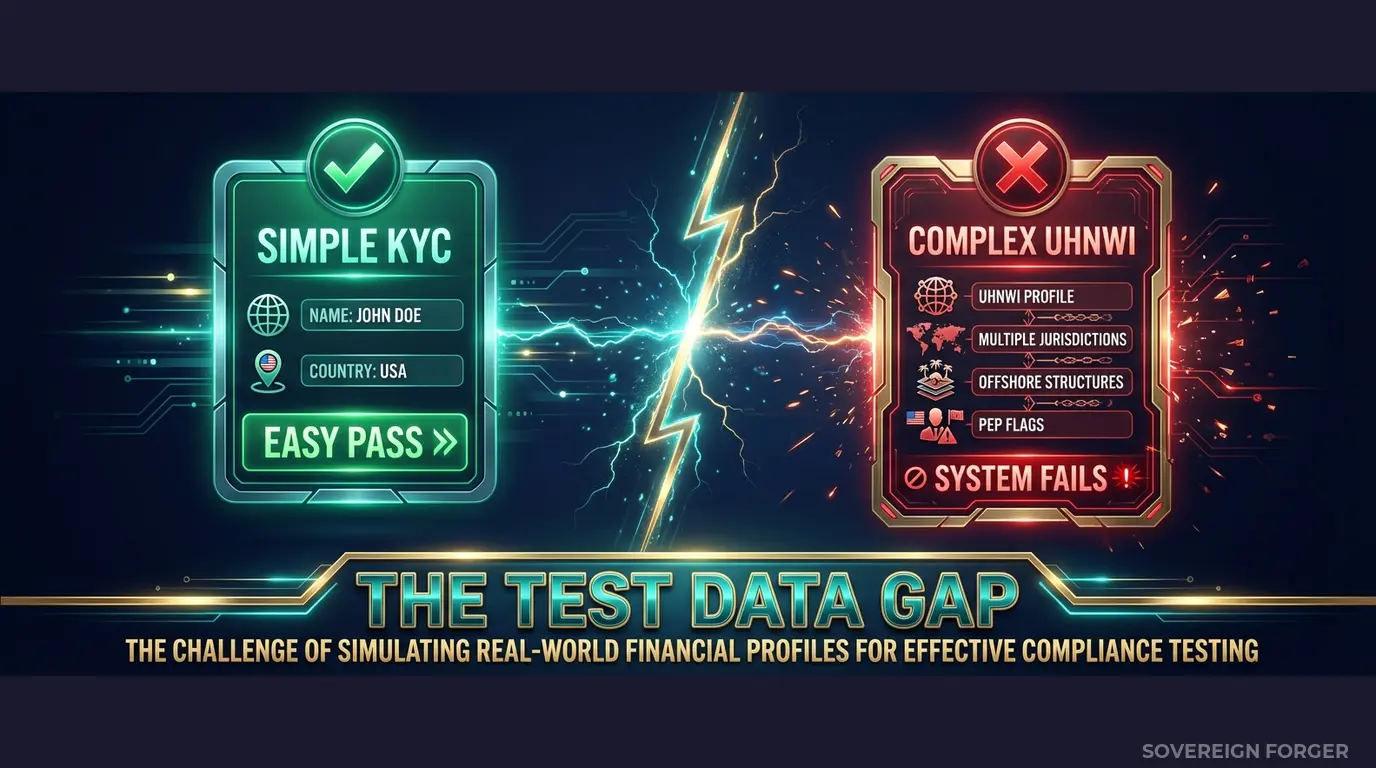
The WealthTech compliance stack has a unique vulnerability: the clients you serve are precisely the population that makes every traditional approach to test data generation fail. Here is why.
Using copies of production data. I have seen this more often in wealth management than in any other vertical. The reasoning sounds logical — “our clients are so complex, only real data captures the full picture.” But the moment you copy a real UHNWI’s profile into a test environment, you have created a GDPR Article 25 violation. Personal data in an environment with broader access, weaker logging, and often no retention policy. With only 265,000 UHNWIs globally, the re-identification surface is enormous — a net worth tier combined with a specific offshore jurisdiction and a profession can narrow the field to a handful of individuals. And under the EU AI Act, if your compliance AI trains on this data, Article 10 demands documented governance of training data provenance. “We copied production” is not a governance framework. It is an audit finding.
Using anonymized client data. Stripping names and tax IDs from UHNWI profiles does not make them anonymous. It makes them pseudonymous — and GDPR applies to pseudonymous data in full. In wealth management, the problem is worse than in retail banking. The combination of net worth range, offshore vehicle type, residence city, and philanthropic focus can uniquely identify a client even without a name attached. A regulator — or a determined journalist — can re-identify anonymized UHNWI profiles with publicly available wealth rankings and foundation registries. I have seen it demonstrated with fewer than five fields.
Using generic synthetic generators. Most synthetic data platforms were built for retail banking. They generate profiles with a single bank account, a single jurisdiction, and a salary. Scale the numbers up and you get a retail customer with a larger balance — not a UHNWI with a Cayman LP, a family trust, a multi-asset portfolio, and PEP exposure through a board appointment. These generators do not model wealth architecture. They model account balances. Your KYC system trains on structurally flat data and learns that wealth is simple. Then the first real client with a four-entity ownership chain walks in, and the system has no frame of reference.
Real Data vs. Anonymized vs. Born-Synthetic
| Dimension | Real Data | Anonymized | Born-Synthetic |
|---|---|---|---|
| PII present | Yes | Residual | None |
| Re-identification risk | Certain | Probable (UHNWI) | Impossible |
| GDPR Art. 25 compliant | No | Disputed | Yes |
| EU AI Act Art. 10 | Violation | Unclear | Compliant |
| Certifiable for auditors | No | No | Yes (Certificate of Origin) |
| Wealth structure depth | High | High (inherited) | High (by design) |
| Fine exposure | Up to 4% global revenue | Up to 4% global revenue | Zero |
Born-Synthetic KYC Data Built for WealthTech Compliance Testing
I built Sovereign Forger because I watched wealth management teams struggle with the same impossible choice: use real data and accept the compliance risk, or use synthetic data that was too simple to test anything meaningful. Neither option works. So I built a third path.
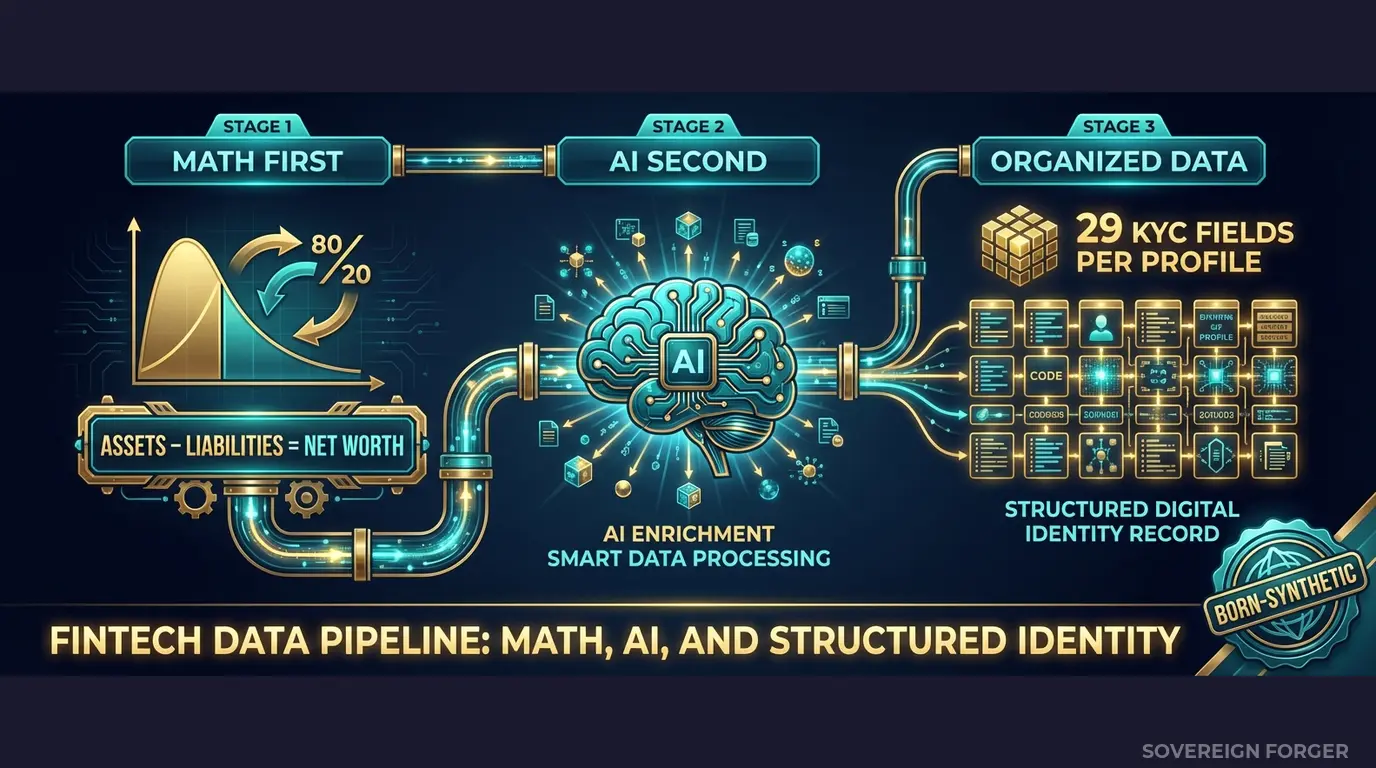
Every profile in the Sovereign Forger KYC dataset is generated from mathematical constraints — not derived from any real person, not anonymized from any client record, not scraped from any public source. The generation pipeline works in two stages:
Math First. Net worth follows a Pareto distribution — the actual shape of wealth distribution, not a bell curve. Asset allocations are computed within algebraic constraints: Assets – Liabilities = Net Worth, by construction. Property value, core equity, cash liquidity, offshore holdings — all computed to balance algebraically. Every single record passes this test. Zero exceptions. This is not a statistical approximation. It is a mathematical guarantee.
AI Second. After the financial figures are locked, a local AI model — running entirely offline, on hardware I control — adds narrative context. Biography, profession, education, philanthropic focus. The AI never touches the numbers. It enriches the profile with culturally coherent details that match the geographic niche, wealth tier, and archetype. A Swiss private banker does not get the same narrative as a Pacific Rim semiconductor dynasty heir, because the underlying wealth structures and cultural contexts are fundamentally different.
29 Fields Designed for Wealth Management KYC Pipelines
I designed the field schema by studying what WealthTech KYC systems actually need to process during onboarding — not what a generic data dictionary suggests. Every KYC-Enhanced profile includes:
Identity & Geography: full_name, residence_city, residence_zone, tax_domicile
Wealth Structure: net_worth_usd, total_assets, total_liabilities, property_value, core_equity, cash_liquidity, assets_composition, liabilities_composition
Professional Context: profession, education, narrative_bio, philanthropic_focus
Offshore Exposure: offshore_jurisdiction, offshore_vehicle
KYC Signals: kyc_risk_rating, pep_status, pep_position, pep_jurisdiction, sanctions_screening_result, sanctions_match_confidence, adverse_media_flag, source_of_wealth_verified, sow_verification_method, high_risk_jurisdiction_flag
Every KYC field is deterministically derived from the profile’s archetype, geographic niche, net worth, and jurisdiction structure. A family office manager domiciled in Switzerland with a BVI vehicle gets different risk signals than a tech founder in Silicon Valley with a Delaware LLC — because the underlying compliance logic is different. The risk ratings are not randomly assigned. They are computed from the same factors that drive real EDD decisions.
This matters for WealthTech specifically because your onboarding pipeline encounters the full spectrum of UHNWI complexity on a daily basis. Old Money Europe profiles with multi-generational trust structures. Middle East sovereign family members with PEP status through government appointments. Pacific Rim shipping dynasty heirs with holdings across five jurisdictions. Swiss-Singapore corridor clients with dual offshore exposure. Your KYC system needs to handle all of these — and your test data needs to contain all of these before you ship.
Built for WealthTech KYC Testing at Scale
6 Geographic Niches: Silicon Valley, Old Money Europe, Middle East, LatAm, Pacific Rim, Swiss-Singapore. Each niche reflects the actual wealth patterns, entity structures, and cultural contexts of that region — not a localized template with translated names. A LatAm agribusiness baron has a fundamentally different wealth architecture than a Swiss multi-family office manager. The data reflects that.
31 Wealth Archetypes: Tech founders, private bankers, commodity traders, family office managers, real estate developers, sovereign family members, shipping dynasty heirs, agribusiness barons — the actual client archetypes that WealthTech platforms encounter. Each archetype drives different offshore structures, risk profiles, and KYC signal distributions.
KYC Signal Distribution: Risk ratings, PEP statuses, sanctions screening results, and source-of-wealth verification methods are distributed with realistic frequencies by niche. Middle East profiles carry ~29% PEP exposure. LatAm profiles show ~84% high risk ratings. European and Swiss-Singapore profiles cluster around ~48% low risk. These distributions are not uniform — they reflect the actual compliance landscape of each region.
Culturally Coherent Identity: Names generated from 28 culture-specific naming databases. A Swiss-German wealth manager has a Swiss-German name. A Singaporean shipping executive has a Singaporean name. No “John Smith” placeholders. No culturally mismatched profiles. This matters because name-based screening systems — sanctions lists, PEP databases — behave differently across naming conventions. If your test data uses only Western names, you have never tested your screening system against the full range of naming patterns it will encounter.
Pricing
| Tier | Records | Price | Best For |
|---|---|---|---|
| Compliance Starter | 1,000 | $999 | QA cycle, proof of concept |
| Compliance Pro | 10,000 | $4,999 | Full regression suite |
| Compliance Enterprise | 100,000 | $24,999 | AI training + production testing |
No SDK. No API key. No sales call. Download a file, open it in Python or Excel, and feed it directly into your KYC pipeline. Every record arrives in JSONL and CSV format with a Certificate of Sovereign Origin documenting the born-synthetic methodology.
Why This Matters for WealthTech Right Now
Enforcement is accelerating across every relevant regulator. FINMA has intensified its focus on wealth management KYC after the Credit Suisse failures — with specific attention to whether compliance systems adequately handle complex client structures. The FCA’s Dear CEO letters to wealth managers explicitly call out the adequacy of risk assessment frameworks. The SEC’s enforcement actions against broker-dealers and registered investment advisors increasingly examine the testing and validation of AML systems. If you serve UHNWI clients, every regulator in your jurisdiction is asking the same question: does your system actually work on complex profiles, or only on simple ones?
The EU AI Act enforcement begins August 2026. Financial AI is classified as high-risk under Annex III. If your KYC scoring models, risk engines, or client classification systems use machine learning, Article 10 requires documented governance of training data — including provenance, bias assessment, and GDPR compliance. Born-synthetic data with a Certificate of Sovereign Origin gives your compliance team a documented answer to every question an auditor will ask about training data provenance.
The fines in wealth management are not hypothetical. Credit Suisse accumulated billions in fines and penalties across multiple jurisdictions before its collapse — with KYC and due diligence failures at the center of every enforcement action. UBS paid $5.1 billion in France for helping clients evade taxes — a failure that started with inadequate client identification and risk assessment. Julius Baer paid $79.7 million to the DoJ for facilitating money laundering through insufficient KYC controls. These are not edge cases. They are the direct, documented consequences of compliance systems that could not handle the complexity of the clients they were supposed to evaluate.
The balance sheet test is open source. Every Sovereign Forger record passes algebraic validation: Assets – Liabilities = Net Worth. Run the Balance Sheet Test on our data, then run it on your current test data. If your test data does not pass this basic mathematical check, every downstream test that depends on financial consistency is already compromised.
Every dataset ships with a Certificate of Sovereign Origin — documenting the born-synthetic methodology, zero PII lineage, and regulatory alignment with GDPR Art.25, EU AI Act Art.10, and CCPA. When your auditor asks “where did this test data come from?”, you hand them the certificate. When a regulator asks whether your training data contains personal information, you show them the declaration: Born-Synthetic Data. Zero Real PII. Compliant by construction — not by anonymization.
Test Your KYC Pipeline Today
Download 100 free KYC-Enhanced UHNWI profiles. Run them through your onboarding flow. Count how many trigger alerts, edge cases, or failures that your current test data never generated.
That number is the size of your compliance blind spot — and in wealth management, that blind spot is where the eight-figure fines come from.
No credit card. No sales call. Just your work email.
Frequently Asked Questions
How does synthetic KYC data help WealthTech platforms test MiFID II client categorization workflows without using real investor data?
Synthetic KYC profiles allow WealthTech platforms to stress-test MiFID II client categorization and suitability assessment workflows across all three client tiers — retail, professional, and eligible counterparty — without exposing real investor identities. Each profile includes interlocked fields such as net worth, investment experience, and risk tolerance, enabling QA teams to validate categorization logic against thousands of edge cases before go-live. This eliminates the legal risk of processing live client data during testing cycles.
Why are UHNWI profiles the hardest KYC test cases to generate, and how does realistic synthetic data solve this for wealth managers?
Ultra-high-net-worth individual profiles require coherent combinations of offshore trust structures, multi-jurisdictional asset holdings, beneficial ownership chains, and Enhanced Due Diligence triggers — all of which must align across 29 interdependent KYC fields to be testable. Generic dummy data fails because inconsistencies between source-of-wealth narratives and declared asset values cause false EDD rejections in production systems. Sovereign Forger generates UHNWI profiles from calibrated statistical distributions that preserve realistic field correlations, giving compliance engineers test cases that mirror the complexity of actual onboarding pipelines.
How can WealthTech QA teams use synthetic KYC data to validate PEP screening and sanctions list matching without triggering false positives on real watchlists?
Testing PEP detection and sanctions screening with real names risks inadvertently matching live watchlist entries, creating regulatory reporting obligations and audit trail complications. Synthetic profiles contain PEP status flags, risk ratings, and sanctions screening result fields that are structurally valid but mathematically generated, meaning they carry zero lineage to real individuals. QA teams can configure pass, fail, and edge-case screening outcomes across hundreds of profiles, enabling thorough regression testing of AML logic without any intersection with operational compliance workflows.
What does born-synthetic mean for KYC testing data, and why does it matter specifically for WealthTech compliance teams?
Born-synthetic means the data was generated entirely from mathematical distributions, such as Pareto curves for wealth allocation, and never derived from, anonymized from, or linked to any real person’s records. For WealthTech compliance teams this distinction is critical: anonymized or masked data retains statistical lineage to source individuals, creating residual GDPR exposure under Art.25 privacy-by-design obligations and potential conflicts with EU AI Act Art.10 training data requirements. Born-synthetic KYC profiles satisfy Art.25 by construction, removing the need for data protection impact assessments before use in testing or model validation environments.
How quickly can a WealthTech team get started with synthetic KYC testing data, and what is included in the free tier?
Teams can download 100 free synthetic KYC profiles instantly using a work email address, with no credit card required. Each profile contains 29 interlocked fields covering risk ratings, PEP status, sanctions screening results, source of wealth verification, and supporting identity attributes, all structurally consistent and ready to load into existing test environments. The free tier is sized to support initial integration testing and proof-of-concept validation before scaling to larger datasets for full regression coverage.
Learn more about WealthTech KYC test data and how Born Synthetic data addresses this in our glossary and comparison guides.