
Credit Suisse: billions in cumulative fines before its collapse. UBS: €5.1B (France, tax fraud facilitation). Julius Baer: $79.7M (DoJ, money laundering conspiracy). Every one of these failures started in the same place — AML models that could not tell the difference between a legitimate multi-jurisdictional wealth structure and a genuine risk signal, because they had never seen either one in training.
Your AML Model Has Never Seen Real Wealth
I have spent years watching WealthTech platforms build AML models on training data that bears no resemblance to the client portfolios those models will encounter in production. The training set contains simple profiles — single jurisdiction, single asset class, linear ownership, no offshore exposure. The model learns that this is what wealth looks like. Then the platform onboards its first family office client, and everything breaks.
Here is what that break looks like in practice. A WealthTech platform serving private banks and multi-family offices deploys an AML transaction monitoring model. The model was trained on profiles with net worth distributed along a bell curve, single-country tax residency, and no entity layering. In production, a third-generation European family arrives with a Liechtenstein trust holding a Luxembourg SOPARFI, which in turn holds equity in a Singapore-based operating company. The beneficial owner has PEP connections through a cousin who served as a government minister. Source of wealth traces back forty years through real estate, commodities, and private equity across seven countries.
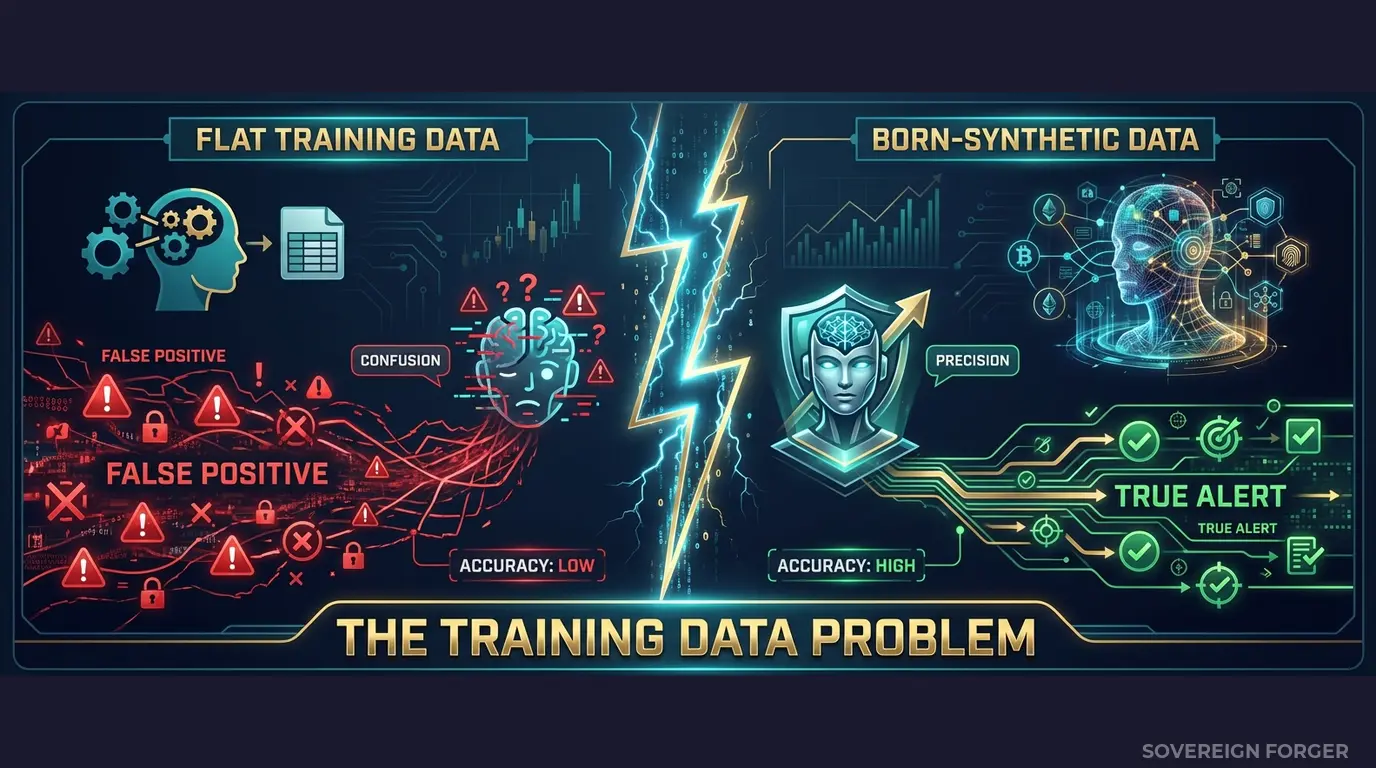
The AML model has two choices, and both are wrong. It can flag the entire structure as suspicious — because nothing in its training data contained this level of complexity — producing a false positive that clogs the compliance team’s queue and delays onboarding for weeks. Or it can fail to flag it at all, because the model learned that complex structures are normal (they are not represented in the training data, so the model has no basis for scoring them).
This is not a hypothetical scenario. It is the structural reason why WealthTech platforms serving UHNWI clients generate either catastrophic false positive rates — I have seen teams where 85% of AML alerts were false positives, consuming the entire compliance headcount — or they miss genuine risk signals entirely, which is how you end up explaining to FINMA why a sanctioned individual’s transactions passed through your platform undetected for fourteen months.
The problem is upstream of the model. No amount of architecture tuning, threshold adjustment, or ensemble stacking will fix an AML model that was trained on data structurally incapable of representing the wealth patterns it needs to score. You cannot teach a model to distinguish legitimate complexity from genuine risk if the training data contains neither.
The core failure: WealthTech platforms serve the most structurally complex client segment in financial services — UHNWIs with multi-generational wealth, cross-border holdings, trust layers, PEP adjacency, and multiple offshore vehicles. AML models trained on flat profiles have never encountered this architecture. They are not undertrained — they are trained on the wrong distribution entirely.
Three Approaches That Produce Broken AML Models
I have evaluated AML training data from platforms serving private banks, family offices, and wealth management firms. The same three failed approaches repeat everywhere.
Training on production client data. Some WealthTech platforms extract real client profiles into their data science environment for model training. For wealth management, this is uniquely dangerous. UHNWI clients are identifiable even without names — the global population is approximately 265,000. A profile with $340M net worth, Zurich residence, offshore vehicles in BVI and Cayman, and a profession in commodity trading narrows the identity to a handful of individuals. Your data science team now has effective access to client identities in an environment with broader access controls, weaker audit trails, and often third-party contractor involvement. This is a GDPR Article 25 violation by design — and under the EU AI Act Article 10, the provenance of AI training data must be documented and auditable. “We used copies of real client files” is not a compliance position. It is an enforcement action waiting to happen.
Training on anonymized client data. Stripping names and account numbers from UHNWI profiles does not prevent re-identification — it merely makes it require one additional step. Research consistently demonstrates that high-net-worth individuals can be re-identified from combinations of wealth tier, jurisdiction, profession, and asset composition. For a WealthTech platform handling 2,000 UHNWI clients across three geographic markets, the anonymization provides statistical cover for approximately none of them. A regulator — or a litigant — can argue that your “anonymized” training data is pseudonymized at best, and GDPR obligations apply in full. Your AML model is now a regulatory liability on two fronts simultaneously.
Training on generic synthetic profiles. Platform-based synthetic data generators produce profiles that look like retail banking customers with inflated numbers. Net worth follows a Gaussian distribution (real wealth follows a Pareto distribution — a fundamentally different shape). Every profile has one jurisdiction, one asset class, no offshore exposure, and no entity layering. The AML model trains on this data and learns that wealth is structurally simple. When a real UHNWI arrives with three jurisdictions, a family trust, and source of wealth spanning four decades, the model has no training basis for scoring the profile. It either flags everything complex as suspicious (false positive flood) or assigns low risk to everything it has not seen before (missed true positives).
Real Data vs. Anonymized vs. Born-Synthetic
| Dimension | Real Client Data | Anonymized | Born-Synthetic |
|---|---|---|---|
| PII present | Yes | Residual (re-identifiable) | None |
| Re-identification risk | Certain | Probable (UHNWI) | Impossible |
| GDPR Art. 25 compliant | No | Disputed | Yes |
| EU AI Act Art. 10 | Violation | Unclear | Compliant |
| Wealth distribution | Correct (Pareto) | Correct (Pareto) | Correct (Pareto) |
| Structural complexity | Present | Present (but legally toxic) | Present (and legally clean) |
| Certifiable for auditors | No | No | Yes (Certificate of Origin) |
| Fine exposure | Up to 4% global revenue | Up to 4% global revenue | Zero |
The fundamental problem is this: the only training data that contains realistic wealth structure is real client data, which you cannot legally use. Generic synthetic data is legally clean but structurally worthless. WealthTech platforms have been stuck between these two options — until now.
Born-Synthetic AML Training Data Built for Wealth Management Complexity

I built the Sovereign Forger pipeline specifically because I watched this problem destroy AML programs from the inside. The solution is not better anonymization, and it is not a more sophisticated synthetic data platform. The solution is data that is generated from mathematical first principles — data that reproduces the structural complexity of UHNWI wealth without any lineage to real individuals.
Every profile in the Sovereign Forger KYC dataset is born-synthetic. No real person was sampled, anonymized, perturbed, or referenced at any point in the generation process. The pipeline works in two stages:
Math First. Net worth follows a Pareto distribution — the actual shape of real wealth concentration. This is not a cosmetic choice. It means the training data contains the same extreme skew, the same long tail, and the same concentration patterns that your AML model will encounter in production. Asset allocations are computed within algebraic constraints: Assets – Liabilities = Net Worth, by construction. Property values, core equity, cash liquidity, and liability composition are all derived from the net worth tier and wealth archetype — not randomly assigned. Every balance sheet balances on every record. Zero exceptions. Your AML model trains on data where the financial mathematics are internally consistent, which means it learns to score genuine structural anomalies rather than data quality artifacts.
AI Second. After the financial figures are locked, a local AI model — running entirely offline, no data ever touches the network — adds narrative context: biography, profession, education, philanthropic focus. The AI enriches the profile with culturally coherent details that match the geographic niche and wealth archetype. A third-generation Zurich private banker gets a different biography than a first-generation Singapore semiconductor founder, because the wealth origin stories are structurally different.
Why This Matters for AML Model Training
AML models learn from patterns. If your training data contains only simple patterns, your model will classify all complexity as anomalous — producing false positives on every legitimate UHNWI client. If your training data never contains genuine risk signals (PEP connections, sanctions exposure, high-risk jurisdictions), your model will never learn to recognize them — producing missed true positives.
Sovereign Forger profiles solve both sides of this problem:
Legitimate complexity is represented. Multi-jurisdictional tax domiciles, offshore vehicles (BVI LPs, Cayman trusts, Luxembourg SOPARFIs), diversified asset compositions across property, equity, and cash. Your AML model trains on profiles where this complexity is normal — so it stops flagging every multi-jurisdictional structure as suspicious.
Genuine risk signals are present and labeled. KYC risk ratings (low/medium/high), PEP statuses (none/domestic/foreign/international_org), sanctions screening results (clear/potential_match/confirmed_match), adverse media flags, and source of wealth verification status. These signals are deterministically derived from each profile’s archetype, niche, net worth, and jurisdiction — they are not randomly distributed. A Middle East sovereign family profile has a different PEP probability than a Silicon Valley tech founder, because the underlying population characteristics are different.
The distributions are niche-accurate. LatAm profiles carry higher risk ratings (~84% high) because the underlying wealth archetypes involve jurisdictions and structures that genuinely correlate with higher AML risk. European and Swiss-Singapore profiles show ~48% low risk. Middle East profiles have ~29% PEP status. These are not arbitrary percentages — they reflect the structural characteristics of each wealth niche. Your AML model trains on distributions that match production reality, not uniform randomness.
29 Fields Designed for AML Pipeline Ingestion
Every KYC-Enhanced profile includes the fields your AML model needs for feature engineering:
Identity & Geography: full_name, residence_city, residence_zone, tax_domicile
Wealth Structure: net_worth_usd, total_assets, total_liabilities, property_value, core_equity, cash_liquidity, assets_composition, liabilities_composition
Professional Context: profession, education, narrative_bio, philanthropic_focus
Offshore Exposure: offshore_jurisdiction, offshore_vehicle
KYC Signals: kyc_risk_rating, pep_status, pep_position, pep_jurisdiction, sanctions_screening_result, sanctions_match_confidence, adverse_media_flag, source_of_wealth_verified, sow_verification_method, high_risk_jurisdiction_flag
Every field is deterministically derived. Same UUID always produces the same KYC signals across any generation run. Your model training is reproducible — a requirement under EU AI Act Article 10 that most training data sources cannot satisfy.
Built for WealthTech AML Model Training at Scale
6 Geographic Niches: Silicon Valley, Old Money Europe, Middle East, LatAm, Pacific Rim, Swiss-Singapore — each with wealth patterns calibrated to the actual client base your platform serves. A WealthTech firm handling European family offices gets training data with European wealth structures. A platform expanding into Middle East sovereign wealth gets profiles with the jurisdiction and PEP characteristics of that market.
31 Wealth Archetypes: Tech founders, dynasty heirs, commodity traders, private bankers, family office principals, real estate developers, sovereign family members — the actual client profiles that flow through WealthTech platforms. Not retail banking customers with extra zeros.
KYC Signal Distribution: Risk ratings, PEP statuses, sanctions screening results, and source-of-wealth verification methods distributed with realistic frequencies by niche. Your AML model trains on the same signal distribution it will encounter in production — not uniform randomness that teaches the model nothing about base rates.
Reproducible Training Runs: Every KYC field is derived from a SHA-256 hash of the profile UUID. Same input, same output, every time. When your regulator asks how your AML model was trained and whether the training data is auditable, you can demonstrate exact reproducibility — a compliance requirement that real or anonymized data cannot satisfy.
Pricing
| Tier | Records | Price | Best For |
|---|---|---|---|
| Compliance Starter | 1,000 | $999 | Model prototyping, proof of concept |
| Compliance Pro | 10,000 | $4,999 | Full model training cycle |
| Compliance Enterprise | 100,000 | $24,999 | Production AML model training + validation |
No SDK. No API key. No sales call. Download a file, load it into your training pipeline, and start building an AML model that actually knows what wealth looks like.
Why This Matters Now
WealthTech is under the regulatory spotlight. FINMA, the FCA, and the SEC are all actively enforcing AML compliance in wealth management. Credit Suisse collapsed under the weight of cumulative compliance failures — billions in fines across multiple jurisdictions. UBS paid €5.1B in France for facilitating tax fraud. Julius Baer paid $79.7M to the DoJ for conspiracy to launder money. These enforcement actions target the exact intersection where WealthTech operates: technology platforms handling complex wealth for high-risk clients.
The EU AI Act is not optional. Fully applicable from August 2026. Financial AI — including AML transaction monitoring and risk scoring — is classified as high-risk under Annex III. Article 10 requires documented governance of training data: provenance, bias assessment, quality metrics, and GDPR compliance. If your AML model trains on real client data or poorly anonymized profiles, you face enforcement on both the AI Act and GDPR simultaneously. Born-synthetic data with a Certificate of Origin satisfies both requirements with a single data source.
False positive rates are a business problem, not just a compliance problem. I have seen WealthTech platforms where AML false positives consumed 70-85% of the compliance team’s capacity. Every false positive is a real cost — analyst time, delayed onboarding, client frustration, and the compounding risk that genuine alerts get buried in noise. An AML model trained on structurally accurate data produces fewer false positives because it has learned to distinguish legitimate UHNWI complexity from actual risk indicators.
The balance sheet test is open source. Every Sovereign Forger record passes algebraic validation: Assets – Liabilities = Net Worth. Run the Balance Sheet Test on our data, then run it on whatever you are currently using for AML model training. If the current data fails basic arithmetic consistency, consider what else your model is learning from it.
Every dataset ships with a Certificate of Sovereign Origin — documenting the born-synthetic methodology, zero PII lineage, and regulatory alignment. When your auditor or regulator asks “what data did you train the AML model on?”, you hand them the certificate. It documents provenance, methodology, and compliance position in a single artifact. No real person was referenced. No re-identification is possible. The data is compliant by construction — not by anonymization.
Train Your AML Model on Data That Reflects Reality
Download 100 free KYC-Enhanced UHNWI profiles. Feed them into your AML pipeline. Check whether your model can distinguish structural complexity from genuine risk signals.
If it cannot — if every multi-jurisdictional profile triggers an alert, or if none of the PEP-adjacent profiles get flagged — then your model has never been trained on data that looks like your actual client base. That gap is measurable, and it is the gap that regulators are now actively examining.
No credit card. No sales call. Just your work email.
Frequently Asked Questions
How does synthetic UHNWI profile data improve AML model performance for wealth managers operating under MiFID II?
Ultra-high-net-worth individual profiles are the hardest segment to synthesize realistically because legitimate wealth patterns — layered offshore structures, multi-jurisdictional holdings, complex beneficial ownership chains — closely resemble money laundering typologies. Sovereign Forger generates statistically coherent UHNWI profiles that include cross-border transaction flows, PEP adjacency flags, and EDD indicators, giving AML models sufficient exposure to this rare but high-risk segment. Teams training on these profiles report measurable reductions in false positives against MiFID II client categorization thresholds without compromising detection sensitivity.
What specific AML typologies relevant to private banking and wealth management can be represented in synthetic training data?
Sovereign Forger synthetic profiles cover typologies including structuring across multiple private banking accounts, trade-based layering through affiliated entities, real estate acquisition patterns correlated with source-of-wealth gaps, and trust or foundation structures used to obscure beneficial ownership. Each profile interlocks risk ratings, sanctions screening results, and transaction velocity indicators across 29 fields, allowing models to learn co-occurrence patterns rather than isolated signals — the approach required to detect sophisticated wealth-channel laundering that simpler rule-based systems miss entirely.
How can WealthTech compliance teams use synthetic AML training data to satisfy EU AI Act Article 10 requirements for high-quality training datasets?
EU AI Act Article 10 requires that training data for high-risk AI systems — which includes AML detection models — be relevant, representative, and free from errors that could introduce bias. Synthetic profiles generated from calibrated financial distributions satisfy representativeness requirements across risk tiers, including rare EDD cases involving offshore structures that are statistically underrepresented in proprietary transaction archives. Because no real client records are involved, teams can document lineage and composition without triggering data-sharing restrictions, simplifying the technical documentation obligations under Article 10 paragraphs 2 through 5.
What does born-synthetic mean and why does it matter specifically for AML training data used in wealth management?
Born-synthetic means the data was generated entirely from mathematical distributions — including Pareto distributions that model realistic wealth concentration — with zero lineage to real persons or actual financial records. No anonymization, tokenization, or masking of real data was performed at any stage. For wealth management AML use cases, this distinction is material: derived synthetic data can re-identify UHNWI individuals from structural patterns even after transformation, creating GDPR exposure. Born-synthetic data is GDPR Article 25 compliant by construction because there is no personal data origin to protect, eliminating re-identification risk entirely.
How can a WealthTech compliance or data science team get started with synthetic AML training data from Sovereign Forger?
Sovereign Forger provides 100 free synthetic KYC profiles available for instant download via work email registration, with no credit card required. Each profile contains 29 interlocked fields covering risk ratings, PEP status, sanctions screening results, source of wealth declarations, and offshore structure indicators — sufficient to begin evaluating model fit against existing AML detection pipelines. The free tier is designed for technical evaluation, allowing teams to assess statistical coherence and field coverage before committing to production-scale dataset generation for model training or regulatory validation purposes.