
Danske Bank: ~$2B. Standard Chartered: $1.1B. ING: €775M. ABN AMRO: €480M. HSBC: £63.9M. These are not outliers — they are the cost of KYC systems that were tested against simple profiles and deployed against the most complex clients on Earth.
Your KYC System Was Built for a Simpler World
I spent years inside financial institutions where the compliance stack had been assembled over decades. Layer upon layer — a domestic onboarding system from 2008, a sanctions filter bolted on in 2014, a PEP screening module acquired through a vendor merger in 2017, a risk scoring engine rewritten during the pandemic. Each layer was tested independently. Each layer passed its own QA cycle.
None of them had ever been tested together against a client who held citizenship in two countries, maintained a tax domicile in a third, operated a Cayman Islands trust layered under a BVI holding company, and whose brother-in-law held a ministerial position in a fourth jurisdiction.
That is the client profile that triggers simultaneous failures across three separate compliance subsystems. And that is the profile that never existed in any test environment I ever reviewed at a traditional bank.
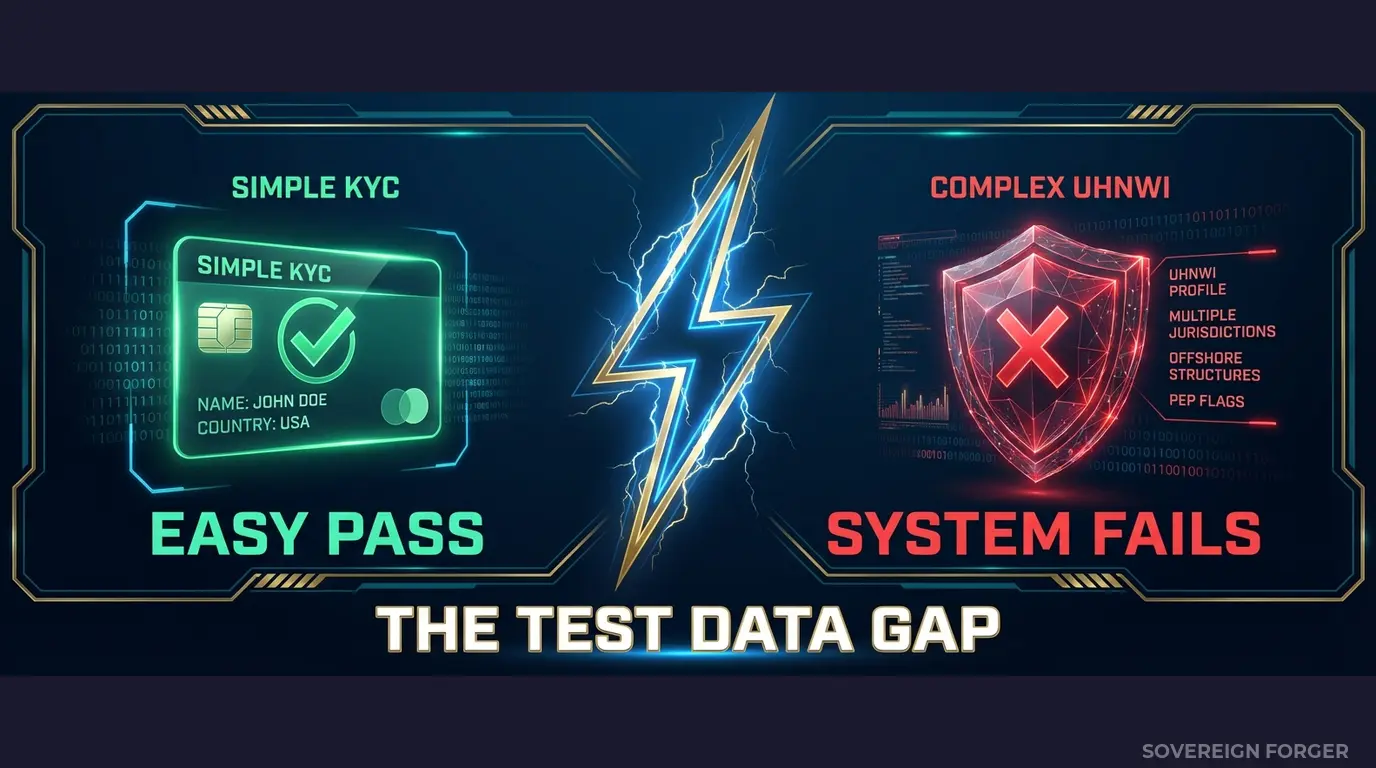
The reason is structural. Traditional banks built their KYC infrastructure for domestic retail banking — millions of single-jurisdiction clients with straightforward income sources and transparent asset structures. The test data reflected this architecture: simple names, single nationalities, employment income, no offshore vehicles, no PEP connections. When the bank expanded into private banking and wealth management, the compliance infrastructure stayed the same. The test data stayed the same. But the client base changed completely.
The result is a compliance system optimized for the wrong population. Your onboarding pipeline processes 50,000 retail accounts per month flawlessly. Then a UHNWI with a $400M family office walks in, and the system has never encountered a profile with that level of jurisdictional layering, entity complexity, or PEP adjacency. Three rules fire simultaneously. The caseworker has no precedent. The case sits in a queue for weeks. The regulator notices.
This is not theoretical. It is the exact pattern the FCA documented in HSBC’s £63.9M penalty — systemic failures in transaction monitoring and KYC remediation for high-risk clients. It is the pattern behind Danske Bank’s ~$2 billion in combined penalties across multiple jurisdictions — a non-resident portfolio that processed €200 billion through an Estonian branch with KYC controls designed for Danish retail customers. It is what ING’s €775M fine exposed: a bank that had the systems in place, but never stress-tested them against the clients who actually posed the highest risk.
The regulatory math for traditional banks is brutal. You operate across multiple jurisdictions simultaneously — FCA, ECB, FinCEN, MAS, BaFin, FINMA. Each regulator has slightly different expectations for KYC depth, EDD triggers, and PEP screening. A test suite that satisfies one regulator’s expectations may leave you exposed to another’s enforcement priorities. And unlike neobanks, traditional banks cannot claim they are still building their compliance infrastructure. Regulators expect mature systems with mature testing — and they fine accordingly, in the billions.
Three Approaches That Don’t Work for Traditional Banks
I have consulted with compliance teams at banks with a hundred years of client history. Every one of them falls into one of three traps when sourcing KYC test data.
Using copies of production data. This is the most common approach — and the most dangerous. A compliance team extracts a sample of real client records into a test environment. They strip obvious identifiers, load the profiles into a staging instance, and run their QA cycle. The problem is twofold. First, GDPR Article 25 requires data protection by design — placing personal data in test environments with broader access and weaker controls is a textbook violation. Second, traditional banks hold client relationships spanning decades. A “sanitized” profile of a 30-year private banking client contains enough structural information — net worth tier, city, offshore jurisdictions, profession — to re-identify the individual without ever seeing their name. With only 265,000 UHNWIs globally, the combination is often unique.
Using anonymized client data. Anonymization sounds safer. Replace names with random strings, hash tax IDs, generalize locations. But UHNWI profiles are inherently sparse populations. A person with $200M net worth, a primary residence in Geneva, offshore vehicles in Guernsey and Singapore, and a profession in commodity trading is not anonymous — they are one of perhaps thirty people in the world matching that description. The Article 29 Working Party (now EDPB) has repeatedly stated that anonymization must be measured against re-identification risk, not against whether direct identifiers are present. For UHNWI profiles, the structural data alone constitutes pseudonymization at best. GDPR applies in full.
Using generic synthetic generators. Platform-based tools like Mostly AI, Tonic, or Gretel generate synthetic data by learning patterns from real datasets. This solves the PII problem in theory — but introduces two new ones. First, if the input dataset is biased toward retail banking profiles, the synthetic output inherits that bias. You get millions of synthetic profiles that look like retail customers, not the thousand complex ones that actually trigger EDD. Second, these platforms produce structurally flat profiles — single jurisdiction, no layered entities, no offshore vehicles, no PEP connections — because they replicate the distribution of inputs, and the inputs are overwhelmingly simple. Your KYC system learns that wealth is straightforward. Then reality arrives.
Real Data vs. Anonymized vs. Born-Synthetic
| Dimension | Real Data | Anonymized | Born-Synthetic |
|---|---|---|---|
| PII present | Yes | Residual | None |
| Re-identification risk | Certain | Probable (UHNWI) | Impossible |
| GDPR Art. 25 compliant | No | Disputed | Yes |
| EU AI Act Art. 10 | Violation | Unclear | Compliant |
| Certifiable for auditors | No | No | Yes (Certificate of Origin) |
| Multi-regulator defensible | No | No | Yes |
| Fine exposure | Up to 4% global revenue | Up to 4% global revenue | Zero |
Born-Synthetic KYC Data Built for Traditional Bank Compliance Testing
I built Sovereign Forger specifically because I watched compliance teams at major banks operate in the dark — testing sophisticated systems against simplistic data, passing every QA cycle, and then watching those same systems fail against the first complex client they encountered in production.
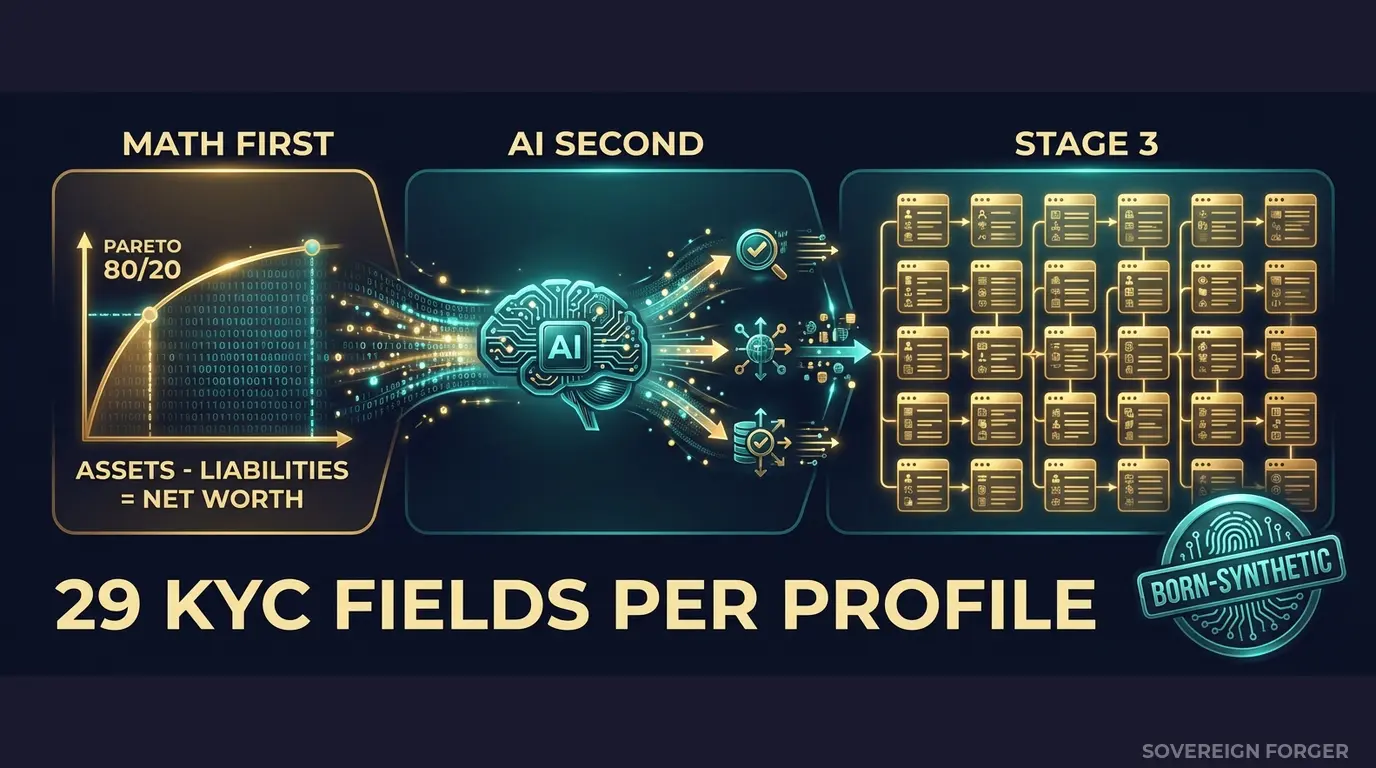
Every profile in the Sovereign Forger KYC dataset is generated from mathematical constraints — not derived from any real person. No production data was accessed, no client records were anonymized, no real-world dataset was used as input. The generation pipeline works in two stages:
Math First. Net worth follows a Pareto distribution — because that is how real wealth is actually distributed. Not a bell curve. Not a uniform spread. A long-tail power law where the top 1% holds more than the bottom 50% combined. Asset allocations are computed within algebraic constraints: Assets – Liabilities = Net Worth, by construction. Every balance sheet balances on every record. Zero exceptions. Property values, equity holdings, cash liquidity, and liability structures are derived from archetype-specific allocation models — a tech founder’s balance sheet looks structurally different from a private banker’s, because their wealth composition is fundamentally different.
AI Second. A local AI model running entirely offline adds narrative context — biography, profession, philanthropic focus — after the financial figures are locked. The AI never touches the numbers. It enriches the profile with culturally coherent details that match the geographic niche and wealth tier. A Middle Eastern sovereign family profile reads differently from a Swiss private banking dynasty, because the cultural context, naming conventions, and wealth patterns are different.
The critical point for traditional banks: no data leaves the pipeline. The entire process runs offline on local hardware. There is no cloud processing, no third-party data handling, no vendor with access to your test profiles. When your DPO asks where the test data came from, the answer is: “Generated from zero, entirely offline, with a Certificate of Sovereign Origin documenting the process.”
29 Fields Designed for Multi-Regulator KYC Systems
Every KYC-Enhanced profile includes the fields that traditional bank onboarding pipelines actually need to process — not a generic set of attributes, but the specific fields that trigger routing decisions, EDD escalation, and risk scoring across multiple regulatory frameworks:
Identity & Geography: full_name, residence_city, residence_zone, tax_domicile
Wealth Structure: net_worth_usd, total_assets, total_liabilities, property_value, core_equity, cash_liquidity, assets_composition, liabilities_composition
Professional Context: profession, education, narrative_bio, philanthropic_focus
Offshore Exposure: offshore_jurisdiction, offshore_vehicle
KYC Signals: kyc_risk_rating, pep_status, pep_position, pep_jurisdiction, sanctions_screening_result, sanctions_match_confidence, adverse_media_flag, source_of_wealth_verified, sow_verification_method, high_risk_jurisdiction_flag
Every KYC field is deterministically derived from the profile’s archetype, niche, net worth, and jurisdiction. This matters for traditional banks because it means the data is internally consistent — a profile flagged as high-risk actually has the structural characteristics that would trigger a high-risk rating in a real system. A PEP-adjacent profile has a plausible position, jurisdiction, and wealth tier. A sanctions potential match has a confidence score that reflects the ambiguity, not a random number.
This is what separates born-synthetic data from randomly generated attributes. When your KYC system processes a Sovereign Forger profile, it encounters the same structural complexity it would face with a real UHNWI client — multi-jurisdictional tax structures, offshore vehicles in high-risk jurisdictions, PEP connections through family or political networks, and source-of-wealth verification requirements. The difference is that no real person exists behind the profile. There is no PII to protect because there was never any PII to begin with.
Built for Traditional Bank KYC Testing Across Jurisdictions
Traditional banks operate globally. Your KYC system must handle clients from every major wealth center — and the compliance requirements differ by jurisdiction. Sovereign Forger generates profiles across six geographic niches, each with its own wealth architecture, naming conventions, and regulatory context:
6 Geographic Niches: Silicon Valley (tech founders, VC), Old Money Europe (dynasties, private banking), Middle East (sovereign families, merchant houses), LatAm (agribusiness, infrastructure), Pacific Rim (semiconductor, shipping), Swiss-Singapore (offshore wealth, multi-family offices).
31 Wealth Archetypes: Each niche contains specific wealth archetypes — not generic “high net worth individual” labels, but structurally distinct profiles. A family office manager in Zurich holds wealth differently from a commodity trader in Singapore or a real estate developer in São Paulo. Your EDD system must handle all of them. Your test data should contain all of them.
KYC Signal Distributions by Niche: Risk ratings, PEP statuses, sanctions screening results, and source-of-wealth verification methods are distributed with realistic frequencies by geographic niche. Latin American profiles show higher risk ratings (~84%) reflecting jurisdictional complexity. Middle Eastern profiles show higher PEP rates (~29%) reflecting the structure of sovereign wealth. European and Swiss-Singapore profiles show moderate risk distributions (~48% low risk). These are not uniform random assignments — they are calibrated distributions that mirror the regulatory patterns your system will encounter in production.
Cross-Jurisdictional Complexity: Every profile includes both a residence jurisdiction and a tax domicile — and they are not always the same country. Offshore jurisdictions span BVI, Cayman Islands, Jersey, Guernsey, Luxembourg, Singapore, Hong Kong, and Panama. When your system processes these profiles, it encounters the multi-jurisdictional combinations that actually trigger EDD escalation and multi-regulator reporting requirements.
Pricing
| Tier | Records | Price | Best For |
|---|---|---|---|
| Compliance Starter | 1,000 | $999 | QA cycle, proof of concept |
| Compliance Pro | 10,000 | $4,999 | Full regression suite, multi-niche testing |
| Compliance Enterprise | 100,000 | $24,999 | AI model training + production testing |
No SDK. No API key. No sales call. No vendor integration. Download JSONL and CSV files, load them into your existing test infrastructure, and feed them into your KYC pipeline. The format is the same one your data engineers already work with.
Every dataset ships with a Certificate of Sovereign Origin — the document your compliance team hands to auditors when they ask where the test data came from.
Why This Matters Now for Traditional Banks
Multi-regulator enforcement is intensifying. Traditional banks face simultaneous scrutiny from multiple regulators — FCA, ECB, FinCEN, BaFin, MAS, FINMA. Each has escalated KYC enforcement independently. The FCA’s 2024 enforcement actions specifically targeted inadequate testing of financial crime controls. The ECB’s supervisory priorities for 2025-2026 list AML/CFT as a top risk area. FinCEN’s recent enforcement actions against major banks have focused on the gap between written compliance policies and actual testing rigor. You need test data that satisfies all of them simultaneously.
The fines are measured in billions, not millions. Danske Bank: ~$2B in combined penalties for processing €200B through inadequate KYC controls. Standard Chartered: $1.1B for sanctions and AML failures. ING: €775M. ABN AMRO: €480M. HSBC: £63.9M from the FCA alone, with additional penalties across jurisdictions. These are the consequences of compliance infrastructure that was tested against domestic retail profiles and deployed against global UHNWI clients. The cost of proper test data — even at the Enterprise tier — is a rounding error compared to a single enforcement action.
The EU AI Act becomes fully applicable in August 2026. Financial AI is classified as high-risk under Annex III. Article 10 requires documented governance of training data — including provenance, bias assessment, and GDPR compliance. If your KYC risk scoring models, PEP screening algorithms, or sanctions matching engines are trained on real or anonymized client data, you need to prove compliance with both GDPR and the AI Act simultaneously. Born-Synthetic data eliminates this requirement entirely: there is no PII lineage to govern, no anonymization methodology to defend, no re-identification risk to assess.
The balance sheet test is open source. Every Sovereign Forger record passes algebraic validation: Assets – Liabilities = Net Worth. Run the Balance Sheet Test on our data, then run it on your current test data. If your current test profiles fail basic mathematical consistency, every downstream test that relies on those profiles is compromised. The difference is measurable and auditable.
Every dataset ships with a Certificate of Sovereign Origin — documenting the born-synthetic methodology, zero PII lineage, and regulatory alignment with GDPR Article 25, EU AI Act Article 10, and CCPA. When the FCA, ECB, or FinCEN asks how you sourced your test data, you hand them the certificate. That conversation ends in minutes instead of months.
Test Your KYC Pipeline Today
Download 100 free KYC-Enhanced UHNWI profiles. Run them through your onboarding flow. Count how many trigger alerts, edge cases, or failures that your current test data never generated.
That number is the size of your compliance blind spot. For a traditional bank operating across multiple jurisdictions with billion-dollar enforcement precedents, that blind spot is not a technical debt item — it is an existential risk.
No credit card. No sales call. Just your work email.
Related reading: DORA Synthetic Data Requirements for Resilience Testing — how DORA Article 24-25 mandates synthetic data for threat-led penetration testing.
Frequently Asked Questions
How does synthetic KYC data help traditional banks manage model validation risk under OCC SR 11-7?
Traditional banks face stricter supervisory scrutiny than neobanks, and OCC SR 11-7 requires robust model risk management including independent validation of KYC systems. Synthetic KYC profiles let compliance and model risk teams run repeatable, auditable validation cycles across edge cases — high-risk PEP profiles, sanctions matches, complex source-of-wealth scenarios — without touching production data. Teams can stress-test scoring logic against statistically representative distributions and document results for examiners, satisfying SR 11-7 requirements for ongoing monitoring and back-testing with zero data-access risk.
Can synthetic KYC data be used to validate sanctions screening and PEP detection logic without triggering real-world compliance alerts?
Yes. Born-synthetic profiles carry no lineage to real individuals, so running them through sanctions screening engines or PEP-detection workflows does not trigger OFAC, UN, or EU consolidated list hits tied to actual persons. Banks can generate controlled test sets with known positive PEP flags, specific risk ratings from 1 to 10, and embedded sanctions-adjacent attributes to validate true-positive and false-positive rates. This allows QA and compliance teams to measure detection accuracy across 29 KYC fields without any operational or legal exposure from using real customer records.
How does synthetic KYC testing data support Basel III/IV capital model validation in traditional banking environments?
Basel III/IV capital frameworks require banks to demonstrate that credit and risk models are validated against representative, high-quality data. Synthetic KYC datasets built from Pareto and calibrated financial distributions allow model validation teams to test customer risk segmentation and capital allocation logic across thousands of statistically plausible profiles. Because the data is mathematically generated, teams can produce reproducible test scenarios that satisfy EBA guidelines on ML model validation and provide auditable evidence to regulators that risk-rating and source-of-wealth fields were tested across the full distribution of expected customer profiles.
What does born-synthetic mean, and why does it matter specifically for KYC testing at traditional banks?
Born-synthetic means the data was generated from scratch using mathematical distributions such as Pareto — it was never derived, anonymized, or transformed from real customer records and has zero lineage to any real person. For traditional banks, this distinction is material under GDPR Art.25, which mandates data protection by design and by default. Because no real personal data was ever processed, there is no re-identification risk, no data subject rights exposure, and no need for a lawful basis under GDPR. The dataset is compliant by construction, not by process, which is the posture regulators and internal data governance teams increasingly expect.
How can traditional bank compliance teams get started testing KYC systems with synthetic data?
Sovereign Forger provides 100 free synthetic KYC profiles available for instant download via work email with no credit card required. Each profile includes 29 interlocked fields covering risk ratings, PEP status, sanctions screening results, and source of wealth verification — designed to reflect the full complexity of a traditional bank onboarding record. The fields are statistically consistent with each other, so a high-risk rating correlates appropriately with other attributes, making the dataset suitable for immediate use in KYC system validation, UAT environments, and regulatory demonstration scenarios.
Learn more about bank KYC test data synthetic and how Born Synthetic data addresses this in our glossary and comparison guides.