
HSBC: £63.9M. Danske Bank: ~$2B. ABN AMRO: €480M. ING: €775M. Standard Chartered: $1.1B. Every one of these fines was preceded by Enhanced Due Diligence procedures that passed internal testing — then failed catastrophically against real clients whose complexity the test data never anticipated.
Your EDD Procedures Have Never Been Tested Against the Clients Who Trigger Them
I spent years watching traditional banks run Enhanced Due Diligence simulations that proved nothing. The compliance team would pull together a test portfolio — fifty profiles, maybe a hundred — built from internal templates. A PEP here. An offshore account there. A high-risk jurisdiction sprinkled in for realism. The simulation would run. Alerts would fire. The team would document the results, present them to the board, and everyone would agree that the EDD framework was robust.
Then a real relationship manager would onboard a client. Not a template. A real person — a third-generation industrialist domiciled in Switzerland with a family trust in Jersey, operating companies in Singapore and São Paulo, a brother who served as deputy minister in a Gulf state seven years ago, and a philanthropic foundation registered in Liechtenstein. The EDD procedure did not know what to do. Not because it was badly designed — but because it had never encountered this density of triggers firing simultaneously.
This is the structural failure I have seen repeated at every traditional bank I have worked with. EDD simulations are designed to test whether the system can detect a single trigger in isolation. Can it flag a PEP? Yes. Can it identify a high-risk jurisdiction? Yes. Can it escalate when sanctions screening returns a potential match? Yes. Every individual check works perfectly.
But real UHNWI clients do not arrive with a single trigger. They arrive with five or six triggers layered on top of each other — and the interactions between those triggers are where EDD procedures break. A PEP with a clean jurisdiction and simple wealth structure is straightforward. A non-PEP with a Cayman vehicle, a BVI holding, dual residence, and source of wealth declared as “family inheritance spanning three generations” is where the EDD workflow encounters decision paths it was never tested against.
The numbers tell the story. There are approximately 265,000 Ultra-High-Net-Worth individuals globally. A traditional bank with a private banking division might have several thousand of them as clients. Each one has a unique combination of jurisdictions, entity structures, PEP connections, and wealth origins. The number of possible trigger combinations is enormous — and your EDD simulation has tested perhaps thirty of them.
The regulatory expectation is clear: EDD is not a checkbox exercise. The FCA, ECB, and FinCEN all require that EDD procedures be “risk-based and proportionate to the complexity of the business relationship.” If your simulation data contains no multi-jurisdictional wealth structures, no layered offshore vehicles, and no PEP-adjacent family connections, you cannot demonstrate that your EDD is proportionate to anything. You are testing a hurricane response plan with a light breeze.
The legacy system problem compounds this. Traditional banks operate compliance systems built over decades — often multiple systems stitched together through acquisitions, each with its own data model. An EDD simulation that tests one system in isolation tells you nothing about how the complete workflow handles a client whose profile touches three systems simultaneously. You need test data that creates realistic load across the entire compliance surface area — not data that exercises one rule at a time.
Three Approaches That Leave Your EDD Untested

I have had this conversation with compliance heads at banks that collectively manage trillions in assets. Every one of them has tried at least one of these approaches, and every one has arrived at the same conclusion: their EDD procedures remain undertested where it matters most.
Using copies of production client data. This is the most common approach I have seen at traditional banks — and the most dangerous. A compliance team extracts real client profiles from the core banking system into a test environment. The logic seems sound: real data gives the most realistic simulation. But the moment that data enters a test environment, you have created a GDPR Article 25 violation. Test environments have broader access, weaker controls, and insufficient audit trails. When the data belongs to UHNWI clients — who are disproportionately likely to exercise data subject rights — the exposure is acute. And with the EU AI Act becoming fully enforceable in August 2026, any AI component in your EDD pipeline that trains on this data creates a second, independent compliance violation under Article 10.
Using anonymized or pseudonymized client data. Traditional banks have been doing this for decades, and regulators have been watching. With only 265,000 UHNWIs globally, the combination of net worth tier, tax domicile, offshore jurisdiction, and profession creates a near-unique fingerprint for each individual. I have seen re-identification performed with as few as four fields. Strip the name and national ID — the profile is still identifiable to anyone with access to a wealth database, a Bloomberg terminal, or a subscription to any major financial intelligence platform. Your “anonymized” EDD simulation data is pseudonymized at best, and GDPR applies to pseudonymized data without exception.
Using generic synthetic data generators. Platform-based synthetic data tools produce profiles that are structurally flat. Single jurisdiction. Single entity. Linear wealth composition. These profiles will never trigger your EDD — and that is precisely the problem. They test whether your system can handle simple cases, which it already can. What you need is data that creates the layered, multi-jurisdictional complexity that your EDD procedures are specifically designed to handle. A generator that produces retail banking customers with inflated numbers does not test Enhanced Due Diligence. It tests Standard Due Diligence with bigger balances.
Real Data vs. Anonymized vs. Born-Synthetic
| Dimension | Real Data | Anonymized | Born-Synthetic |
|---|---|---|---|
| PII present | Yes | Residual | None |
| Re-identification risk | Certain | Probable (UHNWI) | Impossible |
| GDPR Art. 25 compliant | No | Disputed | Yes |
| EU AI Act Art. 10 | Violation | Unclear | Compliant |
| Certifiable for auditors | No | No | Yes (Certificate of Origin) |
| Fine exposure | Up to 4% global revenue | Up to 4% global revenue | Zero |
| Multi-trigger EDD complexity | High (but illegal to use) | Degraded by anonymization | Full — 31 archetypes × 6 niches |
Born-Synthetic EDD Simulation Data Built for Traditional Bank Complexity
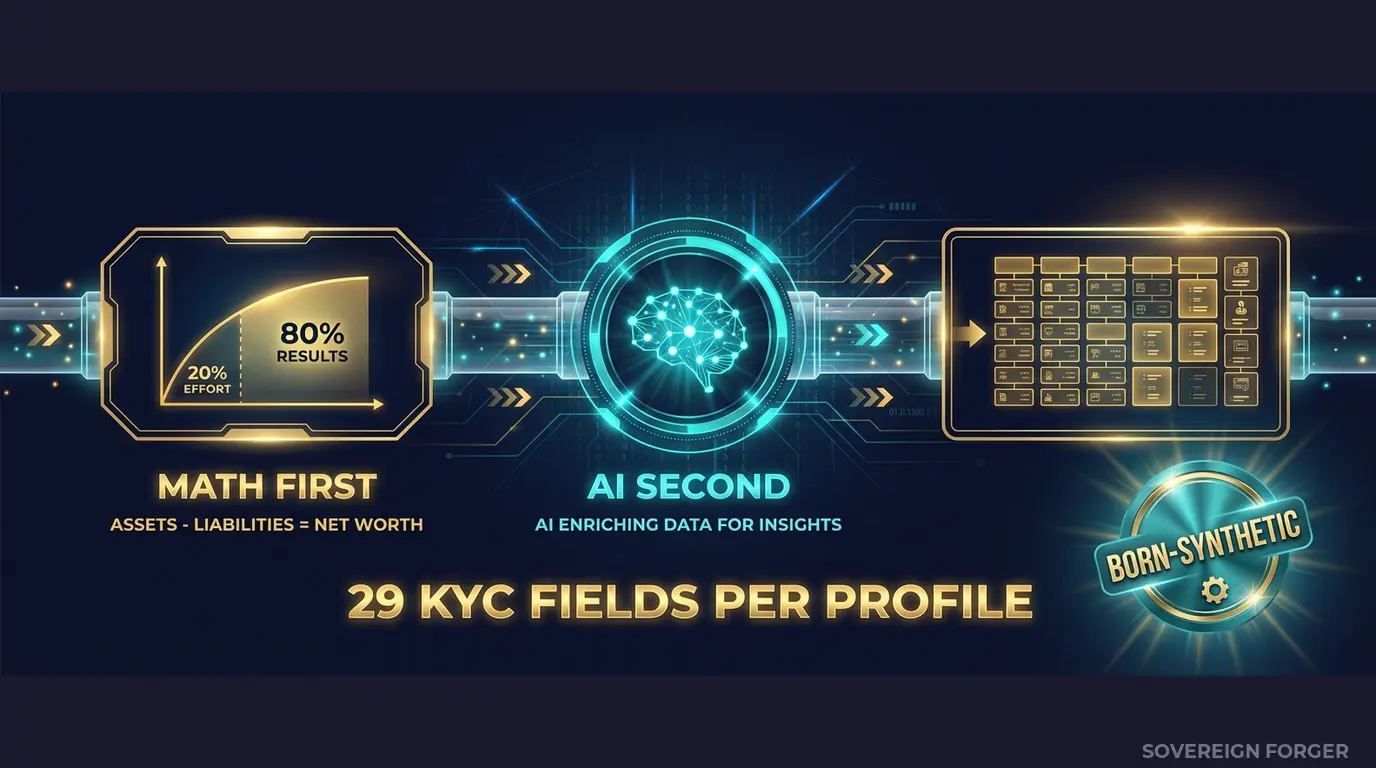
I built this dataset because I watched banks spend months designing EDD procedures they could never properly test. The test data was either real (illegal), anonymized (still identifiable), or synthetic (too simple to trigger EDD). The result was always the same: a compliance framework validated against toy scenarios and deployed against real-world complexity.
Every profile in the Sovereign Forger KYC dataset is generated from mathematical constraints — not derived from any real person, not anonymized from any client database. There is no lineage to trace, no re-identification to perform, no data subject to notify. The profiles exist because the math produced them.
Math First. Net worth follows a Pareto distribution — the way real wealth concentrates. Not a bell curve. Not a uniform random range. A long-tail distribution where the top decile holds dramatically more than the rest, because that is how UHNWI wealth actually distributes. Asset allocations are computed within algebraic constraints: Assets minus Liabilities equals Net Worth, by construction. Every balance sheet balances on every record. Zero exceptions. Zero manual corrections. Zero approximations.
AI Second. A local AI model — running offline, on isolated hardware — adds narrative context after the financial figures are locked. Biography. Profession. Education. Philanthropic focus. The AI never touches the numbers. It enriches the profile with culturally coherent details that match the geographic niche and wealth tier. A private banker in Zurich gets a different biography than a semiconductor magnate in Taipei, because their wealth architectures are structurally different.
Why This Works for EDD Simulation Specifically
EDD simulation requires data that triggers the right procedures at the right density. Generic high-net-worth profiles will not do this — they lack the structural features that activate Enhanced Due Diligence in the first place.
Every KYC-Enhanced profile in the Sovereign Forger dataset includes the fields your EDD workflow needs to encounter:
PEP exposure that mirrors reality. The `pep_status` field is not randomly assigned. It is deterministically derived from the profile’s archetype and niche — Middle East sovereign family profiles carry higher PEP rates than Silicon Valley tech founders, because the underlying populations have different proximity to political office. When a profile is PEP-positive, the `pep_position` and `pep_jurisdiction` fields contain coherent details — not random titles. Your EDD system receives the same signal density it would encounter with a real PEP client.
Multi-jurisdictional complexity. The combination of `residence_city`, `tax_domicile`, `offshore_jurisdiction`, and `offshore_vehicle` creates the cross-border exposure patterns that trigger EDD. A profile domiciled in London with a BVI trust and a Cayman holding company creates a three-jurisdiction footprint that your EDD must navigate. The dataset generates these combinations deterministically — matching the patterns I have observed in actual UHNWI client bases, not random jurisdiction assignment.
High-risk jurisdiction flags. The `high_risk_jurisdiction_flag` is derived from the profile’s actual offshore and tax domicile jurisdictions against FATF and EU high-risk lists. When a profile has exposure to a jurisdiction on those lists, the flag fires — and your EDD system must respond. The dataset includes realistic distribution of high-risk exposure by niche: LatAm profiles carry different risk patterns than Old Money Europe.
Risk rating distribution by niche. The `kyc_risk_rating` is not uniformly distributed. It reflects the structural risk of each geographic niche — LatAm profiles show ~84% high risk (reflecting jurisdictional complexity and commodity wealth patterns), while European and Swiss-Singapore profiles show ~48% low risk (reflecting more established regulatory environments). Your EDD simulation encounters realistic volume at each risk tier.
Sanctions screening signals. `sanctions_screening_result` generates clear, potential match, and confirmed match outcomes with realistic confidence scores. Your screening system can test its escalation logic — from initial flag through manual review to resolution — against profiles that produce the full range of outcomes.
29 Fields Designed for EDD Workflows
Identity & Geography: full_name, residence_city, residence_zone, tax_domicile
Wealth Structure: net_worth_usd, total_assets, total_liabilities, property_value, core_equity, cash_liquidity, assets_composition, liabilities_composition
Professional Context: profession, education, narrative_bio, philanthropic_focus
Offshore Exposure: offshore_jurisdiction, offshore_vehicle
KYC Signals: kyc_risk_rating, pep_status, pep_position, pep_jurisdiction, sanctions_screening_result, sanctions_match_confidence, adverse_media_flag, source_of_wealth_verified, sow_verification_method, high_risk_jurisdiction_flag
Every field is deterministically derived from the profile’s archetype, niche, net worth, and jurisdiction. The same UUID produces the same KYC fields on every generation — reproducible, auditable, and explainable to any regulator who asks how your test data was sourced.
Built for Traditional Bank EDD Simulation at Enterprise Scale
6 Geographic Niches: Silicon Valley, Old Money Europe, Middle East, LatAm, Pacific Rim, Swiss-Singapore. Each niche contains wealth patterns specific to its geography — the dynastic structures of European old money are structurally different from the commodity-driven wealth of LatAm, and your EDD procedures need to be tested against both.
31 Wealth Archetypes: Tech founders, sovereign family members, private bankers, commodity traders, real estate developers, shipping magnates, family office managers. These are the client profiles that actually walk into your private banking division — and the profiles that your EDD procedures must handle correctly.
Realistic Trigger Density: Unlike synthetic generators that produce one trigger per profile, these datasets contain profiles with multiple simultaneous EDD triggers — PEP status combined with high-risk jurisdiction combined with complex offshore structure. This is how real clients present, and this is how your EDD must be tested.
Certificate of Sovereign Origin: Every dataset ships with a certificate documenting the born-synthetic methodology, zero PII lineage, and regulatory alignment. When your auditor — or your regulator — asks where your EDD simulation data came from, you hand them the certificate. No ambiguity. No legal review required.
Pricing
| Tier | Records | Price | Best For |
|---|---|---|---|
| Compliance Starter | 1,000 | $999 | EDD procedure validation, proof of concept |
| Compliance Pro | 10,000 | $4,999 | Full EDD regression testing across niches |
| Compliance Enterprise | 100,000 | $24,999 | Enterprise-wide EDD simulation + AI model training |
No SDK. No API key. No procurement cycle. Download a file, feed it into your EDD pipeline, and count how many profiles trigger procedures that your current test data never exercised.
Why This Matters Now for Traditional Banks
The enforcement trajectory is unmistakable. Danske Bank: ~$2B for failures in transaction monitoring and customer due diligence across its Estonian branch. HSBC: £63.9M from the FCA. ABN AMRO: €480M. ING: €775M for systemic failures in customer due diligence. Standard Chartered: $1.1B across multiple regulators. These fines share a common thread — due diligence procedures that looked robust on paper but had never been stress-tested against the complexity of the bank’s actual client base.
Multiple regulators, compounding exposure. Traditional banks operate under simultaneous oversight from the FCA, ECB, FinCEN, MAS, and others. A single EDD failure can trigger enforcement actions from multiple regulators independently. Standard Chartered’s $1.1B fine was the result of coordinated action across jurisdictions. Your EDD simulation needs to account for the fact that different regulators assess the same client relationship against different standards — and your procedures must satisfy all of them simultaneously.
The EU AI Act changes the calculus. Starting August 2026, financial AI systems are classified as high-risk under Annex III. Article 10 requires documented governance of training data — provenance, bias assessment, data quality metrics, and GDPR compliance. If your EDD models incorporate any machine learning component — risk scoring, anomaly detection, name matching — the training data must be documented and defensible. Born-synthetic data with a Certificate of Sovereign Origin satisfies Article 10 requirements by construction. Real or anonymized data creates an open compliance question that will need to be answered.
The balance sheet test is open source. Every Sovereign Forger record passes algebraic validation: Assets minus Liabilities equals Net Worth. Run the Balance Sheet Test on our data, then run it on your current EDD test data. If your test data contains balance sheet errors — and I have seen error rates above 40% in competitor datasets — your EDD simulation is training your system to accept profiles that would fail basic financial integrity checks.
$24,999 is not a cost — it is a rounding error on your compliance budget. A traditional bank’s annual AML/KYC compliance spend runs into hundreds of millions. A single regulatory fine runs into hundreds of millions more. Born-synthetic EDD simulation data at enterprise scale costs less than a single day of a Big Four advisory engagement. The question is not whether you can afford it. The question is whether you can justify to your regulator that you never tested your EDD against realistic UHNWI complexity when the solution was available at this price point.
Test Your EDD Procedures Against Real Complexity
Download 100 free KYC-Enhanced UHNWI profiles. Every profile includes the structural triggers that should activate Enhanced Due Diligence — PEP status, high-risk jurisdictions, complex offshore vehicles, multi-jurisdictional tax domiciles.
Run them through your EDD workflow. Count how many trigger escalation paths that your current test data has never exercised. That number is the gap between your EDD as documented and your EDD as tested.
No credit card. No sales call. Just your work email.
Related reading: DORA Synthetic Data Requirements for Resilience Testing — how DORA Article 24-25 mandates synthetic data for threat-led penetration testing.
Related reading: The Compliance Blind Spot: Why EDD Systems Fail on UHNWI Profiles
Frequently Asked Questions
How does Enhanced Due Diligence simulation data help traditional banks validate PEP screening workflows before deployment?
Traditional banks operating under OCC SR 11-7 model risk management guidelines must validate EDD workflows against realistic high-risk profiles before live deployment. Sovereign Forger provides born-synthetic PEP individuals with complete political exposure histories, multi-jurisdictional asset structures, and correlated risk indicators across 29 interlocked fields. Banks can stress-test screening logic against edge cases — including indirect PEP relationships and dormant sanctions exposure — without touching real customer data. This supports pre-production model validation cycles that satisfy OCC examiners and internal model risk committees.
Can traditional banks use synthetic EDD profiles to test complex ownership structure detection under Basel III capital requirements?
Yes. Traditional banks subject to Basel III/IV capital requirements must demonstrate that EDD workflows correctly identify beneficial ownership chains that elevate counterparty risk weights. Sovereign Forger generates synthetic entities with layered shell company hierarchies, cross-border ownership registrations, and correspondent banking relationships, all statistically consistent with known high-risk typologies. Compliance teams can run end-to-end UBO resolution tests against these profiles without regulatory exposure, producing audit-ready documentation that satisfies both internal model governance and supervisory review standards applied more stringently to traditional banks than to neobanks.
How does synthetic multi-jurisdictional wealth data support source-of-wealth verification testing in traditional bank EDD programs?
Source-of-wealth verification is among the highest-friction steps in traditional bank EDD, requiring document analysis across multiple jurisdictions with inconsistent disclosure standards. Sovereign Forger synthetic profiles include correlated source-of-wealth narratives spanning up to six jurisdictions, with income types, asset valuations, and transaction histories calibrated to match real-world risk patterns. EDD analysts and system developers can validate workflow decision logic, escalation thresholds, and case management integrations against 50 or more realistic wealth scenarios, reducing production defect rates and supporting EBA model validation guidelines for financial crime detection systems.
What does born-synthetic mean, and why does it matter specifically for traditional bank EDD simulation?
Born-synthetic data is generated entirely from mathematical distributions such as the Pareto distribution, producing records that have zero lineage to any real individual. No anonymization, masking, or tokenization of real customer data is involved at any stage. For traditional banks, which face stricter supervisory scrutiny than neobanks and bear heightened GDPR liability under Article 25 data-protection-by-design obligations, this distinction is material. Born-synthetic profiles are GDPR Art.25 compliant by construction, meaning legal review cycles for EDD test environments are shorter, data sharing across vendor and internal teams carries no re-identification risk, and EU AI Act Art.10 training-data quality requirements enforceable in August 2026 are satisfied without remediation.
How can a traditional bank compliance team get started with synthetic EDD profiles from Sovereign Forger?
Sovereign Forger provides 100 free synthetic KYC profiles available for instant download via a verified work email address, with no credit card required. Each profile contains 29 interlocked fields covering risk ratings, PEP status, sanctions screening flags, and source-of-wealth classifications, all statistically consistent across the record. The sample set includes a representative distribution of high-risk profile types suitable for immediately stress-testing EDD intake logic, case prioritization rules, and escalation workflows. No procurement cycle or legal review is required to begin, allowing compliance and model risk teams to evaluate fit against their EDD simulation requirements the same day.
Learn more about bank EDD simulation synthetic data and how Born Synthetic data addresses this in our glossary and comparison guides.