
This transaction monitoring data is built for exactly this scenario. Starling Bank: £29M. HSBC: £63.9M. N26: €9.2M. Your clients paid those fines — and the post-mortem pointed at transaction monitoring systems that were never calibrated against realistic wealth flows. Your product was in the stack. Your reputation was on the line.
Your Clients’ Transaction Monitoring Fails Because Your Test Data Is Flat
I have sat in product demos where RegTech vendors showed their transaction monitoring dashboards catching suspicious patterns with impressive precision. Clean charts. Low false-positive rates. Every alert justified.
Then I looked at the test data behind the demo. Single-jurisdiction profiles. Net worths that follow a bell curve. Zero offshore vehicles. No PEP-adjacent connections. No trust structures, no multi-layered LPs, no wealth flowing legitimately between a tax domicile in Switzerland and a holding company in the Cayman Islands.
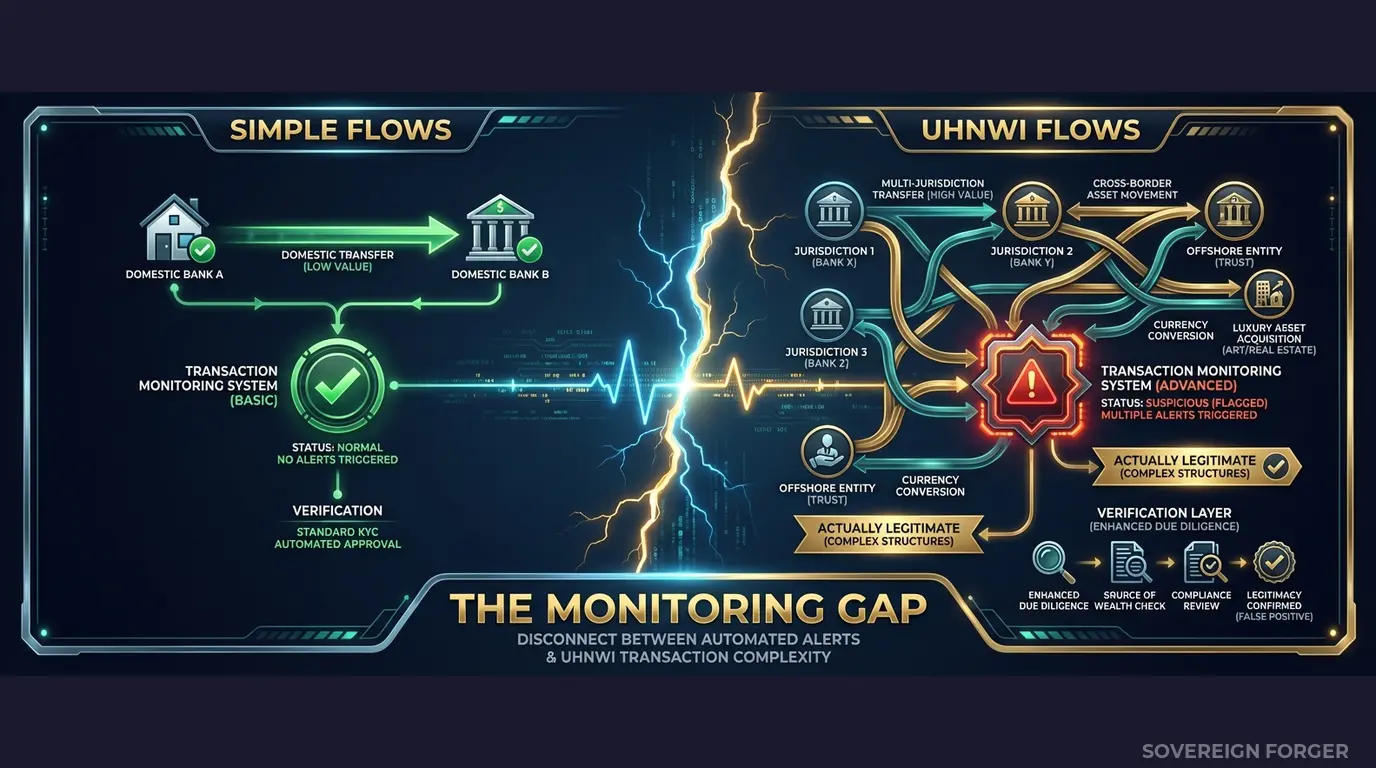
The system looked brilliant because the test data was simple. It flagged domestic anomalies perfectly — an unexpected $50,000 wire from a retail account, a sudden spike in card transactions. But hand it a real UHNWI client who moves $3M quarterly between four jurisdictions through a family office structure, and the system does one of two things: it flags everything as suspicious, generating a cascade of false positives that buries the compliance team — or it flags nothing, because the thresholds were calibrated against profiles that never exhibited this pattern.
This is the problem I have watched destroy RegTech credibility. ComplyAdvantage, Napier AI, Lucinity, Unit21, Flagright, Fenergo, NICE Actimize — every vendor in this space builds sophisticated detection engines. The algorithms are good. The rules are sound. But the data used to calibrate, validate, and stress-test those engines is structurally incapable of representing the clients who actually trigger Enhanced Due Diligence in production.
Here is what happens next. A neobank deploys your product. The first quarter looks clean. Then a UHNWI with a Singapore family office, a BVI holding company, and a charitable foundation in Liechtenstein opens an account. Your system flags every single cross-border transfer because it has never seen a legitimate multi-jurisdictional wealth flow. The compliance team spends 40 hours investigating alerts that are all false positives. Or worse — your system does not flag a genuinely suspicious pattern buried among the noise, because the alert queue is already saturated.
The neobank gets fined. The regulator’s report mentions “inadequate transaction monitoring.” Your product was the transaction monitoring layer. Your next enterprise deal just got significantly harder to close.
The calibration gap is measurable. If your transaction monitoring thresholds were set using test profiles with zero offshore exposure, zero multi-jurisdictional flows, and zero PEP-adjacent connections, your false-positive rate on real UHNWI clients is not a known quantity. It is an unknown unknown — and that is the most dangerous kind of compliance risk your clients carry.
Three Approaches That Fail RegTech Vendors Specifically
The standard approaches to test data are dangerous for any financial institution. For RegTech vendors, they are career-ending — because when your client gets fined, the blame flows upstream to the product they trusted.
Using your clients’ production data for calibration. Some RegTech vendors negotiate data-sharing agreements with early clients to calibrate their engines. This creates a GDPR Article 25 violation the moment that data enters your development environment. Your engineers now have access to real PII in a system with broader permissions, less logging, and weaker access controls than your client’s production stack. If one of your clients is a European bank, you are also creating an EU AI Act Article 10 liability — because any model trained on that data requires documented data governance that traces back to lawful processing. You cannot provide that documentation if the data was shared under a vague “product improvement” clause.
Using anonymized transaction data. Stripping names and account numbers from real UHNWI transaction flows does not eliminate re-identification risk. With only 265,000 UHNWIs globally, the combination of transaction size, jurisdiction pair, frequency, and offshore vehicle type is often unique to an individual. A regulator — or a motivated adversary — can cross-reference your “anonymized” calibration data against public records and re-identify the underlying clients. Your test data is not anonymous. It is pseudonymous, and GDPR applies in full.
Using generic synthetic generators. Platform-based synthetic data tools produce transaction patterns derived from statistical models of retail banking. They generate domestic transfers with realistic-looking amounts and timestamps. But they do not generate the structural complexity that defines UHNWI wealth flows: quarterly trust distributions from a Cayman vehicle to a Swiss account, cross-border equity transactions linked to a family office, management fee payments flowing through three jurisdictions before reaching the beneficial owner. Your transaction monitoring engine trains on flat data and learns flat patterns. The first real UHNWI client breaks every threshold you set.
Real Data vs. Anonymized vs. Born-Synthetic
| Dimension | Real Data | Anonymized | Born-Synthetic |
|---|---|---|---|
| PII present | Yes | Residual | None |
| Re-identification risk | Certain | Probable (UHNWI) | Impossible |
| GDPR Art. 25 compliant | No | Disputed | Yes |
| EU AI Act Art. 10 | Violation | Unclear | Compliant |
| Certifiable for auditors | No | No | Yes (Certificate of Origin) |
| Fine exposure | Up to 4% global revenue | Up to 4% global revenue | Zero |
| Multi-jurisdictional complexity | High (but illegal to use) | Degraded by stripping | Full (by design) |
| Calibration accuracy for UHNWI | Best (but unlawful) | Lossy | Purpose-built |
Born-Synthetic KYC Data Built for Transaction Monitoring Calibration
I built Sovereign Forger because I watched the same failure pattern repeat across every RegTech vendor I worked with: brilliant detection engines calibrated against data that bore no structural resemblance to the clients who actually trigger alerts in production. The problem was never the algorithm. It was always the data.
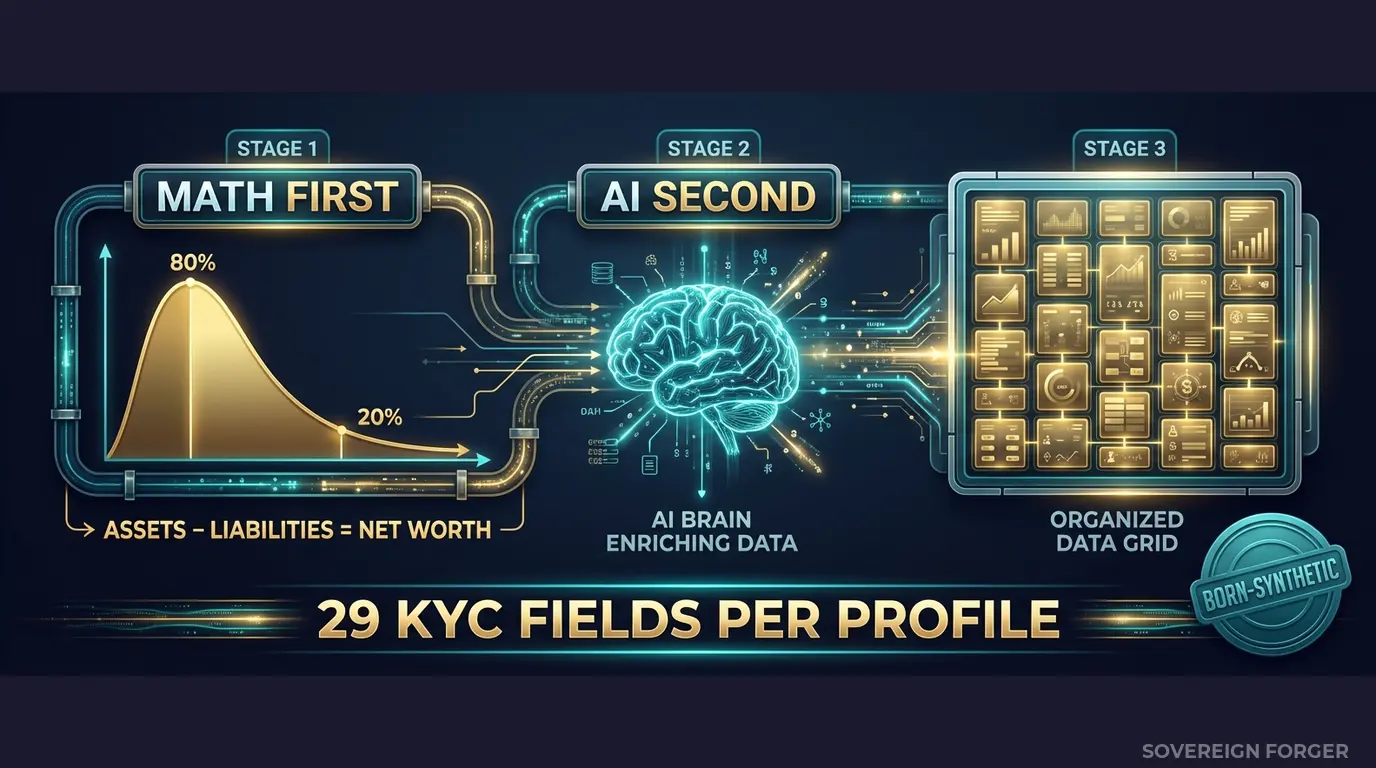
Every profile in the Sovereign Forger KYC dataset is generated from mathematical constraints — not derived from any real person. The generation pipeline works in two stages:
Math First. Net worth follows a Pareto distribution — the way real wealth is actually distributed, with a long tail of extreme values that a bell curve never produces. Asset allocations are computed within algebraic constraints: Assets – Liabilities = Net Worth, by construction. Every balance sheet balances on every record. Zero exceptions. This means your transaction monitoring engine sees wealth flows that are internally consistent — not random amounts attached to random profiles.
AI Second. A local AI model running entirely offline adds narrative context — biography, profession, philanthropic focus — after the financial figures are locked. The AI never touches the numbers. It enriches the profile with culturally coherent details that match the geographic niche and wealth tier. A tech founder in Silicon Valley has a different asset composition than a commodity trader in Singapore, and the profiles reflect that difference structurally.
Why This Matters for Transaction Monitoring Specifically
Transaction monitoring calibration fails when the test data does not represent the legitimate baseline of complex wealth flows. Your system needs to learn the difference between a suspicious cross-border transfer and a routine quarterly distribution from an offshore trust. That distinction requires test profiles with:
Realistic offshore exposure. Every Sovereign Forger profile includes `offshore_jurisdiction` and `offshore_vehicle` fields — BVI LPs, Cayman trusts, Delaware LLCs, Liechtenstein foundations. These are not randomly assigned. They are derived from the profile’s archetype and geographic niche. A Pacific Rim shipping dynasty gets different offshore structures than an Old Money European family, because the underlying wealth architectures are different.
Multi-jurisdictional complexity. The `tax_domicile`, `residence_city`, and `offshore_jurisdiction` fields create realistic multi-jurisdictional footprints. Your monitoring engine can calibrate thresholds against profiles where wealth legitimately flows between three or four countries — so it stops flagging every cross-border transfer as suspicious.
Wealth composition detail. The `assets_composition` and `liabilities_composition` fields break down the balance sheet into specific instruments — property, equity, liquidity, venture capital, art, commodity holdings. Transaction monitoring systems that understand the underlying asset structure can distinguish between a suspicious cash movement and a routine equity liquidation.
Risk signal coherence. The `kyc_risk_rating`, `pep_status`, `high_risk_jurisdiction_flag`, and `sanctions_screening_result` fields are deterministically derived from each profile’s archetype, niche, net worth, and jurisdiction. A Middle East sovereign family profile gets different risk signals than a Swiss private banker — because the regulatory exposure is structurally different. Your monitoring engine calibrates against realistic risk distributions, not uniform randomness.
29 Fields Designed for Transaction Monitoring Calibration
Every KYC-Enhanced profile includes the fields your monitoring engine needs to set accurate thresholds:
Identity & Geography: full_name, residence_city, residence_zone, tax_domicile
Wealth Structure: net_worth_usd, total_assets, total_liabilities, property_value, core_equity, cash_liquidity, assets_composition, liabilities_composition
Professional Context: profession, education, narrative_bio, philanthropic_focus
Offshore Exposure: offshore_jurisdiction, offshore_vehicle
KYC Signals: kyc_risk_rating, pep_status, pep_position, pep_jurisdiction, sanctions_screening_result, sanctions_match_confidence, adverse_media_flag, source_of_wealth_verified, sow_verification_method, high_risk_jurisdiction_flag
Every KYC field is deterministically derived from the profile’s archetype, niche, net worth, and jurisdiction — not randomly assigned. This means your transaction monitoring thresholds reflect the actual correlations between wealth structure and risk signals, not noise.
Built for RegTech Product Validation at Scale
6 Geographic Niches: Silicon Valley, Old Money Europe, Middle East, LatAm, Pacific Rim, Swiss-Singapore — each with culturally coherent wealth patterns, offshore structures, and risk distributions. Your product gets tested against the same diversity your clients encounter in production.
31 Wealth Archetypes: Tech founders, sovereign family members, commodity traders, shipping magnates, private bankers, real estate developers, family office managers — the actual client profiles that generate the cross-border flows your monitoring engine needs to classify correctly.
KYC Signal Distribution: Risk ratings, PEP statuses, sanctions screening results, and source-of-wealth verification methods distributed with realistic frequencies by niche. Middle East profiles carry ~29% PEP status. LatAm profiles show ~84% high-risk ratings. Silicon Valley profiles are predominantly low-risk with occasional offshore exposure through venture structures. These distributions match what your clients see in production — not a flat 33/33/33 split.
Deterministic Reproducibility. Every KYC field is derived via SHA-256 hash of the profile UUID. Same UUID, same fields, every run. Your regression tests produce identical results across environments — critical for CI/CD pipelines in RegTech product development.
Pricing
| Tier | Records | Price | Best For |
|---|---|---|---|
| Compliance Starter | 1,000 | $999 | Proof of concept, demo environment |
| Compliance Pro | 10,000 | $4,999 | Full regression suite, QA pipeline |
| Compliance Enterprise | 100,000 | $24,999 | AI model training + production validation |
No SDK. No API key. No sales call. Download a file, load it into your pipeline, and calibrate your thresholds against profiles that actually look like your clients’ clients.
Why This Matters Now — Especially for RegTech
Your clients’ fines are your problem. When Starling Bank paid £29M for inadequate financial crime controls, every vendor in their compliance stack faced scrutiny. When HSBC was fined £63.9M for transaction monitoring failures, the regulators did not stop at the bank — they looked at the tools the bank relied on. If your product is in that stack, your next renewal conversation starts with “why didn’t your system catch this?”
The EU AI Act changes the game for RegTech vendors. Starting August 2026, financial AI is classified as high-risk under Annex III. Article 10 requires documented governance of training data — including provenance, bias assessment, and GDPR compliance. If your transaction monitoring models were calibrated using real or anonymized client data, you need to prove lawful processing of that data under both GDPR and the AI Act simultaneously. Born-synthetic data eliminates both obligations: there is no PII, there is no real person, there is no data subject.
False positives are a measurable cost. Industry estimates put the cost of investigating a single false-positive alert at $25-$75. A RegTech product that generates 30% false positives on UHNWI clients — because it was calibrated against flat test data — costs its clients hundreds of thousands of dollars annually in wasted compliance analyst hours. Reducing that rate by calibrating against structurally realistic profiles is not a feature. It is a competitive advantage.
The balance sheet test is open source. Every Sovereign Forger record passes algebraic validation: Assets – Liabilities = Net Worth. Run the Balance Sheet Test on our data, then run it on whatever you are currently using for calibration. The structural difference is immediate and measurable.
Every dataset ships with a Certificate of Sovereign Origin — documenting the born-synthetic methodology, zero PII lineage, and regulatory alignment. When your client’s auditor asks “what data did you use to validate this product?”, you hand them the certificate. That conversation takes thirty seconds instead of three weeks.
Calibrate Your Transaction Monitoring
Download 100 free KYC-Enhanced UHNWI profiles with realistic multi-jurisdictional exposure, offshore structures, and wealth composition. Use them to baseline your monitoring thresholds.
Feed them into your detection engine. Count how many generate false-positive alerts that would never occur with a real UHNWI client — and how many genuine risk patterns your current test data would never have surfaced.
That gap is the difference between a product demo that works and a production deployment that holds.
No credit card. No sales call. Just your work email.
Frequently Asked Questions
How does synthetic transaction monitoring data help RegTech providers reduce false positive rates during platform development and client demos?
RegTech providers use Sovereign Forger’s born-synthetic profiles to stress-test alert engines against thousands of pre-labeled scenarios — structuring patterns, layering sequences, and high-velocity cross-border flows — without touching production data. Because each profile carries risk ratings, PEP flags, and sanctions indicators across 29 interlocked fields, QA teams can tune detection thresholds and measure false positive suppression rates against a ground-truth dataset. Clients report calibration cycles shortening from weeks to days when realistic edge cases are available from day one.
How does synthetic KYC data help neobanks avoid AML fines of the kind levied against Starling (£29M) and N26 (€9.2M)?
Regulators fined Starling £29M and N26 €9.2M partly because transaction monitoring systems failed to flag high-risk customers correctly. Neobanks using Sovereign Forger can validate their monitoring pipelines against synthetic profiles that include dormant accounts activating with unusual volumes, mismatched source-of-wealth declarations, and nested PEP relationships — all scenarios regulators scrutinize during audits. Testing with statistically representative adversarial profiles before go-live closes the coverage gaps that attract supervisory enforcement actions.
Can synthetic transaction data realistically replicate cross-border payment patterns and suspicious typologies required to test SWIFT, SEPA, and crypto monitoring rules?
Sovereign Forger generates cross-border transaction sequences calibrated to real correspondent banking corridors, including high-risk jurisdictions flagged by FATF. Profiles simulate round-trip structuring across currency pairs, layering through shell entity networks, and smurfing patterns that stay below reporting thresholds across multiple accounts. Each synthetic customer includes nationality, residency, and source-of-wealth attributes that drive plausible transaction geography, giving compliance engineers the typology coverage needed to validate both rules-based and machine learning detection models.
What does born-synthetic mean and why does it matter specifically for RegTech transaction monitoring use cases?
Born-synthetic means every profile is generated entirely from mathematical distributions, including Pareto-distributed wealth curves and correlated risk attribute models, with zero lineage to any real person. No anonymisation or pseudonymisation step was applied because no real data was ever used as input. For transaction monitoring applications this matters because EU GDPR Art.25 requires data-protection-by-design: born-synthetic data satisfies that obligation by construction, not by post-processing. RegTech vendors can share datasets with clients across jurisdictions without data transfer agreements, and EU AI Act Art.10 training-data quality requirements are met without re-identification risk.
How quickly can a RegTech team get started with synthetic KYC profiles for transaction monitoring, and what is included in the free tier?
Teams can download 100 free KYC profiles instantly via work email with no credit card required. Each profile includes 29 interlocked fields covering risk ratings, PEP status, sanctions screening results, source-of-wealth classification, and transaction behavior parameters — everything needed to populate a monitoring sandbox and begin threshold tuning on day one. The free tier is sized for proof-of-concept builds and client demonstration environments, with volume tiers available for full regression suites and ongoing platform QA pipelines.
Learn more about RegTech transaction monitoring data and how Born Synthetic data addresses this in our glossary and comparison guides.