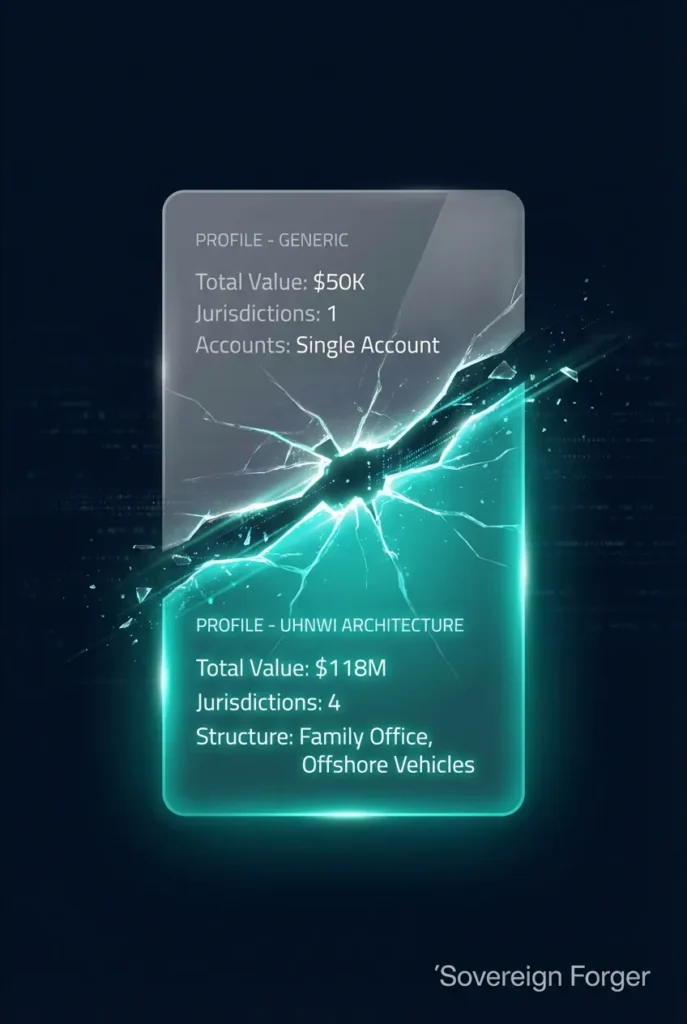
I chose to sell finished datasets, not a platform. Not because platforms are bad — but because I have seen what happens when a compliance team needs test data by Friday and the platform requires a three-week onboarding.
Both models have legitimate use cases. But for WealthTech and RegTech teams that need UHNWI profiles for AI training, compliance testing, or product development, the platform model introduces friction that the data model eliminates.
The Platform Model: What You Actually Buy
A synthetic data platform gives you the ability to generate data. This sounds like maximum flexibility. In practice, it means you are buying a tool — and a tool requires learning, configuration, and maintenance.
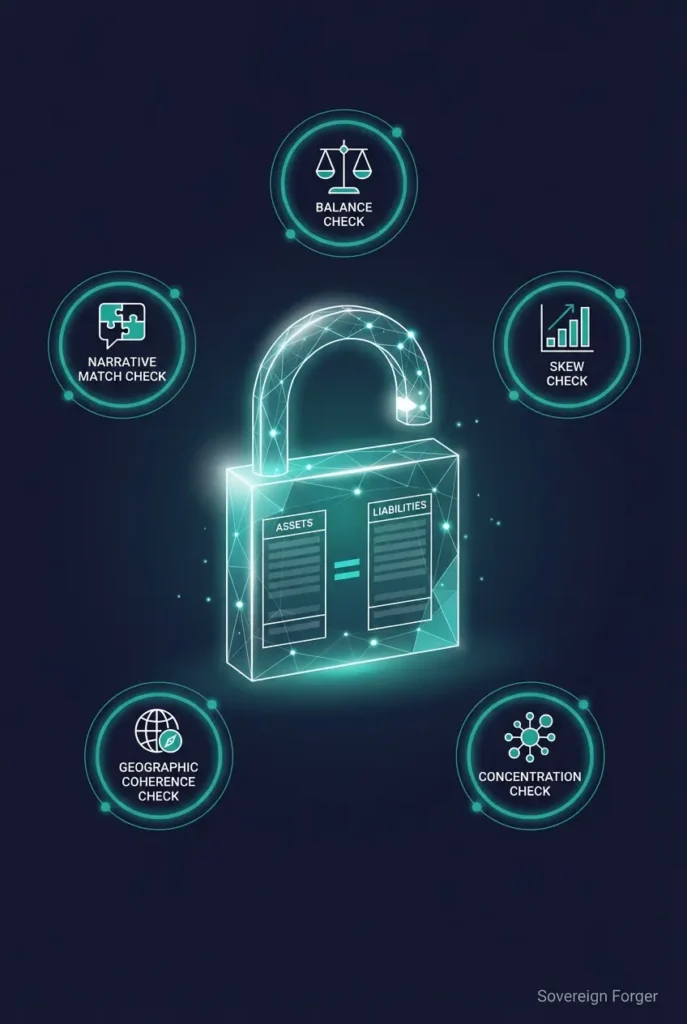
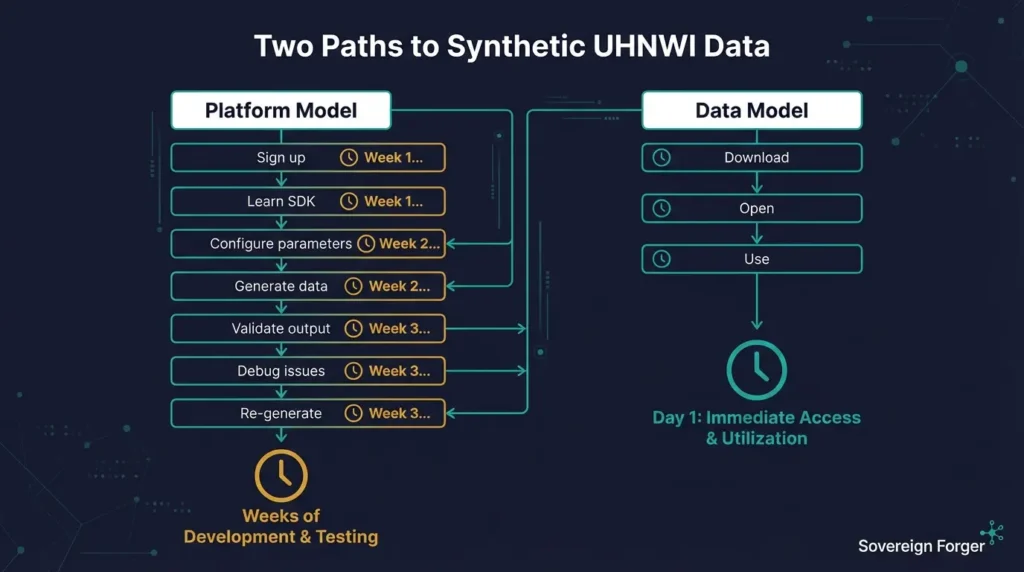
A typical onboarding with a platform provider looks like this. You sign up. You learn the SDK or API. You configure the generation parameters — which fields to include, what distributions to use, what constraints to apply. You run a generation job. You validate the output. You find issues — maybe the balance sheet does not balance, maybe the geographic coherence is off, maybe the distributions are unrealistic. You adjust parameters. You re-generate. You validate again.
For a team building a wealth management product, this onboarding cycle takes one to three weeks before the data is production-ready. During that time, your engineers are configuring a data tool instead of building your actual product.
There is also a knowledge problem. Configuring a synthetic data generator for UHNWI profiles requires knowing what UHNWI profiles look like — the right asset class distributions, the right offshore vehicle types, the right wealth creation pathways by geography. If you already had this domain knowledge encoded in your configuration, you probably would not need the synthetic data in the first place.
The Data Model: What You Actually Buy
A finished dataset skips the entire configuration and validation cycle. You receive a file. You open it. The data is ready to use.
The validation has already been done by the provider. The balance sheets balance. The geographic coherence is built in. The wealth distribution follows a Pareto curve. The offshore structures match the jurisdictions.
With born-synthetic data, you do not need to learn an SDK or understand how the generation pipeline works — you only need to verify that the output meets your requirements. We even publish the verification tool as open source so you can audit the math yourself.
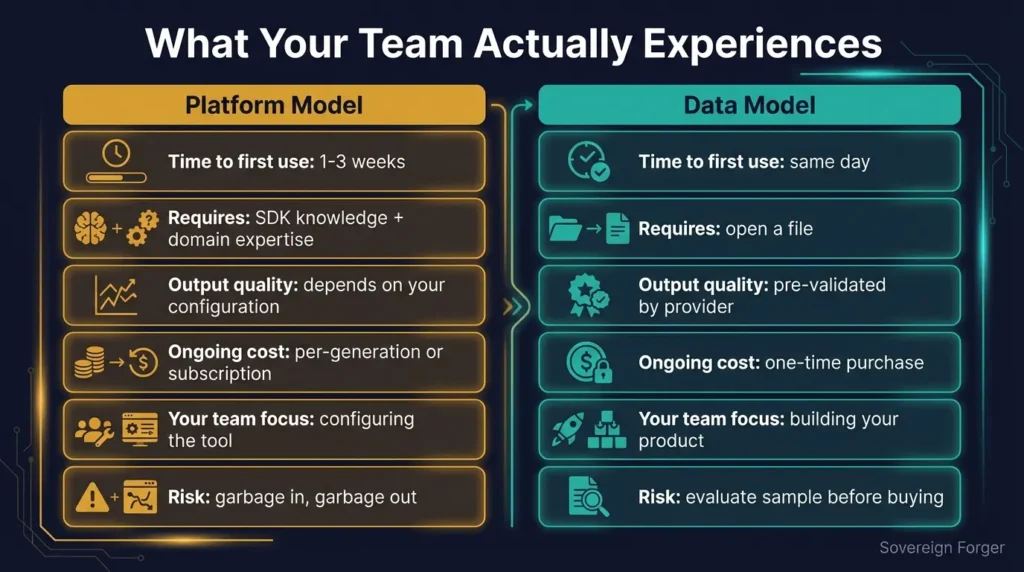
For a startup with a small engineering team and a tight development timeline, the difference between ‘data ready in three weeks’ and ‘data ready today’ is significant. Three weeks of engineer time spent on data tool configuration is three weeks not spent on the product that will generate revenue.
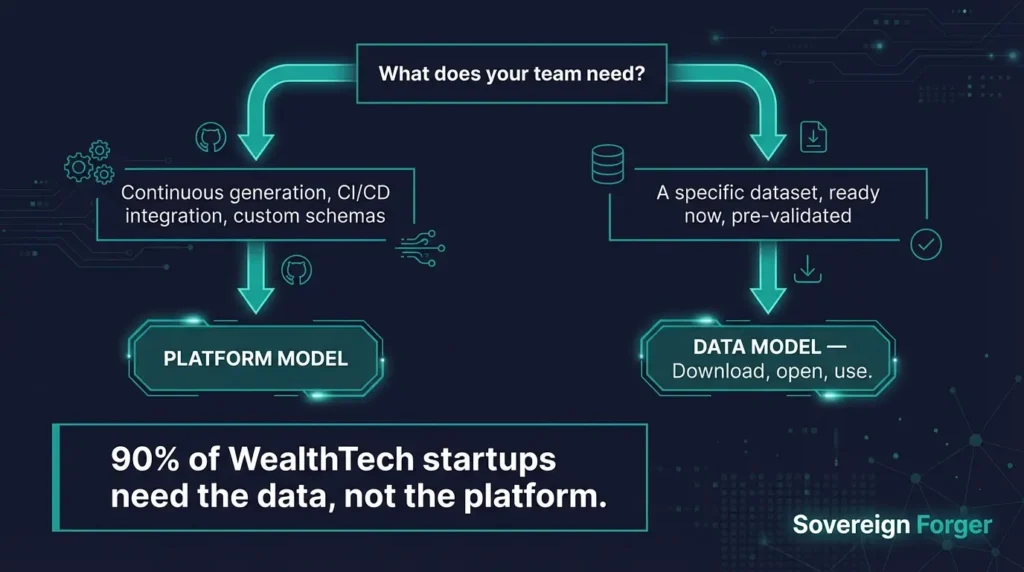
When Each Model Makes Sense
The platform model is the right choice when you need to generate data continuously — thousands of new records per day, customized to changing requirements, integrated into a CI/CD pipeline. If your use case requires dynamic generation at scale, the upfront investment in learning the platform pays off over time.
The data model is the right choice when you need a specific dataset for a specific purpose — training an AI model, testing a compliance system, populating a demo environment, running a QA cycle. You need the data to be correct, and you need it now. The value is in the quality of the output, not in the flexibility of the tool.
And because the data is born synthetic, not anonymized, there is no GDPR re-identification risk to manage.
Most WealthTech and RegTech teams, especially at the startup and growth stage, fall into the second category. They need 1,000 or 10,000 or 100,000 realistic UHNWI profiles to build their product. They do not need to become experts in synthetic data generation — they need to become experts in wealth management or compliance.
No SDK. No Credits. No Learning Curve.
This is exactly how I built Sovereign Forger. Six global wealth niches — Silicon Valley, Swiss-Liechtenstein, Singapore-Hong Kong, London-Channel Islands, Gulf States, and New York-Connecticut. Three tiers per niche — 1,000, 10,000, or 100,000 records. Every record passes the balance sheet test. Every field is interlocked. Every profile is born synthetic.
You download a file. You open it in Python, Excel, or any data tool. You start building. The pricing is published on the website — no sales calls, no custom quotes, no negotiation.
Try the Output First
Download 100 free Silicon Valley UHNWI profiles. Open the file. Check the math. If the data meets your requirements, the full dataset works exactly the same way — just with more records. If it doesn’t, you’ve lost five minutes, not three weeks.
Frequently Asked Questions
Should I buy a synthetic data platform or pre-built datasets?
It depends on your use case. Platforms (Mostly AI, Tonic, Gretel) require real data as input, technical staff to configure, and ongoing maintenance. Pre-built datasets from Sovereign Forger are ready to use in minutes with standard formats (JSONL, CSV), require no input data, no configuration, and no technical staff. For compliance testing and AI training on financial profiles, pre-built born-synthetic datasets are faster, cheaper, and carry zero GDPR risk.
What are the hidden costs of a synthetic data platform?
Beyond the license fee (typically $50K-500K/year), platforms require: data engineering time to connect real data sources, configuration of privacy parameters, ongoing maintenance as schemas change, compute resources for generation, and a Data Protection Impact Assessment because you are processing real personal data. Pre-built datasets eliminate all of these costs.
Can a synthetic data platform generate UHNWI profiles without real UHNWI data?
No. Platforms that learn from real data need real UHNWI data as input — which most organizations do not have in sufficient quantity or diversity. If you feed retail banking data to a platform, it generates profiles with retail characteristics regardless of configuration. Born-synthetic generation from Sovereign Forger uses domain-specific distributions and archetypes, requiring zero input data.
What format does Sovereign Forger deliver data in?
Every dataset is delivered in JSONL (one JSON object per line) and CSV format, with 19 interlocked fields for UHNWI profiles or 29 fields for KYC-enhanced profiles. Each package includes a README with schema documentation and a Certificate of Sovereign Origin documenting the born-synthetic provenance.
How quickly can I start using pre-built synthetic datasets?
Within five minutes of purchase. Download the JSONL or CSV file, load it into your system, and start testing or training. No installation, no configuration, no data engineering. The free sample (100 profiles from any niche) requires only a work email — no credit card, no sales call.