
If your synthetic wealth data looks like a bell curve, every model you trained on it learned the wrong shape of money. This is the single most important thing I can tell you about synthetic financial data.
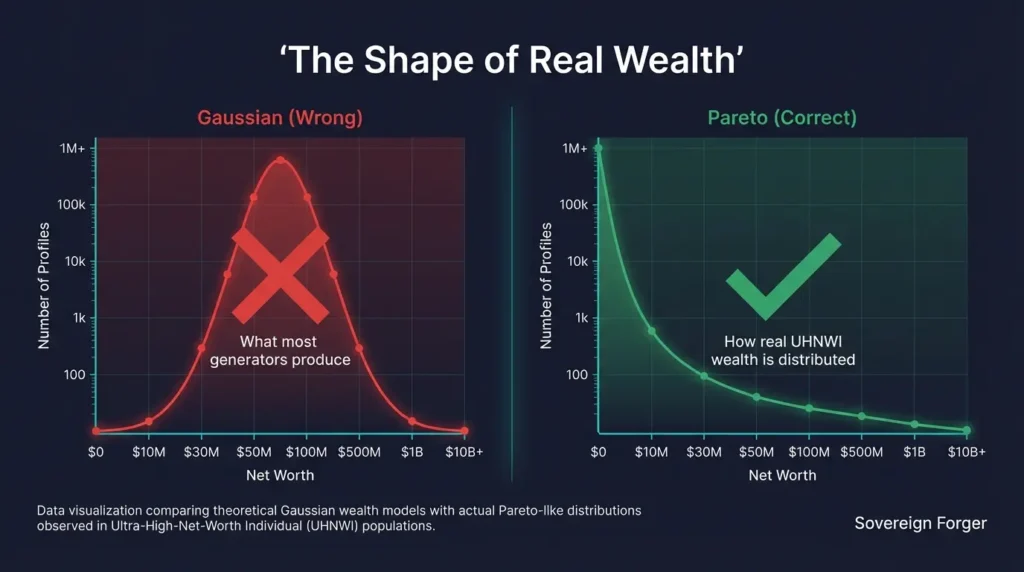
Why the Shape of the Distribution Matters
When you generate synthetic wealth data, you need to pick a distribution to sample net worth values from. This choice determines the statistical properties of your entire dataset — and by extension, the statistical properties that any downstream model learns.
A Gaussian (normal) distribution is symmetric. It clusters values around a mean and produces roughly equal numbers of profiles above and below that center point. If you set the mean at $50 million, you get as many profiles at $80 million as at $20 million, and almost no profiles above $150 million or below $5 million.
A Pareto distribution is asymmetric. It produces many profiles at the lower end of the range and progressively fewer at higher values, with a long tail that extends to very high net worth. In a UHNWI dataset with a lower bound of $10 million, most profiles cluster between $10 million and $30 million. A meaningful fraction sits between $30 million and $100 million. A small number exceeds $100 million. And a handful extends past $500 million.
This is how real UHNWI wealth is distributed. The empirical evidence has been consistent since Vilfredo Pareto first observed it in 1896: the top of the wealth spectrum follows a power law. The Pareto principle — that 20% of the population holds 80% of the wealth — is a direct consequence of this distribution shape.
What Goes Wrong with Gaussian Data
A model trained on Gaussian-distributed wealth data learns several things that are false.
It learns that extreme wealth is essentially impossible. In a normal distribution, a profile with $300 million net worth is multiple standard deviations from the mean — a statistical outlier that the model treats as noise. In a Pareto distribution, $300 million is uncommon but well within the expected range. A model that has never seen extreme wealth profiles will mishandle them in production.
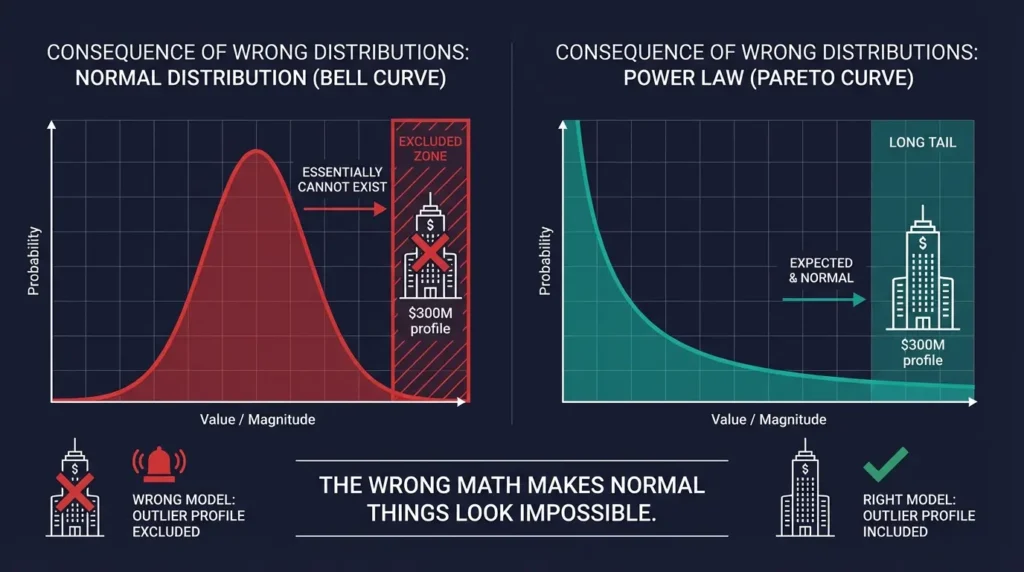
It learns that wealth tiers are uniformly populated. A Gaussian distribution implies that there are roughly as many profiles at $80 million as at $20 million. In reality, there are far more UHNWIs at $20 million than at $80 million. A wealth management platform that allocates equal resources across tiers — because its training data suggested equal frequency — will misallocate capacity where it matters most.
It learns the wrong correlations between wealth level and complexity. In real UHNWI populations, the relationship between net worth and structural complexity is non-linear. A client at $200 million does not simply have “twice the complexity” of a client at $100 million. They have qualitatively different entity structures, more jurisdictions, and different asset class allocations. This non-linearity is driven by the Pareto distribution itself: the tail behavior of the distribution produces clients whose complexity grows faster than their net worth.
These wrong correlations compound the structural problems described in From Retail to UHNWI — Gaussian sampling and linear scaling are two sides of the same mistake.

How Sovereign Forger Uses the Pareto Distribution
The Sovereign Forger pipeline starts with a Pareto distribution calibrated to empirical wealth data. I set the shape parameter (alpha) based on published research on UHNWI populations — typically between 1.1 and 1.5, depending on the geographic niche.
Net worth is sampled from this distribution first. Total assets and total liabilities are then derived through constrained mathematical splits — never independently sampled. Asset decomposition into property, equity, and liquidity follows further constrained allocations that vary by wealth tier.
The result is born-synthetic data where the wealth distribution matches real-world patterns, where the balance sheet balances on every record, and where complexity scales realistically with net worth. Every algebraic relationship is verifiable — the Balance Sheet Test is open source so you can confirm it yourself. A model trained on this data learns the right shape of the world.
Verify the Distribution Yourself
Then go further: run all five checks with The Balance Sheet Test or our open-source audit tool on GitHub.
Download 100 free Silicon Valley UHNWI profiles. Plot the net worth distribution. If the shape is right, the rest probably is too. Then check whether the balance sheet balances on every record. Then check whether the structural complexity increases at the highest net worth tiers.
Frequently Asked Questions
Why is Pareto distribution better than Gaussian for wealth data?
Wealth follows a power-law (Pareto) distribution, not a bell curve (Gaussian). In reality, a small number of individuals hold the vast majority of wealth, creating a long-tail distribution. Gaussian distributions cluster values around the mean, producing unrealistic wealth data where most profiles have similar net worth. Using the wrong distribution means your synthetic data teaches AI wrong patterns about how wealth is distributed.
What is the Pareto alpha parameter and why does it matter?
The alpha (shape) parameter controls how concentrated the wealth distribution is. A lower alpha means more extreme concentration — more billionaires relative to mere millionaires. Sovereign Forger calibrates alpha for each geographic niche based on real-world wealth concentration data. If alpha is wrong, the entire distribution is wrong, and every profile generated from it will have unrealistic wealth levels.
How can I tell if my synthetic data uses the correct distribution?
Plot the net worth values on a log-log scale. If the data follows a Pareto distribution, the plot should be approximately linear (a straight line on log-log axes). If it curves or shows a bell shape, the generator is using a Gaussian or similar symmetric distribution. You can also check the ratio of maximum to median net worth — for UHNWI data, this ratio should be very high (100x or more).
Does the distribution shape affect AI model quality?
Yes, fundamentally. AI models trained on Gaussian-distributed wealth data will expect most clients to have similar net worth and will poorly predict outcomes for extreme values. Models trained on Pareto-distributed data will correctly handle the long tail of ultra-wealthy clients, leading to better risk assessments, more accurate fraud detection, and fewer false positives on legitimate high-value transactions.
What other mathematical constraints does Sovereign Forger enforce?
Beyond Pareto distributions for wealth, Sovereign Forger enforces: algebraic balance sheet integrity (Assets minus Liabilities equals Net Worth), floor prices per city (minimum realistic net worth for UHNWI in each location), archetype-specific asset allocation rules, cross-validated offshore jurisdiction and tax domicile consistency, and deterministic KYC signal derivation via SHA-256 hashing.