
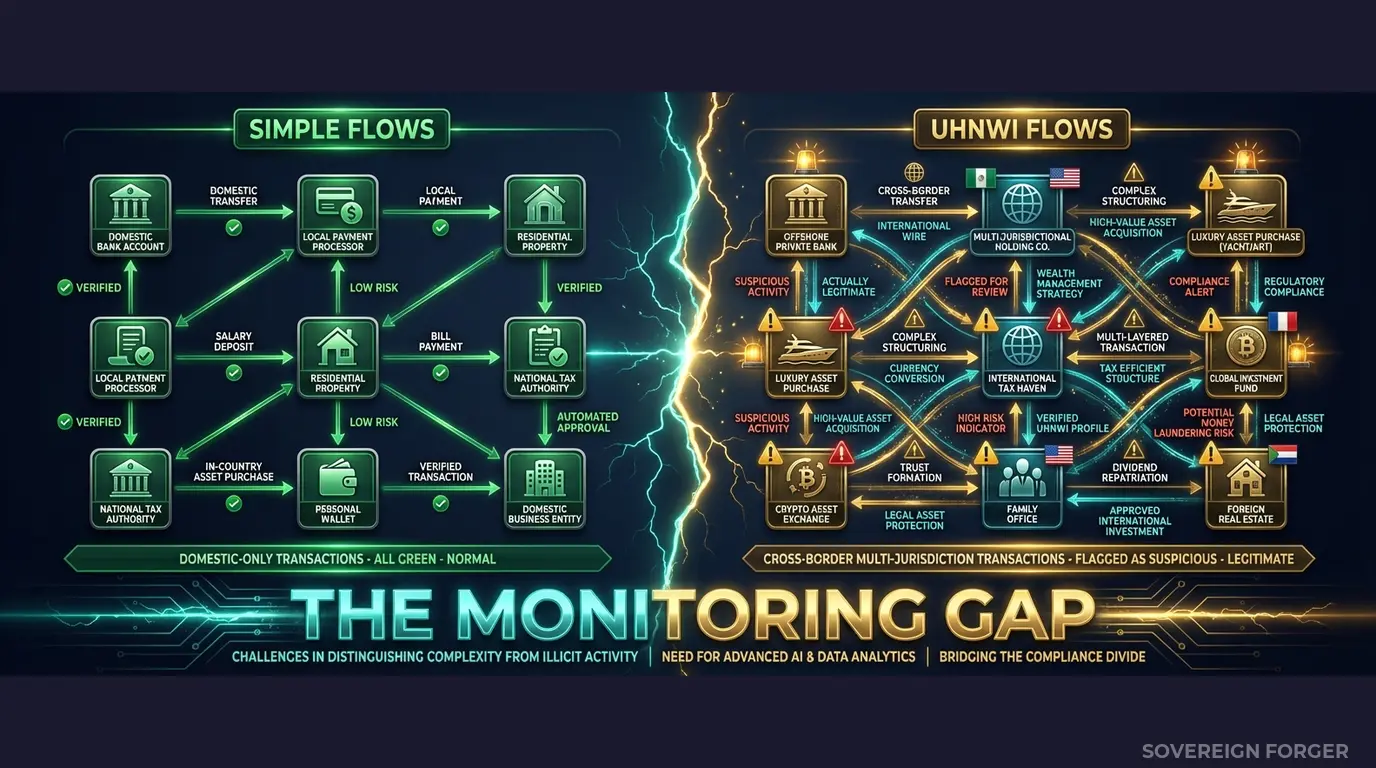
This transaction monitoring data is built for exactly this scenario. Your transaction monitoring system flags 95% of cross-border UHNWI transfers as suspicious. Not because they are — but because your training data never contained a single legitimate multi-jurisdictional wealth flow. Every alert your team investigates is time not spent on actual financial crime.
Your Transaction Monitoring System Is Calibrated Against the Wrong Reality
I spent years watching transaction monitoring teams at digital banks drown in alerts. Not because their systems were broken — because their systems had never seen what normal looks like for a wealthy client with international exposure.
Here is what happens. A neobank builds its transaction monitoring rules using internal data. The client base is overwhelmingly domestic: single-country accounts, single-currency transfers, straightforward salary deposits and card payments. The monitoring engine learns that this is normal. Cross-border transfers are rare. Offshore jurisdictions appear in maybe 0.3% of accounts. Anything involving the Cayman Islands, BVI, or Singapore triggers an alert.
Then the bank starts onboarding higher-value clients. A tech founder in London receives a dividend from a Delaware holding company, routes it through a Swiss private bank, and uses it to purchase property in Portugal. Four jurisdictions, three currencies, one completely legitimate wealth flow. The transaction monitoring system generates seven alerts in a single day. The compliance team spends four hours investigating. They find nothing — because there is nothing to find.
Multiply this by a thousand clients, and you have the operational reality that every growing neobank faces: a transaction monitoring system that cannot distinguish between legitimate international wealth management and actual money laundering, because it was trained on data where international wealth management did not exist.
This is not a configuration problem. It is a data problem. Your monitoring thresholds, your risk scoring models, your alert prioritization logic — all of it was calibrated against a client population that looks nothing like the clients who are now triggering 80% of your alerts. The system is working exactly as designed. The design was based on the wrong data.
The regulatory consequences are precise. Starling Bank’s £29M fine was explicitly tied to inadequate financial crime controls — systems that passed internal testing but failed under the complexity of real client behavior. Revolut’s €3.5M penalty cited gaps in transaction monitoring. Block paid $120M for AML failures. In every case, the monitoring system existed. It had been tested. It had passed QA. It simply had never been exposed to the structural complexity it would face in production.
The false positive problem is also a real risk problem. When your compliance team processes 2,000 alerts per day and 97% are false positives, they stop looking carefully. Alert fatigue becomes the actual vulnerability. The genuine suspicious transaction — the one that actually involves layering through shell companies — gets the same 90-second review as the tech founder’s routine dividend payment. Your monitoring system is not just inefficient. It is actively making your compliance team worse at detecting financial crime.
I built Sovereign Forger’s KYC-Enhanced profiles specifically to solve this calibration problem. Not by generating fake transactions, but by giving your monitoring system what it actually needs: a baseline understanding of what legitimate UHNWI wealth flows look like across jurisdictions, vehicle types, and asset classes — so it can learn the difference between complexity and criminality.
Three Approaches That Leave Your Monitoring Blind
Every neobank compliance team I have spoken to has tried at least one of these. None of them work — and I can tell you exactly why each one fails for transaction monitoring calibration specifically.
Calibrating against your own production data. This is the most common approach and the most dangerous. You use your existing client base to set monitoring thresholds. The problem: your existing client base is not representative of the clients who will trigger the most complex alerts. If you onboarded 50,000 domestic retail clients before your first UHNWI with offshore exposure, your thresholds are calibrated for domestic retail. Every UHNWI transaction becomes an outlier — not because it is suspicious, but because your model has never seen legitimate wealth at this scale. Worse, using production data in your model development environment creates a GDPR Article 25 violation: personal data in environments with weaker access controls and broader team access.
Using anonymized transaction histories. Some teams strip identifying information from real transaction records and use them for threshold calibration. For UHNWI clients, this is pseudonymization at best. With only 265,000 UHNWIs globally, the combination of transaction patterns, jurisdictions, amounts, and timing can re-identify individuals even without names or account numbers. A wire transfer of $4.2M from a Zurich private bank to a BVI registered agent on a Tuesday in March — how many people in your client base match that pattern? Probably one. Your “anonymized” calibration data is traceable, and a regulator can make that argument under GDPR Article 4.
Using generic synthetic data generators. Platform-based synthetic data tools generate transactions that mirror the statistical distribution of your input data. If your input data is 95% domestic transfers, your synthetic data will be 95% domestic transfers. You have reproduced the exact blind spot you were trying to eliminate. These tools are designed for data augmentation — making more of what you already have. Transaction monitoring calibration requires the opposite: generating the data you do not have, representing the client behaviors your system has never observed.
Production Data vs. Anonymized vs. Born-Synthetic for TM Calibration
| Dimension | Production Data | Anonymized | Born-Synthetic |
|---|---|---|---|
| PII present | Yes | Residual | None |
| Re-identification risk | Certain | Probable (UHNWI) | Impossible |
| GDPR Art. 25 compliant | No | Disputed | Yes |
| EU AI Act Art. 10 | Violation | Unclear | Compliant |
| Represents UHNWI complexity | Only if already onboarded | Only if already onboarded | Yes — by construction |
| Cross-border exposure | Limited to existing clients | Limited to existing clients | 6 niches, 31 archetypes |
| Offshore vehicle diversity | Whatever you happen to have | Whatever you happen to have | Full spectrum per niche |
| Certifiable for auditors | No | No | Yes (Certificate of Origin) |
The critical row is the fifth one. Production data and anonymized data can only represent what you already have. If you are a neobank with 200 UHNWI clients, your calibration data reflects 200 UHNWI behavioral patterns. Born-synthetic data gives you 100,000 structurally diverse profiles — representing the full spectrum of wealth architectures your system will encounter as you scale.
Born-Synthetic KYC Profiles That Teach Your Monitoring System What Normal Looks Like

Transaction monitoring calibration does not require synthetic transactions. It requires understanding the client profiles that generate those transactions. When your monitoring engine knows that a Pacific Rim semiconductor dynasty routinely moves capital between Singapore, Taiwan, and the Cayman Islands — and this is normal for that archetype — it stops flagging every cross-border transfer as suspicious.
This is what Sovereign Forger’s KYC-Enhanced profiles provide: the structural baseline your monitoring system needs to distinguish legitimate complexity from actual risk.
Math First. Every profile’s wealth structure follows a Pareto distribution — the way real UHNWI wealth is actually distributed. Assets are allocated across property, equity, cash, and offshore vehicles within algebraic constraints: Assets – Liabilities = Net Worth, by construction. Every balance sheet balances on every record. This means the wealth composition in each profile is internally consistent — your monitoring system can learn realistic asset-to-transaction ratios because the underlying numbers are mathematically coherent, not randomly generated.
AI Second. After the financial structure is locked, a local AI model adds narrative context: biography, profession, philanthropic focus. The AI runs entirely offline — no profile data ever touches the internet. It enriches the record with culturally coherent details that match the geographic niche and wealth tier: a Middle East sovereign family member gets different professional context than a Silicon Valley venture capitalist, because their wealth structures and transaction patterns are fundamentally different.
How This Fixes Transaction Monitoring
Threshold calibration. Your monitoring rules need to know what “normal” cross-border volume looks like for different client types. A Swiss-Singapore multi-family office manager with $180M in assets and three offshore vehicles in different jurisdictions will naturally generate more cross-border activity than a domestic retail client. The profile’s `offshore_jurisdiction`, `offshore_vehicle`, `tax_domicile`, and `assets_composition` fields give your rules engine the parameters to set jurisdiction-specific thresholds instead of blanket ones.
False positive reduction. When your system has been trained on profiles that include legitimate BVI structures, Cayman trusts, and Delaware LLCs — across 31 different wealth archetypes — it learns that these structures exist in normal UHNWI banking. The `high_risk_jurisdiction_flag` field tells you which profiles have exposure to FATF-listed jurisdictions, so your model can learn the difference between “high-risk jurisdiction present” and “high-risk jurisdiction present with no legitimate business reason.”
Alert prioritization. Not all alerts deserve the same investigation effort. A cross-border transfer from a PEP-adjacent client (`pep_status`, `pep_position`, `pep_jurisdiction`) with an unverified source of wealth (`source_of_wealth_verified: false`) is categorically different from a cross-border transfer by a tech founder with verified wealth and clear equity provenance. The 29 KYC fields give your prioritization model enough signal to rank alerts by actual risk, not by superficial complexity.
29 Fields That Map to Your Monitoring Pipeline
Every KYC-Enhanced profile includes the fields your transaction monitoring rules actually consume:
Identity & Geography: full_name, residence_city, residence_zone, tax_domicile
Wealth Structure: net_worth_usd, total_assets, total_liabilities, property_value, core_equity, cash_liquidity, assets_composition, liabilities_composition
Professional Context: profession, education, narrative_bio, philanthropic_focus
Offshore Exposure: offshore_jurisdiction, offshore_vehicle
KYC Signals: kyc_risk_rating, pep_status, pep_position, pep_jurisdiction, sanctions_screening_result, sanctions_match_confidence, adverse_media_flag, source_of_wealth_verified, sow_verification_method, high_risk_jurisdiction_flag
Every KYC field is deterministically derived from the profile’s archetype, niche, net worth, and jurisdiction — not randomly assigned. A commodity trader in the Middle East with exposure to high-risk jurisdictions gets a different risk signal distribution than a private banker in Zurich, because the underlying wealth structures and regulatory environments are different. Your monitoring system learns these correlations instead of treating every field as independent.
Built for Neobank Transaction Monitoring at Scale
6 Geographic Niches: Silicon Valley, Old Money Europe, Middle East, LatAm, Pacific Rim, Swiss-Singapore — each with distinct cross-border patterns, offshore preferences, and jurisdiction exposure that your monitoring system needs to understand.
31 Wealth Archetypes: Tech founders, sovereign family members, commodity traders, private bankers, shipping dynasty heirs, real estate developers — the actual client profiles that generate the multi-jurisdictional transaction patterns your rules engine must learn to classify.
KYC Signal Distribution: Risk ratings, PEP statuses, sanctions screening results, and source-of-wealth verification methods distributed with realistic frequencies by niche. Middle East profiles show ~29% PEP exposure. LatAm profiles carry ~84% high-risk ratings. Swiss-Singapore profiles show ~48% low-risk. These are the distributions your thresholds need to be calibrated against — not uniform random noise.
Deterministic Reproducibility: Every KYC field is derived from a SHA-256 hash of the profile UUID. Same profile, same fields, every time. When your monitoring team identifies a threshold that needs adjustment, they can rerun the exact same profiles and verify the impact. No stochastic drift between calibration runs.
Pricing
| Tier | Records | Price | Best For |
|---|---|---|---|
| Compliance Starter | 1,000 | $999 | Initial TM calibration, proof of concept |
| Compliance Pro | 10,000 | $4,999 | Full threshold regression testing |
| Compliance Enterprise | 100,000 | $24,999 | ML model training + production calibration |
No SDK. No API key. No sales call. Download a file, load it into your monitoring pipeline, and start calibrating against realistic UHNWI complexity.
Why This Matters Now
False positives are a measurable cost. Industry estimates put the average cost of investigating a single transaction monitoring alert at $25-50. If your system generates 2,000 alerts per day with a 97% false positive rate, that is $48,000-$97,000 per day spent investigating nothing. Reducing your false positive rate by even 20% through better calibration data saves more annually than the cost of 100,000 profiles. The dataset pays for itself before your first real detection improvement.
Enforcement is accelerating. The EU AI Act becomes fully applicable in August 2026. Financial AI — including transaction monitoring models — is classified as high-risk under Annex III. Article 10 requires documented governance of training data: provenance, bias assessment, and GDPR compliance. If your TM models were calibrated on production data or anonymized client records, you need to prove compliance on both GDPR and AI Act simultaneously. Born-Synthetic data with a Certificate of Origin resolves both requirements in a single document.
The fines are not slowing down. Starling Bank: £29M for inadequate financial crime controls — including transaction monitoring gaps. Revolut: €3.5M. Monzo: £21M. N26: €9.2M. Block: $120M. The FCA and BaFin are not issuing warnings anymore. They are issuing penalties. And every penalty letter mentions systems that were tested but not tested well enough.
The balance sheet test is open source. Every Sovereign Forger record passes algebraic validation: Assets – Liabilities = Net Worth. Run the Balance Sheet Test on our data, then run it on whatever you are currently using for TM calibration. If your current data does not pass — if the wealth structures are not internally consistent — then every threshold you derived from that data is calibrated against financial fiction.
Every dataset ships with a Certificate of Sovereign Origin — documenting the born-synthetic methodology, zero PII lineage, and regulatory alignment. When your auditor asks “what data did you use to calibrate these monitoring thresholds?”, you hand them the certificate. When the EU AI Act auditor asks about your training data governance, you hand them the same certificate. One document, two regulatory frameworks, zero exposure.
Calibrate Your Transaction Monitoring
Download 100 free KYC-Enhanced UHNWI profiles with realistic multi-jurisdictional exposure, offshore structures, and wealth composition. Use them to baseline your monitoring thresholds.
Feed them into your transaction monitoring rules. Count how many trigger alerts that are structurally indistinguishable from legitimate UHNWI banking. That number is your false positive floor — the minimum alert volume your team will process forever unless you recalibrate against data that actually represents your growing client base.
No credit card. No sales call. Just your work email.
Frequently Asked Questions
How does synthetic transaction data help neobanks reduce AML compliance fines?
Neobanks have faced significant regulatory penalties for inadequate transaction monitoring: Starling Bank was fined £29M in 2022, Monzo received a £21M warning in 2024, and Revolut was penalised €3.5M. Sovereign Forger’s born-synthetic profiles let compliance teams stress-test alert thresholds, tune velocity rules, and validate cross-border payment screening before deployment — eliminating the gap between model assumptions and live behaviour that regulators consistently cite as the root cause of systemic monitoring failures.
Can synthetic profiles accurately replicate the suspicious behavioural patterns that neobank transaction monitoring systems must detect?
Sovereign Forger generates profiles with mathematically calibrated anomaly signals: structuring sequences below reporting thresholds, rapid cross-border layering across 30+ jurisdictions, and PEP-adjacent fund flows. Because each profile carries interlocked attributes — risk rating, source of wealth, sanctions status — the alert triggers mirror real escalation logic. Teams can generate thousands of edge-case scenarios in hours, covering patterns that would take years to accumulate organically in production data.
How does born-synthetic data support EU AI Act compliance for neobank transaction monitoring models?
EU AI Act Article 10 classifies transaction monitoring as a high-risk AI application and mandates documented data governance for training sets, enforceable from August 2026. N26 was fined €9.2M and Block $120M partly due to monitoring model deficiencies traceable to inadequate training data. Born-synthetic data from Sovereign Forger ships with full provenance documentation — no real-world lineage, no re-identification risk — giving compliance and model risk teams the audit trail regulators will require under Article 10 obligations.
What does born-synthetic mean for neobank transaction monitoring data, and why does it matter?
Born-synthetic means the data was never derived, anonymised, or pseudonymised from real persons — it is generated entirely from mathematical distributions, including Pareto-modelled wealth distributions and stochastic transaction graphs, with zero lineage to any natural person. This is architecturally distinct from anonymised data, which retains re-identification risk. For neobank transaction monitoring, it means GDPR Article 25 compliance by construction: data protection is built into the generation methodology itself, not applied as a post-processing layer, eliminating the legal exposure that accompanies real-customer data use in test environments.
How can a neobank compliance team get started testing transaction monitoring systems with Sovereign Forger profiles?
Sovereign Forger offers 100 free synthetic KYC profiles available for instant download via work email with no credit card required. Each profile contains 29 interlocked fields covering risk ratings, PEP status, sanctions screening flags, and source of wealth narratives — the exact attributes needed to exercise transaction monitoring alert logic end-to-end. The profiles are ready to load directly into staging environments, enabling teams to validate detection rules, measure false-positive rates, and produce regulator-ready documentation before a single line of production data is touched.
Learn more about neobank transaction monitoring synthetic data and how Born Synthetic data addresses this in our glossary and comparison guides.