

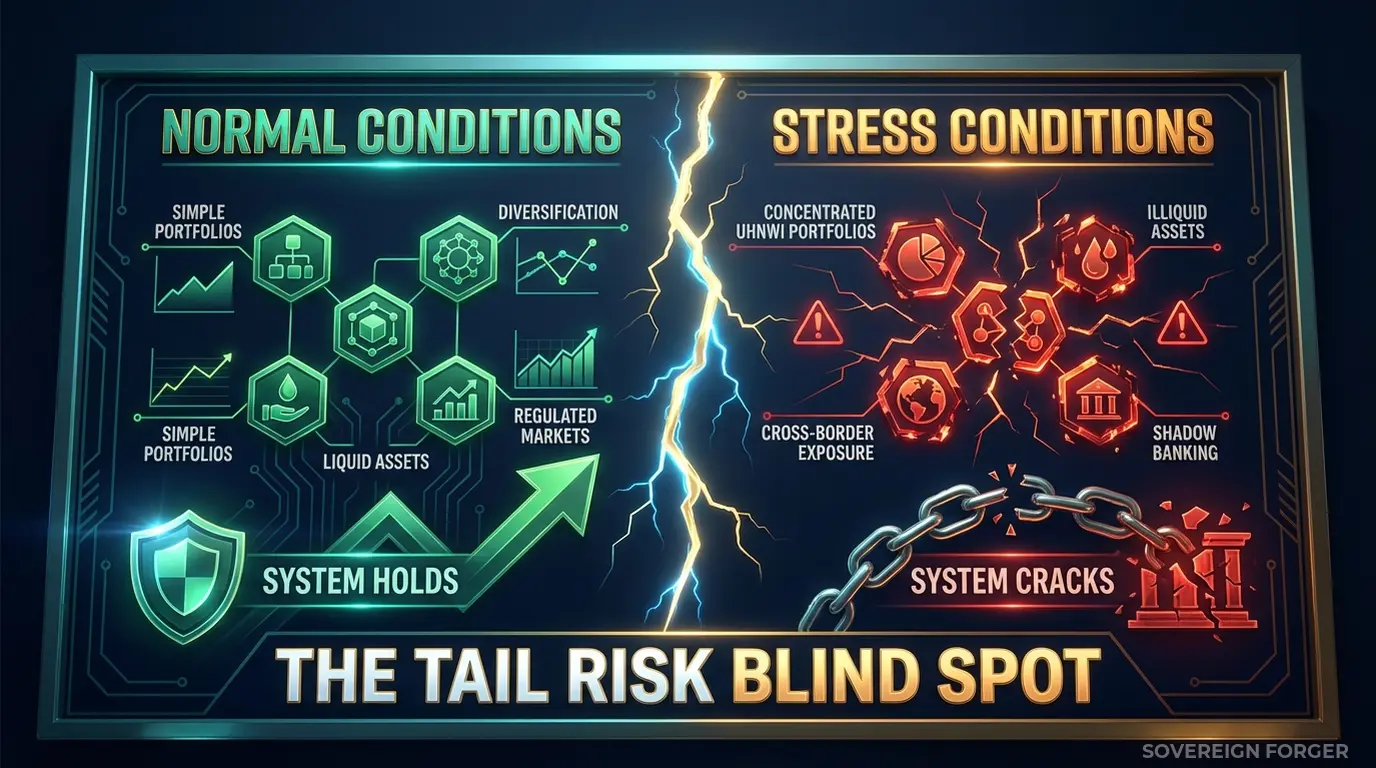
Your stress testing framework runs thousands of scenarios. But if every synthetic policyholder has a diversified portfolio, a single jurisdiction, and liquid assets — your models have never encountered the concentrated, illiquid, cross-border wealth structures that amplify losses during a real crisis. You are stress-testing against fair weather.
Your Stress Tests Are Missing the Tail
I spent years building data pipelines for financial institutions, and the pattern I saw most often in insurance was this: the stress testing team would run a scenario — equity market crash, interest rate spike, real estate correction — and declare the portfolio resilient. The models held. The capital buffers looked adequate. The board report went out with green indicators across every line.
Then 2022 happened. Or the UK gilts crisis. Or SVB. And the losses did not come from the average policyholder. They came from a handful of UHNWI clients with premium financing arrangements backed by concentrated equity positions. One family office in Singapore with $400M in a single shipping conglomerate. A Swiss trust with 70% of assets in illiquid real estate across three jurisdictions. A LatAm industrialist whose cash liquidity was 2% of total assets — everything locked in agricultural land and a family holding company.
These are not edge cases. In the UHNWI segment, concentrated, illiquid, cross-border wealth is the norm. But in every stress testing framework I have examined, the synthetic data feeding the models looked nothing like this. It looked like retail wealth scaled up — diversified allocations, single-country exposure, liquid portfolios that respond predictably to market shocks.
This is the structural flaw. Stress testing is supposed to find the scenarios that break your portfolio. But if your test data does not contain the wealth structures that actually amplify during crises, your stress tests are proving resilience against a scenario that does not exist.
The concentration problem is mathematical. Real UHNWI wealth follows a Pareto distribution — a small number of policyholders hold a disproportionate share of total exposure, with asset compositions that are structurally different from the rest of the book. If your synthetic data follows a normal distribution, your stress scenarios systematically underestimate tail risk. The models converge toward the mean, and the tail — where the actual losses live — is invisible.
Insurance regulators have noticed. EIOPA’s 2025 stress testing guidelines explicitly call for scenario analysis that captures concentration risk and cross-border exposure in life insurance and unit-linked products. Solvency II’s Own Risk and Solvency Assessment (ORSA) requires firms to demonstrate that internal models capture the full distribution of risk — not just the centre. If your stress testing data cannot generate the tail, your ORSA submission is structurally incomplete.
The premium financing blind spot. High-value life insurance policies — $5M, $10M, $50M face values — are frequently financed against collateral portfolios. When markets drop, the collateral drops, the financing arrangements trigger margin calls, and the insurer faces simultaneous lapse risk and counterparty exposure. I have seen stress testing frameworks that model lapse rates as a flat percentage across the book, with no connection to the underlying wealth structure of the policyholder. That is not stress testing. That is hope.
Three Approaches That Don’t Work for Insurance Stress Testing
The insurance industry arrived late to synthetic data. Banks have been using synthetic profiles for KYC testing for years. Insurance companies are still, in many cases, relying on approaches that were never designed for the complexity of UHNWI portfolios under stress.
Using actuarial model points. Traditional stress testing in insurance uses model points — simplified representations of the policyholder book. A model point might represent 500 policyholders with similar age, policy type, and sum assured. This works for mortality and morbidity modelling. It fails completely for wealth-driven stress scenarios. Model points aggregate away exactly the information that matters under stress: asset concentration, offshore exposure, liquidity ratios, cross-border collateral structures. You cannot stress-test premium financing arrangements on a model point that has no asset composition field.
Using copies of policyholder data. Some actuarial teams extract real policyholder data — including financial questionnaire responses, wealth declarations, and suitability assessments — into stress testing environments. This creates a GDPR Article 25 violation the moment the data leaves the production system. The policyholder consented to underwriting, not to being a test subject in a scenario where their wealth structure is modelled losing 40% of value. AXA was fined €2.3M by CNIL for data protection failures. Lloyd’s market participants face increasing FCA scrutiny on data handling. The regulatory direction is clear: real policyholder data does not belong in test environments.
Using generic synthetic generators. Platform-based synthetic data tools generate profiles that look like retail banking customers with insurance labels attached. They produce policyholders with diversified portfolios, single jurisdictions, and predictable asset allocations. These profiles do not stress-test anything — they confirm the baseline assumption that your portfolio is well-behaved. A stress test is only as useful as the worst-case scenario it can simulate. If your synthetic data cannot produce a policyholder with 80% of net worth in a single illiquid asset class, your framework has never tested the scenario that matters.
Model Points vs. Real Data vs. Born-Synthetic
| Dimension | Actuarial Model Points | Real Policyholder Data | Born-Synthetic Profiles |
|---|---|---|---|
| Asset composition detail | None (aggregated) | Full but PII-laden | Full, zero PII |
| Concentration risk visible | No | Yes | Yes |
| Cross-border exposure | No | Partial | Yes (6 niches, offshore) |
| GDPR Art. 25 compliant | N/A (no personal data) | No | Yes |
| Pareto wealth distribution | No (model points average) | Yes (but unusable) | Yes (by construction) |
| Stress scenario coverage | Centre of distribution | Full but restricted access | Full tail distribution |
| Certifiable for ORSA | Accepted practice | Regulatory risk | Yes (Certificate of Origin) |
Born-Synthetic Wealth Profiles Built for Insurance Stress Testing

Every profile in the Sovereign Forger dataset is generated from mathematical constraints that capture the structural properties of UHNWI wealth — the properties that drive tail risk in insurance portfolios. This is not scaled-up retail data. It is wealth architecture modelled from the distribution up.
Math First — Pareto, Not Gaussian. Real wealth follows a Pareto distribution. The top 1% of policyholders hold a disproportionate share of total exposure, and their asset compositions are structurally different from the average. I set the shape parameter of the Pareto distribution to match empirical wealth data, then generate net worth values that reproduce the heavy tail — the region where your stress scenarios actually live. Every balance sheet is computed within algebraic constraints: Assets – Liabilities = Net Worth, by construction. No rounding errors. No impossible portfolios. Every record balances.
Asset Compositions That Stress-Test Realistically. Each profile includes a detailed `assets_composition` field — the breakdown of property, equity, cash, and alternative assets that makes up total wealth. These compositions are not randomly generated. They are derived from the profile’s archetype and geographic niche. A Silicon Valley tech founder has concentrated equity in a single venture. An Old Money European dynasty has illiquid real estate spanning three countries. A Pacific Rim shipping magnate has 60% of assets in a single conglomerate. These are the compositions that amplify under market stress — and they are the compositions your framework needs to test against.
Liquidity Ratios That Reveal Vulnerability. The `cash_liquidity` field shows how much of a policyholder’s wealth is actually accessible under stress. In the UHNWI segment, this number is often shockingly low — 2-5% of total assets. When your stress scenario triggers a margin call on a premium financing arrangement, the model needs to know whether the policyholder can meet it from liquid reserves or whether the insurer faces a forced lapse. Generic synthetic data assigns liquidity randomly. Sovereign Forger derives it from the wealth archetype, because a real estate baron and a hedge fund manager have fundamentally different liquidity profiles.
Cross-Border Exposure Built In. Every profile includes `residence_city`, `tax_domicile`, and `offshore_jurisdiction` — the three-axis geography that determines how a portfolio behaves under jurisdictional stress. Currency risk, regulatory divergence, capital controls — these are not theoretical concerns for insurers with UHNWI clients across Singapore, Switzerland, the Cayman Islands, and Delaware. Your stress testing framework needs profiles that span these jurisdictions, not profiles that all reside in London.
29 Fields Designed for Stress Testing Frameworks
Every KYC-Enhanced profile includes the fields your stress models actually need to process:
Identity & Geography: full_name, residence_city, residence_zone, tax_domicile
Wealth Structure: net_worth_usd, total_assets, total_liabilities, property_value, core_equity, cash_liquidity, assets_composition, liabilities_composition
Professional Context: profession, education, narrative_bio, philanthropic_focus
Offshore Exposure: offshore_jurisdiction, offshore_vehicle
KYC Signals: kyc_risk_rating, pep_status, pep_position, pep_jurisdiction, sanctions_screening_result, sanctions_match_confidence, adverse_media_flag, source_of_wealth_verified, sow_verification_method, high_risk_jurisdiction_flag
For stress testing specifically, the critical fields are `assets_composition`, `liabilities_composition`, `cash_liquidity`, `property_value`, `core_equity`, and `offshore_jurisdiction`. These six fields determine how a profile behaves under market stress — whether assets are concentrated or diversified, liquid or locked, domestic or cross-border. Every synthetic data generator gives you net worth. Sovereign Forger gives you the internal structure of that wealth.
Built for Insurance Stress Testing at Scale
6 Geographic Niches: Silicon Valley, Old Money Europe, Middle East, LatAm, Pacific Rim, Swiss-Singapore — each with distinct wealth structures, asset concentrations, and cross-border patterns that behave differently under stress scenarios.
31 Wealth Archetypes: Tech founders with concentrated equity, real estate dynasties with illiquid property portfolios, commodity traders with volatile holdings, family office managers with multi-jurisdictional structures — the actual policyholder profiles that generate tail risk in life insurance, unit-linked products, and premium financing.
Pareto-Distributed Net Worth: Not a bell curve. Not uniform random. The wealth distribution matches empirical patterns — heavy tail, extreme concentration at the top, the exact shape that your stress testing framework needs to capture.
Realistic Asset Concentrations: Each archetype has a characteristic asset composition. A LatAm agribusiness baron is 65% in agricultural land and infrastructure. A Pacific Rim semiconductor heir is 70% in a single equity holding. These concentrations are what amplify losses in your stress scenarios — and they are absent from generic synthetic data.
Pricing
| Tier | Records | Price | Best For |
|---|---|---|---|
| Compliance Starter | 1,000 | $999 | Proof of concept, single scenario |
| Compliance Pro | 10,000 | $4,999 | Full stress testing suite |
| Compliance Enterprise | 100,000 | $24,999 | Enterprise ORSA + model validation |
No SDK. No API key. No sales call. Download a file, load it into your stress testing framework, and run scenarios against wealth structures that actually break models.
Why This Matters Now
Insurance AML enforcement is accelerating. Regulators are extending banking-grade KYC/AML requirements to the insurance sector. EIOPA has flagged life insurance, premium financing, and high-value single-premium policies as money laundering vectors. National regulators — BaFin, FCA, ACPR — are following with sector-specific enforcement. AXA’s €2.3M CNIL fine was a data protection action, but the direction is clear: insurance companies face the same regulatory scrutiny that neobanks have been under for years.
Solvency II ORSA requires realistic scenarios. The Own Risk and Solvency Assessment demands that internal models capture the full distribution of risk — including tail scenarios driven by policyholder concentration. If your stress testing data cannot generate the tail of the wealth distribution, your ORSA submission is mathematically incomplete. An auditor who understands Pareto distributions will see the gap immediately.
The EU AI Act applies to insurance AI. Financial AI — including pricing models, underwriting algorithms, and risk scoring — is classified as high-risk under Annex III. Article 10 requires documented governance of training data, including provenance and bias assessment. If your stress testing models train on real policyholder data, you need to prove GDPR compliance and AI Act compliance simultaneously. Born-synthetic data eliminates both problems at once.
The balance sheet test is open source. Every Sovereign Forger record passes algebraic validation: Assets – Liabilities = Net Worth. Run the Balance Sheet Test on our data, then run it on your current stress testing data. If the balances do not hold, your stress scenarios are built on profiles that could not exist in the real world. That is not a stress test — it is fiction.
Every dataset ships with a Certificate of Sovereign Origin — documenting the born-synthetic methodology, Pareto distribution parameters, zero PII lineage, and regulatory alignment. When your ORSA auditor or DPO asks where the stress testing data came from, you hand them the certificate. Born-Synthetic data. Zero real persons. Compliant by construction — not by anonymization.
Stress-Test With Realistic Wealth Distributions
Download 100 free UHNWI profiles with Pareto-distributed wealth, realistic asset concentrations, and cross-border exposure. Feed them into your stress testing framework. Run the equity crash scenario, the real estate correction, the liquidity squeeze.
Count how many profiles trigger outcomes your current test data never produced. That number tells you how much of the tail your framework has been ignoring.
No credit card. No sales call. Just your work email.
Related reading: DORA Synthetic Data Requirements for Resilience Testing — how DORA Article 24-25 mandates synthetic data for threat-led penetration testing.
Frequently Asked Questions
Why do standard stress testing datasets fail to break insurance models effectively?
Standard stress testing data uses uniform scaling — multiplying normal distributions by a stress factor. Real financial stress affects UHNWI portfolios asymmetrically: property values in specific markets may collapse while offshore holdings appreciate, or equity positions may crater while trust-protected assets remain stable. Sovereign Forger profiles include detailed asset composition breakdowns (property, equity, cash, offshore) across 31 archetypes, enabling insurers to model realistic stress scenarios where different wealth components respond differently to market shocks.
How does born-synthetic stress testing data satisfy both EIOPA and GDPR requirements simultaneously?
EIOPA requires insurers to conduct regular stress tests with realistic scenarios, while GDPR Art.25 prohibits using real policyholder data in test environments without adequate protection. Born-synthetic data resolves this contradiction: Sovereign Forger profiles are generated from Pareto distributions and algebraic balance constraints, not derived from real individuals. The data is statistically realistic enough for EIOPA stress test validation while containing zero personal information — satisfying both regulators with a single dataset.
What Solvency II stress testing scenarios can be simulated with synthetic UHNWI profiles?
Solvency II Pillar 2 requires insurers to assess risks beyond standard formula calculations, including concentration risk in UHNWI portfolios. Sovereign Forger profiles across six geographic niches enable scenario modeling for regional economic downturns (European real estate correction, Middle East oil price shock, Pacific Rim semiconductor cycle), jurisdictional risk events (sanctions regime changes affecting offshore structures), and systemic events (global liquidity crisis affecting cross-border asset transfers). Each profile’s 29 interlocked fields provide the granularity needed for meaningful stress calculations.
Can synthetic stress testing data be shared across departments without additional GDPR controls?
Yes. Because born-synthetic data contains no personal information by construction, there are no data subject rights to manage, no consent requirements, no data processing agreements needed between departments, and no data protection impact assessments required. Actuarial teams, risk management, compliance, and IT can all access the same stress testing dataset without the access controls, audit trails, and purpose limitation restrictions that would apply to real or anonymized policyholder data.
How does the EU AI Act affect insurance stress testing data requirements from August 2026?
The EU AI Act Art.10 requires documented data governance for AI systems used in financial risk assessment — which includes AI-driven stress testing models. From August 2026, insurers must demonstrate that training and testing data is relevant, representative, and free from biases. Born-synthetic profiles from Sovereign Forger come with a Certificate of Sovereign Origin documenting provenance, generation methodology, and field specifications — providing the audit trail Art.10 demands without the lineage complications of anonymized production data.
Learn more about insurance stress testing synthetic data and how Born Synthetic data addresses this in our glossary and comparison guides.