

AXA: €2.3M. Lloyd’s: multiple enforcement actions. EIOPA extending banking-grade AML requirements to every insurance company in Europe. Your sanctions screening engine was tested against clean profiles with simple names and single jurisdictions. The clients who trigger real sanctions alerts look nothing like that.
Your Sanctions Screening Engine Has Never Been Properly Stress-Tested
I have spent years watching sanctions screening systems in financial services — and insurance is where the gap between testing and reality is widest.
Here is what I have seen repeatedly. An insurance compliance team configures their sanctions screening engine — Dow Jones, World-Check, a custom integration — and tests it against a dataset of synthetic profiles. The profiles have names like “John Williams” and “Maria Garcia.” Single jurisdiction. Single nationality. No offshore exposure. No PEP connections. The screening engine runs. A handful of matches come back. The team tunes the fuzzy matching threshold until the false positive rate looks reasonable. They sign off. The system goes to production.
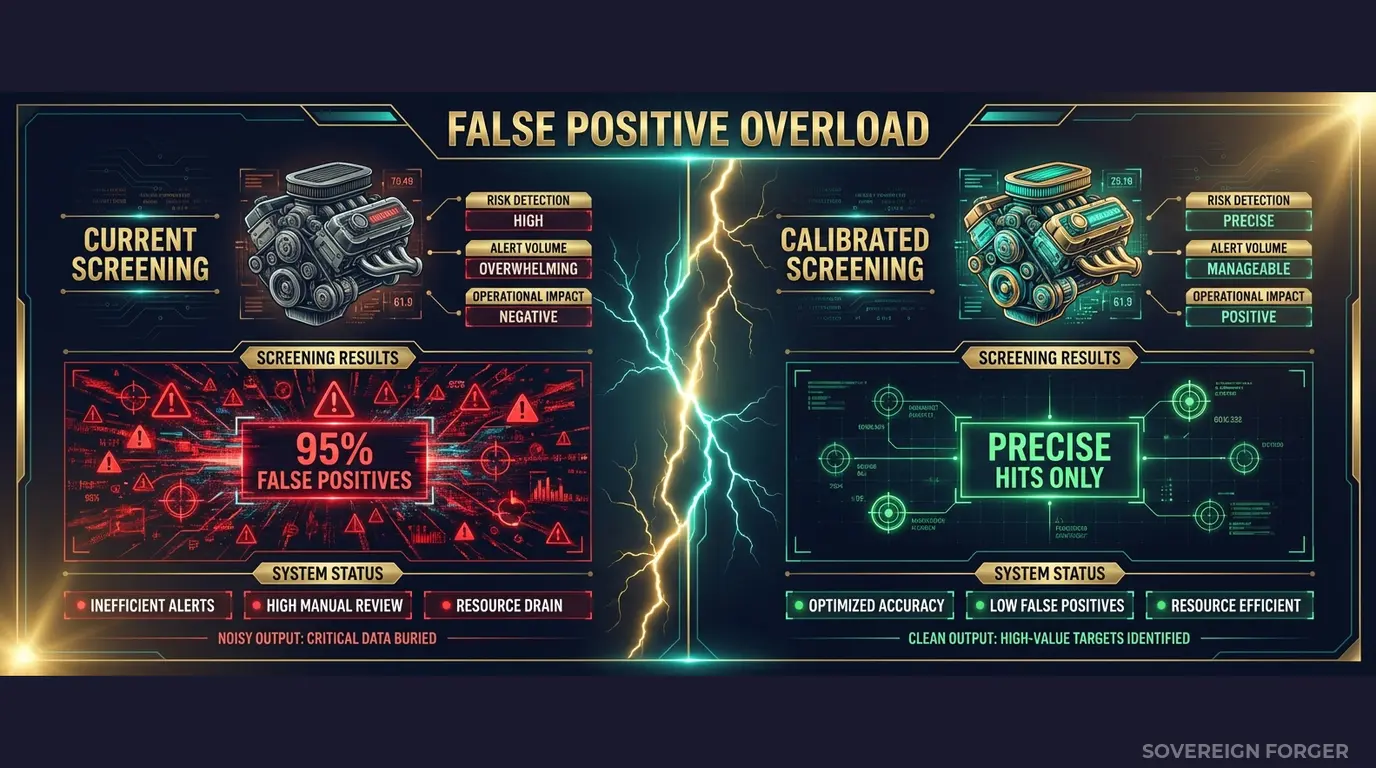
Then reality arrives. A high-value life insurance application from a client whose family name translitates three different ways from Arabic. A premium financing request routed through a Cayman trust with a BVI holding company. A reinsurance counterparty whose beneficial owner sits on the board of a state-owned enterprise in a jurisdiction that just landed on the FATF grey list. The screening engine either drowns in false positives it was never calibrated to handle, or — worse — it misses a genuine match because the name transliteration variant was not in the test data.
This is not a banking problem that occasionally spills into insurance. It is an insurance-specific structural failure. Life insurance policies are one of the oldest money laundering vehicles in existence — large single premiums, long duration, legitimate-looking payouts. Premium financing structures add layers of opacity. Reinsurance treaties involve counterparties across dozens of jurisdictions. EIOPA and national regulators have recognized this, which is why they are extending the same AML standards that crushed neobanks to the insurance sector.
The core problem is this: sanctions screening accuracy is a function of the data you test against. If your test data contains zero multi-jurisdictional exposure, zero transliterated names, zero PEP-adjacent connections, and zero high-risk jurisdiction flags, your screening engine has been calibrated in a vacuum. You do not know your real false positive rate. You do not know your real false negative rate. You know your test-environment rates — and those numbers are meaningless.
The regulatory pressure is not theoretical. EIOPA’s guidelines on AML/CFT supervision now explicitly require insurance companies to demonstrate the effectiveness of their sanctions screening processes. National regulators — BaFin, ACPR, the FCA — are conducting thematic reviews of insurance AML controls. When the examiner asks “how did you validate your screening thresholds?”, the answer cannot be “we tested against 500 profiles with Anglo-Saxon names and no offshore exposure.”
Three Approaches That Leave Your Screening Engine Uncalibrated
Using copies of policyholder data. I have seen compliance teams extract real policyholder records into test environments to calibrate screening thresholds. This creates an immediate GDPR Article 25 violation — personal data of insured individuals in environments with weaker access controls, broader team access, and insufficient audit trails. For insurance specifically, this is doubly dangerous: policyholder data includes health information, beneficiary details, and financial disclosures that fall under multiple regulatory regimes simultaneously. The August 2026 EU AI Act enforcement adds a third layer — if your screening model trains on this data, Article 10 requires documented governance of training data provenance.
Using anonymized policyholder data. Stripping names and policy numbers from real UHNWI policyholders does not eliminate re-identification risk. In life insurance, the combination of premium amount, policy inception date, jurisdiction, profession, and beneficiary structure can uniquely identify high-net-worth individuals — especially when the global UHNWI population is only 265,000. A regulator can argue, correctly, that your “anonymized” screening test data is merely pseudonymized. GDPR applies in full, and your sanctions screening validation is built on a compliance violation.
Using generic synthetic generators. This is the most common failure I encounter in insurance. Platform-based generators produce profiles that look like retail banking customers with higher numbers. Single jurisdiction. Simple names. No offshore vehicles. No entity layering. No PEP connections. Your screening engine calibrates its fuzzy matching against “Michael Johnson” and “Sophie Martin” — then faces “محمد بن عبدالعزيز” transliterated as Mohammed bin Abdulaziz, Mohammad Bin Abdul Aziz, and Mohamed Ben Abdelaziz in the same week. Three potential sanctions matches, three different transliterations, and a screening engine that was never tested against any of them.
Real Data vs. Anonymized vs. Born-Synthetic
| Dimension | Real Policyholder Data | Anonymized | Born-Synthetic |
|---|---|---|---|
| PII present | Yes | Residual | None |
| Re-identification risk | Certain | Probable (UHNWI) | Impossible |
| GDPR Art. 25 compliant | No | Disputed | Yes |
| EU AI Act Art. 10 | Violation | Unclear | Compliant |
| Name transliteration coverage | Limited to existing clients | Limited to existing clients | 6 cultural niches, 31 archetypes |
| Multi-jurisdictional exposure | Depends on book | Inherited, identifiable | Structurally designed |
| Certifiable for auditors | No | No | Yes (Certificate of Origin) |
| Fine exposure | Up to 4% global revenue | Up to 4% global revenue | Zero |
Born-Synthetic Sanctions Screening Data Built for Insurance Compliance

Every profile in the Sovereign Forger KYC dataset is generated from mathematical constraints — not derived from any real policyholder, insured party, or counterparty. The generation pipeline works in two stages:
Math First. Net worth follows a Pareto distribution — the way real wealth is actually distributed, not a bell curve. Asset allocations are computed within algebraic constraints: Assets – Liabilities = Net Worth, by construction. Every balance sheet balances on every record. Zero exceptions. This matters for sanctions screening because it creates structurally coherent wealth profiles — the kind that produce realistic screening complexity, not random noise.
AI Second. A local AI model running entirely offline adds narrative context — biography, profession, philanthropic focus — after the financial figures are locked. The AI never touches the numbers. It enriches the profile with culturally coherent details that match the geographic niche and wealth tier. This means names, jurisdictions, and professional descriptions that actually stress-test your screening engine’s transliteration handling and fuzzy matching logic.
How This Solves Sanctions Screening Specifically
I built these profiles to break the specific patterns that cause sanctions screening failures in production. Here is what the data contains and why it matters for insurance:
Sanctions screening signals that mirror real-world distributions. Every KYC-Enhanced profile includes a `sanctions_screening_result` (clear, potential_match, or confirmed_match) and a `sanctions_match_confidence` score. These are not randomly assigned — they are deterministically derived from the profile’s archetype, jurisdiction, offshore exposure, and PEP status. A sovereign family member in the Middle East niche gets different screening signals than a tech founder in Silicon Valley, because the underlying risk profiles are different.
PEP indicators with jurisdictional depth. The `pep_status` field distinguishes between domestic PEP, foreign PEP, and international organization PEP — the three categories your screening engine must handle differently. The `pep_jurisdiction` field specifies the country of the political appointment. For insurance, this is critical: a foreign PEP with a life insurance policy triggers different Enhanced Due Diligence requirements than a domestic PEP, and your screening engine needs to route them to different review workflows.
Multi-jurisdictional exposure by design. Every profile includes `tax_domicile`, `offshore_jurisdiction`, `offshore_vehicle`, and `high_risk_jurisdiction_flag`. A profile with a tax domicile in Switzerland, an offshore vehicle in BVI, and a residence in London creates the exact kind of multi-jurisdictional screening complexity that produces false positives in production. Your screening engine needs to handle these profiles without drowning your compliance team in alerts — and the only way to calibrate that is to test against data that contains them.
Name complexity across six cultural niches. Sovereign Forger generates profiles across Silicon Valley, Old Money Europe, Middle East, LatAm, Pacific Rim, and Swiss-Singapore — each with culturally authentic naming patterns. Arabic naming conventions, East Asian naming structures, Latin American compound surnames — these are the name patterns that break screening engines tuned against Anglo-Saxon test data.
29 Fields Designed for Sanctions Screening Validation
Every KYC-Enhanced profile includes the fields your screening engine needs to process:
Identity & Geography: full_name, residence_city, residence_zone, tax_domicile
Wealth Structure: net_worth_usd, total_assets, total_liabilities, property_value, core_equity, cash_liquidity, assets_composition, liabilities_composition
Professional Context: profession, education, narrative_bio, philanthropic_focus
Offshore Exposure: offshore_jurisdiction, offshore_vehicle
KYC Signals: kyc_risk_rating, pep_status, pep_position, pep_jurisdiction, sanctions_screening_result, sanctions_match_confidence, adverse_media_flag, source_of_wealth_verified, sow_verification_method, high_risk_jurisdiction_flag
Every field is deterministically derived from the profile’s archetype, niche, net worth, and jurisdiction. The same UUID always produces the same KYC signals — reproducible, auditable, explainable to a regulator.
Built for Insurance Sanctions Screening at Scale
6 Geographic Niches: Silicon Valley, Old Money Europe, Middle East, LatAm, Pacific Rim, Swiss-Singapore — each with culturally coherent wealth patterns, naming conventions, and jurisdictional exposure that stress-test screening engine transliteration and fuzzy matching.
31 Wealth Archetypes: Tech founders, commodity traders, sovereign family members, private bankers, real estate developers, family office managers — the actual client profiles that trigger screening alerts in production. Not retail customers with bigger numbers.
Sanctions Signal Distribution: Screening results, match confidence scores, PEP statuses, and high-risk jurisdiction flags distributed with realistic frequencies by niche. Middle East profiles carry higher PEP rates (~29%). LatAm profiles carry higher risk ratings (~84% high). These distributions reflect real-world patterns, not uniform randomness.
Reproducible Results: Every profile is deterministic. Run the same dataset twice, get the same sanctions signals twice. This means you can tune your screening thresholds, re-run calibration, and measure improvement — with confidence that the data is stable.
Pricing
| Tier | Records | Price | Best For |
|---|---|---|---|
| Compliance Starter | 1,000 | $999 | Screening engine POC, threshold tuning |
| Compliance Pro | 10,000 | $4,999 | Full calibration suite, false positive analysis |
| Compliance Enterprise | 100,000 | $24,999 | Enterprise-wide screening validation + AI training |
No SDK. No API key. No sales call. Download a file, open it in Python or Excel, and feed it into your sanctions screening pipeline.
Why This Matters Now for Insurance
Insurance is the next enforcement frontier. EIOPA has explicitly extended AML/CFT supervisory guidelines to the insurance sector. National regulators are conducting thematic reviews of insurance sanctions screening controls. BaFin, ACPR, the FCA — all of them are applying the same scrutiny to insurers that they applied to banks five years ago. The fines that crushed neobanks are coming to insurance. AXA’s €2.3M CNIL fine was a data protection penalty — the AML enforcement actions will be larger.
Life insurance is a documented money laundering vehicle. Large single premiums, long policy durations, legitimate-looking surrender values — these characteristics make high-value life insurance policies attractive for laundering. FATF guidance explicitly identifies insurance as a high-risk sector. When your sanctions screening misses a match on a €5M single premium life policy, the consequences are not theoretical.
The EU AI Act enforcement clock is ticking. August 2026. Financial AI — including sanctions screening models — is classified as high-risk under Annex III. Article 10 requires documented governance of training data. If your screening model was trained or calibrated on real policyholder data, you need to prove GDPR compliance and AI Act compliance simultaneously. Born-synthetic data eliminates both problems in a single step.
The balance sheet test is open source. Every Sovereign Forger record passes algebraic validation: Assets – Liabilities = Net Worth. Run the Balance Sheet Test on our data, then run it on your current screening test data. The difference is measurable — and auditable.
Every dataset ships with a Certificate of Sovereign Origin — documenting the born-synthetic methodology, zero PII lineage, and regulatory alignment. When your regulator or auditor asks “where did you get the data you used to calibrate your sanctions screening?”, you hand them the certificate. Born-Synthetic Data. Zero Real PII. Compliant by construction — not by anonymization.
Stress-Test Your Sanctions Screening
Download 100 free KYC-Enhanced UHNWI profiles with sanctions screening signals, PEP indicators, and multi-jurisdictional exposure. Run them through your screening engine. Count the alerts, the false positives, and the matches your current test data never generated.
That gap between what your test data finds and what these profiles find — that is the size of your screening blind spot.
No credit card. No sales call. Just your work email.
Related reading: DORA Synthetic Data Requirements for Resilience Testing — how DORA Article 24-25 mandates synthetic data for threat-led penetration testing.
Frequently Asked Questions
Why do insurance sanctions screening systems generate excessive false positives with standard test data?
Standard test data uses simple Western-centric name formats that do not reflect the cultural and linguistic diversity of real UHNWI applicants. Sanctions screening systems must handle Arabic patronymic naming, Chinese transliteration variations, hyphenated European surnames, and Southeast Asian naming conventions. Sovereign Forger generates culturally authentic names across 31 archetypes and six geographic niches, exposing exactly the kind of name-matching edge cases that cause false positives in production.
How does born-synthetic sanctions screening data differ from traditional watchlist test files?
Traditional test files are static lists of fictional names with no financial context. Born-synthetic profiles from Sovereign Forger include 29 interlocked fields — sanctions screening results with match confidence scores, PEP status and jurisdiction, offshore vehicle structures, and high-risk jurisdiction flags — all deterministically derived from the profile’s archetype and geography. This allows testing of the complete screening pipeline, not just name-matching in isolation.
Can synthetic sanctions data test both OFAC and EU consolidated list screening simultaneously?
Yes. Sovereign Forger profiles include sanctions screening results (clear, potential match, or confirmed match) with confidence scores, plus high-risk jurisdiction flags that map to both OFAC and EU sanctions regimes. The six geographic niches generate profiles across jurisdictions relevant to both US and EU screening requirements — including BVI, Cayman Islands, Panama, and other high-risk territories flagged by FATF and national regulators.
Does GDPR Art.25 apply to sanctions screening test environments in insurance companies?
Yes. GDPR Art.25 requires data protection by design across all processing activities, including testing and development environments. Using real policyholder data to test sanctions screening systems constitutes processing of personal data — even in non-production environments. Born-synthetic data eliminates this risk entirely: no real person exists in the dataset, so there is no personal data to protect, no consent to obtain, and no re-identification attack surface to defend.
Learn more about insurance sanctions screening synthetic data and how Born Synthetic data addresses this in our glossary and comparison guides.