

AXA: €2.3M from CNIL. Lloyd’s: repeated enforcement actions. Generali: regulatory orders across multiple jurisdictions. Insurance is no longer exempt from banking-grade AML scrutiny — and your onboarding simulation was never built to handle what is coming.
Your Onboarding Simulation Only Tests the Easy Cases
I spent years watching insurance companies run onboarding simulations with profiles that would never trigger a single flag in production. A 45-year-old professional in London. Clean documentation. One jurisdiction. One source of wealth. The simulation runs end to end, the workflow passes, and the compliance team signs off.
Then a real client walks in to purchase a €5M single-premium life insurance policy. The source of funds is a family trust registered in Liechtenstein. The beneficial owner is a dual national — Italian passport, UAE tax residency — with a brother who held a government advisory role in a Gulf state three years ago. The premium is paid from a Swiss private bank account that routes through a Channel Islands intermediary.
I have watched this exact scenario break three separate onboarding systems at three different insurers. Not because the systems were badly built — because they had never encountered this structure during simulation. The workflow assumed a linear path: client submits documents, system checks identity, risk score is assigned, policy is issued. Nobody simulated what happens when the source-of-wealth documentation spans four jurisdictions and the PEP screening returns a partial match on a family member rather than the applicant.
This is not an edge case. This is the profile of your highest-value clients. UHNWIs purchase life insurance as estate planning instruments, as tax-efficient wealth transfer vehicles, and — regulators are increasingly aware — as potential money laundering channels. Single-premium policies above €15,000 trigger mandatory AML checks under the EU’s Anti-Money Laundering Directives. Premium financing arrangements add another layer of complexity. And EIOPA has made it explicitly clear that insurance distributors must apply the same customer due diligence standards that banks have been held to for a decade.
The simulation gap is structural. If your onboarding test data contains zero offshore structures, zero PEP-adjacent connections, and zero multi-jurisdictional wealth architectures, you have never simulated the onboarding path that actually matters — the one where your system encounters a real UHNWI and must decide, in real time, whether to escalate to Enhanced Due Diligence, request additional documentation, or flag the application for manual review. You are simulating a world that does not exist.
The regulatory pressure is accelerating. EIOPA’s 2025 guidelines on AML/CFT supervision explicitly target life insurance and premium financing as high-risk products. National regulators — BaFin, ACPR, the FCA — are extending banking-grade expectations to insurance onboarding. The days when insurance could treat AML compliance as a checkbox exercise are over. And the first question a regulator will ask is: “Show me how you tested your onboarding controls.” If the answer is 500 clean profiles with single jurisdictions, you have a problem.
Three Approaches That Leave Your Onboarding Blind

Insurance compliance teams face a unique constraint: they need to simulate the full client journey — from initial application through KYC checks, risk scoring, document verification, and policy issuance — with data that behaves like real clients. Most available options fail at this requirement in different ways.
Using copies of policyholder data. Some teams extract real client records into staging environments to run onboarding simulations. This creates an immediate GDPR Article 25 violation — personal data in environments with weaker access controls, broader team access, and often insufficient logging. Insurance data is particularly sensitive: it combines financial information with health data, beneficiary details, and family relationships. The August 2026 EU AI Act enforcement adds another dimension: if your onboarding models or risk-scoring algorithms train on this data, Article 10 requires documented governance of training data provenance. Using real policyholder data in simulation environments exposes you on both regulations simultaneously.
Using anonymized policyholder data. Stripping names and policy numbers from real UHNWI insurance clients does not eliminate re-identification risk. With only 265,000 UHNWIs globally, the combination of net worth tier, jurisdiction, premium amount, and profession can uniquely identify individuals even without direct identifiers. In the insurance context, this is even more dangerous: add beneficiary structure, policy type, and source-of-wealth jurisdiction, and you have a fingerprint that any determined adversary — or regulator — can trace back to a real person. A regulator can argue — correctly — that your “anonymized” simulation data is merely pseudonymized, and GDPR still applies in full.
Using generic synthetic generators. Platform-based generators produce structurally flat profiles — single jurisdiction, no offshore vehicles, no entity layering, no PEP connections. They generate retail insurance customers with bigger policy amounts, not actual UHNWI wealth architecture. Your onboarding simulation trains on these profiles and learns that every client is simple. Then a real applicant arrives with a Cayman trust funding the premium through a Luxembourg holding company, and your system has no frame of reference. The simulation passed. The production onboarding fails.
Real Data vs. Anonymized vs. Born-Synthetic
| Dimension | Real Data | Anonymized | Born-Synthetic |
|---|---|---|---|
| PII present | Yes | Residual | None |
| Re-identification risk | Certain | Probable (UHNWI) | Impossible |
| GDPR Art. 25 compliant | No | Disputed | Yes |
| EU AI Act Art. 10 | Violation | Unclear | Compliant |
| Certifiable for auditors | No | No | Yes (Certificate of Origin) |
| Fine exposure | Up to 4% global revenue | Up to 4% global revenue | Zero |
| Insurance-specific sensitivity | Health + financial + beneficiary data | Residual linkage | None by construction |
Born-Synthetic Data Built for Insurance Onboarding Simulation
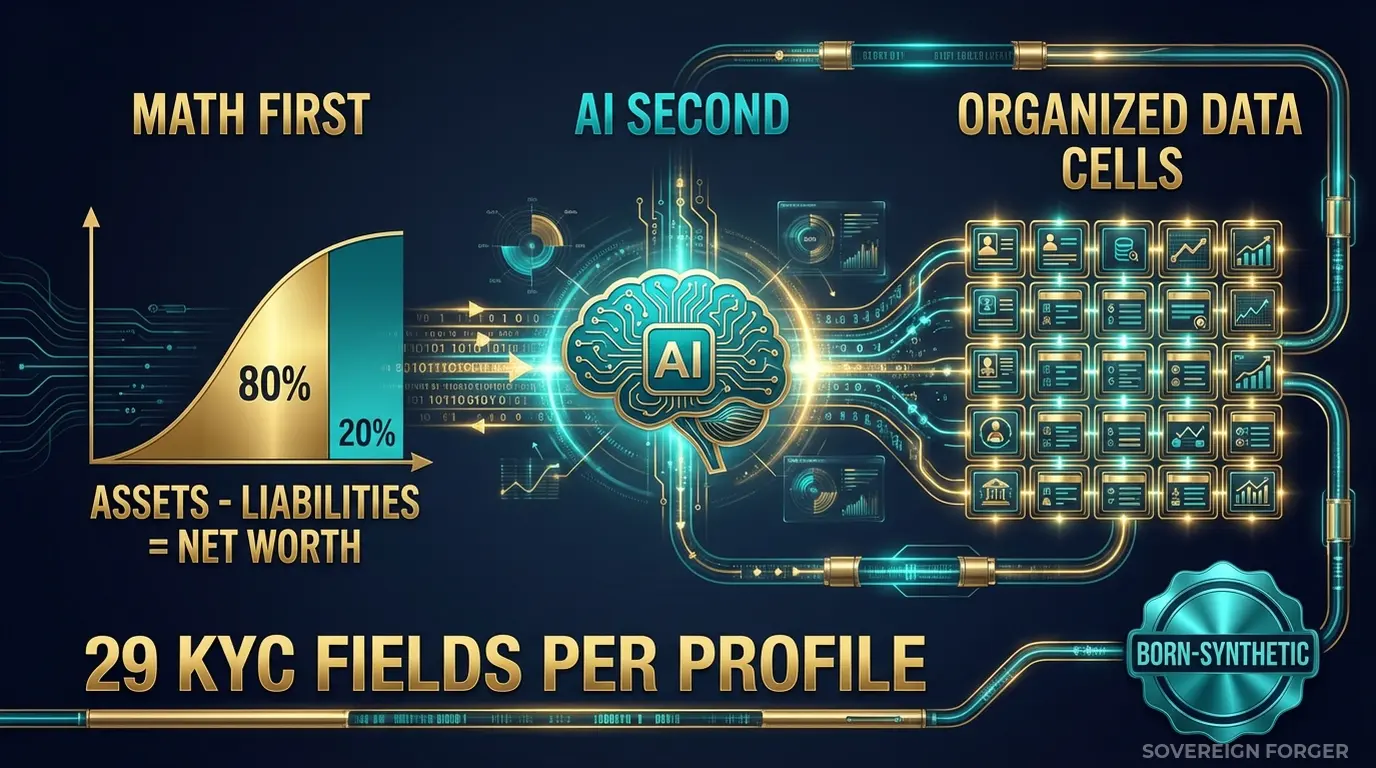
I built Sovereign Forger’s KYC-Enhanced profiles specifically for the kind of simulation that insurance onboarding requires — not just identity verification, but the full workflow: initial data capture, risk scoring, PEP screening, source-of-wealth assessment, jurisdiction analysis, and the decision tree that determines whether a client proceeds to standard onboarding or gets escalated to Enhanced Due Diligence.
Every profile in the dataset is generated from mathematical constraints — not derived from any real person. The generation pipeline works in two stages:
Math First. Net worth follows a Pareto distribution — the way real wealth is actually distributed, not a bell curve. Asset allocations are computed within algebraic constraints: Assets – Liabilities = Net Worth, by construction. Every balance sheet balances on every record. Zero exceptions. This matters for insurance onboarding because premium affordability checks, source-of-wealth verification, and risk scoring all depend on coherent financial profiles. If the numbers do not add up internally, your simulation is testing against impossible clients.
AI Second. A local AI model adds narrative context — biography, profession, philanthropic focus — after the financial figures are locked. The AI never touches the numbers. It enriches the profile with culturally coherent details that match the geographic niche and wealth tier. A Swiss private banker gets a different biography, education path, and philanthropic pattern than a LatAm agribusiness baron — because the underlying wealth structures are fundamentally different, and your onboarding system needs to encounter both.
29 Fields That Map to the Insurance Onboarding Workflow
Every KYC-Enhanced profile includes the fields your onboarding pipeline actually processes at each stage:
Initial Data Capture: full_name, residence_city, residence_zone, tax_domicile, profession, education — the fields your application form collects and your system validates.
Identity & Risk Scoring: kyc_risk_rating, pep_status, pep_position, pep_jurisdiction — the signals that determine whether a client triggers standard or enhanced due diligence. A profile with `pep_status: foreign` and `kyc_risk_rating: high` should route differently through your onboarding than one with `pep_status: none` and `kyc_risk_rating: low`. If your simulation data only contains the second type, you have never tested the first path.
Source of Wealth Assessment: net_worth_usd, total_assets, total_liabilities, property_value, core_equity, cash_liquidity, assets_composition, liabilities_composition, source_of_wealth_verified, sow_verification_method — the fields that determine whether the premium source is documentable and whether the wealth composition is consistent with the stated profession.
Offshore & Jurisdiction Analysis: offshore_jurisdiction, offshore_vehicle, high_risk_jurisdiction_flag — the fields that trigger additional scrutiny under EIOPA guidelines. A client with offshore vehicles in the BVI and a tax domicile in a jurisdiction flagged by FATF requires a different onboarding path than a domestic client. Your simulation must include both.
Sanctions & Adverse Media: sanctions_screening_result, sanctions_match_confidence, adverse_media_flag — the fields that can halt onboarding entirely or trigger manual review. Every KYC field is deterministically derived from the profile’s archetype, niche, net worth, and jurisdiction — not randomly assigned. A sovereign family member in the Middle East gets different PEP signals than a tech founder in Silicon Valley, because the underlying risk profiles are structurally different.
What This Means for Your Simulation
When you feed these profiles into your onboarding workflow, some will sail through in minutes. Others will trigger EDD. Some will flag sanctions partial matches that require manual review. A few will present source-of-wealth documentation gaps that your workflow must handle gracefully — or fail visibly.
That is the point. Your simulation should surface the failures before production does.
Built for Insurance Onboarding Simulation at Scale
6 Geographic Niches: Silicon Valley, Old Money Europe, Middle East, LatAm, Pacific Rim, Swiss-Singapore — each with culturally coherent wealth patterns and jurisdiction-specific risk profiles. A life insurance onboarding simulation for a global insurer needs clients from all six.
31 Wealth Archetypes: Tech founders, private bankers, commodity traders, family office managers, sovereign family members, real estate developers — the actual client profiles that purchase high-value life insurance, premium financing arrangements, and investment-linked policies. These are the profiles that trigger Enhanced Due Diligence in production.
KYC Signal Distribution: Risk ratings, PEP statuses, sanctions screening results, and source-of-wealth verification methods distributed with realistic frequencies by niche. Middle East profiles have higher PEP rates (~29%) because sovereign and government-adjacent families are a larger proportion of the UHNWI population. LatAm profiles have higher risk ratings (~84% high-risk) because of jurisdiction exposure. Your simulation encounters the same distribution your production system will face.
Deterministic Consistency: Every field derives from the profile’s archetype and niche via SHA-256 hash — same UUID always produces same KYC signals. This means your simulation results are reproducible. Run it today, run it next quarter with the same data, get the same results. Essential for audit trails and regression testing.
Pricing
| Tier | Records | Price | Best For |
|---|---|---|---|
| Compliance Starter | 1,000 | $999 | Single onboarding workflow test |
| Compliance Pro | 10,000 | $4,999 | Full regression suite across niches |
| Compliance Enterprise | 100,000 | $24,999 | Enterprise simulation + AI model training |
No SDK. No API key. No sales call. Download a file, open it in Python or Excel, and feed it into your onboarding pipeline.
Why This Matters Now for Insurance
EIOPA is closing the gap. The European Insurance and Occupational Pensions Authority has made AML/CFT supervision of insurance a strategic priority. Their 2025 supervisory convergence plan explicitly targets life insurance products and premium financing as high-risk channels. National competent authorities — BaFin, ACPR, the FCA, IVASS — are conducting thematic reviews of insurance AML controls. The question is not whether your onboarding will be audited. It is when.
The fines are crossing into insurance. AXA received a €2.3M fine from CNIL for data protection failures. Lloyd’s has faced repeated enforcement actions. Generali has been subject to regulatory orders across multiple jurisdictions. The EU’s Anti-Money Laundering Authority (AMLA), operational from 2025, will have direct supervisory powers over financial institutions including insurers designated as high-risk. The pattern from banking — where fines escalated from millions to hundreds of millions over five years — is beginning to repeat in insurance.
Life insurance is a documented money laundering channel. Single-premium policies, early surrenders, premium financing through opaque structures, and beneficiary changes are all recognized typologies in FATF guidance. Regulators expect insurers to simulate these scenarios during onboarding testing. If your simulation data cannot produce a client who funds a €2M single premium through an offshore vehicle with a PEP family connection, you cannot demonstrate that your controls work.
The balance sheet test is open source. Every Sovereign Forger record passes algebraic validation: Assets – Liabilities = Net Worth. Run the Balance Sheet Test on our data, then run it on your current simulation data. The difference is measurable. Internally consistent financial profiles are the minimum requirement for a credible onboarding simulation.
Every dataset ships with a Certificate of Sovereign Origin — documenting the born-synthetic methodology, zero PII lineage, and regulatory alignment. When your compliance officer or external auditor asks “where did the simulation data come from?”, you hand them the certificate. Born-Synthetic data. Zero real PII. Compliant by construction — not by anonymization.
Simulate Realistic Client Onboarding
Download 100 free KYC-Enhanced UHNWI profiles. Run the full onboarding simulation — from initial data capture through KYC checks, risk scoring, and EDD triggers. Count how many profiles route to Enhanced Due Diligence, how many trigger sanctions partial matches, and how many expose source-of-wealth documentation gaps.
Then compare that to what your current simulation data produces. The difference is the size of your onboarding blind spot — and the gap a regulator will find during their next thematic review.
No credit card. No sales call. Just your work email.
Related reading: DORA Synthetic Data Requirements for Resilience Testing — how DORA Article 24-25 mandates synthetic data for threat-led penetration testing.
Frequently Asked Questions
What gaps does synthetic onboarding simulation data reveal in insurance KYC workflows?
Most insurance onboarding flows are optimized for the happy path — domestic clients with simple financial profiles. Sovereign Forger synthetic profiles expose gaps in handling UHNWI applicants with multi-jurisdictional tax domiciles, offshore trust structures, PEP status requiring enhanced due diligence, and wealth sources that span multiple asset classes. These are the profiles most likely to trigger regulatory action if mishandled, and the ones least represented in standard test datasets.
How does born-synthetic onboarding data help insurers comply with the EU AI Act Art.10 training data requirements?
The EU AI Act, fully enforceable from August 2026, requires documented governance over training and testing data for AI systems used in financial services. Art.10 mandates that training datasets be relevant, representative, and free of errors. Born-synthetic data from Sovereign Forger satisfies these requirements by construction — every profile is mathematically balanced, culturally representative across six niches, and carries a Certificate of Sovereign Origin documenting its provenance. No real person’s data enters the pipeline.
Can synthetic profiles simulate the full insurance onboarding journey including document verification steps?
Sovereign Forger profiles include 29 fields that map to standard KYC document verification checkpoints — identity verification (name, residence, tax domicile), wealth verification (source of wealth method, asset composition), risk assessment (KYC risk rating, PEP status, sanctions screening), and compliance flags (high-risk jurisdiction, adverse media). This allows QA teams to simulate complete onboarding workflows from initial application through enhanced due diligence without using any real applicant data.
How many synthetic profiles does an insurance onboarding simulation typically require?
For regression testing individual workflow changes, 1,000 profiles (Compliance Starter at $999) cover all major archetypes and edge cases. For comprehensive onboarding simulation including load testing and concurrent processing validation, 10,000 profiles (Compliance Pro at $4,999) provide statistical depth across all six geographic niches. Enterprise programs running continuous integration with onboarding pipeline changes typically maintain 100,000 profiles per niche for maximum coverage.
Does using synthetic data for onboarding simulation satisfy Solvency II risk management requirements?
Solvency II requires insurers to maintain robust risk management systems, including the ability to test operational processes against realistic scenarios. Using production policyholder data in test environments creates a secondary compliance risk under GDPR. Sovereign Forger synthetic profiles allow insurers to satisfy both requirements simultaneously — realistic test scenarios for Solvency II, zero personal data exposure for GDPR — without the operational overhead of data anonymization pipelines that introduce re-identification risk.
Learn more about insurance onboarding test synthetic data and how Born Synthetic data addresses this in our glossary and comparison guides.