
AXA: €2.3M. Lloyd’s: multiple enforcement actions. Generali: regulatory remediation orders. Insurance is no longer exempt from banking-grade AML scrutiny — and every one of these enforcement actions traces back to KYC systems that were never tested against the clients who actually trigger failures.
Insurance KYC Was Built for a World That No Longer Exists
I have spent years watching the insurance sector operate under a comfortable assumption: that KYC and AML are banking problems. Life insurance, property coverage, reinsurance — these were products, not financial instruments. Regulators focused on banks. Insurers ran lighter compliance programs. And for a long time, nobody noticed.
That era is over.
EIOPA’s guidelines on AML/CFT supervision now explicitly extend banking-grade KYC requirements to the insurance sector. National regulators across Europe — BaFin, ACPR, the FCA — are applying the same lens to insurance that they have applied to banking for the past decade. The Fifth Anti-Money Laundering Directive made it explicit: life insurance, premium financing, and high-value policies are money laundering vehicles, and the companies that sell them are obligated entities with the same duties as banks.
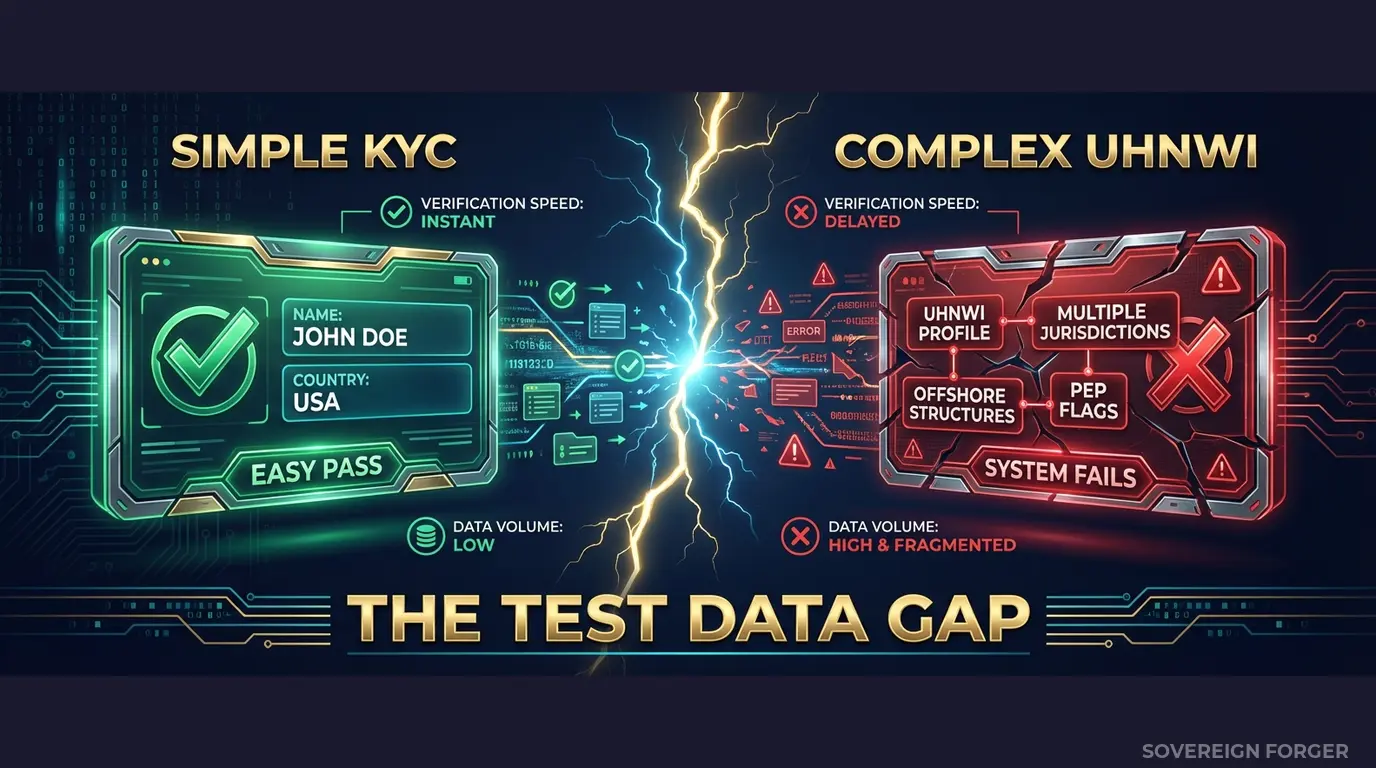
Here is what I have watched happen, repeatedly. An insurer’s compliance team builds a KYC onboarding system. They test it with synthetic profiles — simple ones. A business owner in Munich with a single property and a straightforward income source. A retiree in London with a pension and a savings account. Every profile clears onboarding. Every test passes. The system gets signed off.
Then a real UHNWI client applies for a €5M single-premium life insurance policy. The source of wealth traces through a Liechtenstein foundation that holds a BVI trust. The beneficial owner is a PEP’s spouse. The premium is funded by a wire from a Cayman Islands account held by a holding company registered in Delaware. The KYC system has never seen a structure like this — because the test data never contained one.
Three compliance rules fail simultaneously. The PEP screening misses the indirect connection. The source-of-wealth verification flags nothing because the system was never calibrated for multi-layered funding sources. The jurisdictional risk scoring treats Liechtenstein the same as Luxembourg because nobody tested the difference.
This is not a banking problem that happens to affect insurance. It is an insurance-specific problem. Life insurance policies are uniquely attractive for money laundering because they convert large lump sums into legitimate financial instruments with guaranteed payouts. Premium financing allows clients to move money through the insurance system with minimal scrutiny. And single-premium policies — particularly in the UHNWI segment — create exactly the kind of concentrated, high-value, cross-border transactions that AML systems are supposed to catch.
The regulatory math for insurers is identical to banking: if your KYC test data contains zero offshore structures, zero PEP-adjacent connections, and zero multi-jurisdictional wealth architectures, your system has never been tested against the policy applications that actually trigger Enhanced Due Diligence. EIOPA is watching. Your national regulator is watching. And the fines are no longer theoretical.
Three Approaches That Don’t Work for Insurance
Insurance compliance teams face the same test data problem as banks — but with an additional complication. The insurance sector has less mature data infrastructure for compliance testing, fewer off-the-shelf solutions designed for insurance-specific KYC, and a legacy assumption that lighter-touch compliance was acceptable. This means the workarounds are even more fragile.
Using copies of policyholder data. Some teams extract real client records into test environments — policy applications, source-of-wealth documentation, beneficiary declarations. This creates an immediate GDPR Article 25 violation: personal data in environments with weaker access controls, broader team access, and often insufficient logging. For insurers handling UHNWI clients, the risk is amplified — a single leaked record containing net worth, offshore structures, and beneficiary information is a privacy catastrophe. The August 2026 EU AI Act enforcement adds another layer: if your AI-driven underwriting or risk models train on this data, Article 10 requires documented governance of training data provenance.
Using anonymized policyholder data. Removing names and policy numbers from real UHNWI insurance records does not eliminate re-identification risk. With only 265,000 UHNWIs globally, the combination of premium amount, policy type, jurisdiction, and wealth structure can uniquely identify individuals even without direct identifiers. A regulator — or a plaintiff’s attorney — can argue that your “anonymized” data is merely pseudonymized, and GDPR applies in full. For life insurance records specifically, the combination of age, policy value, and beneficiary structure makes re-identification even more straightforward.
Using generic synthetic generators. Platform-based generators produce flat profiles — single jurisdiction, simple income, no entity layering. They create what I call “retail insurance customers with bigger premiums.” Your KYC system trains on these profiles and learns that wealth is simple, source of funds is straightforward, and every client has one jurisdiction. Then a real UHNWI walks in with a premium funded through a trust cascade across three countries, and the system has no frame of reference.
Real Data vs. Anonymized vs. Born-Synthetic
| Dimension | Real Data | Anonymized | Born-Synthetic |
|---|---|---|---|
| PII present | Yes | Residual | None |
| Re-identification risk | Certain | Probable (UHNWI) | Impossible |
| GDPR Art. 25 compliant | No | Disputed | Yes |
| EU AI Act Art. 10 | Violation | Unclear | Compliant |
| Certifiable for auditors | No | No | Yes (Certificate of Origin) |
| Fine exposure | Up to 4% global revenue | Up to 4% global revenue | Zero |
Born-Synthetic KYC Data Built for Insurance Compliance Testing

Every profile in the Sovereign Forger KYC dataset is generated from mathematical constraints — not derived from any real policyholder or applicant. There is zero lineage to any real person, anywhere. The generation pipeline works in two stages:
Math First. Net worth follows a Pareto distribution — the way real wealth is actually distributed, not a bell curve. Asset allocations are computed within algebraic constraints: Assets – Liabilities = Net Worth, by construction. Property values, equity holdings, cash liquidity, offshore vehicle allocations — all computed so that every balance sheet balances on every record. Zero exceptions. This matters for insurance because your underwriting and risk models need to see realistic wealth composition, not random numbers that happen to sum correctly.
AI Second. A local AI model running entirely offline adds narrative context — biography, profession, philanthropic focus — after the financial figures are locked. The AI never touches the numbers. It enriches the profile with culturally coherent details that match the geographic niche and wealth tier. A Swiss private banker gets a different narrative than a LatAm agribusiness dynasty, because their wealth structures, offshore preferences, and compliance profiles are structurally different.
The result: profiles that look and behave like the UHNWI clients whose policy applications actually stress-test your KYC pipeline. Multi-jurisdictional. Offshore-exposed. PEP-adjacent. With source-of-wealth patterns that require genuine Enhanced Due Diligence — not a rubber stamp.
29 Fields Designed for Insurance KYC/AML Systems
Every KYC-Enhanced profile includes the fields your onboarding and underwriting pipeline actually needs to process:
Identity & Geography: full_name, residence_city, residence_zone, tax_domicile
Wealth Structure: net_worth_usd, total_assets, total_liabilities, property_value, core_equity, cash_liquidity, assets_composition, liabilities_composition
Professional Context: profession, education, narrative_bio, philanthropic_focus
Offshore Exposure: offshore_jurisdiction, offshore_vehicle
KYC Signals: kyc_risk_rating, pep_status, pep_position, pep_jurisdiction, sanctions_screening_result, sanctions_match_confidence, adverse_media_flag, source_of_wealth_verified, sow_verification_method, high_risk_jurisdiction_flag
Every KYC field is deterministically derived from the profile’s archetype, niche, net worth, and jurisdiction — not randomly assigned. A Middle Eastern sovereign family member applying for a high-value life policy gets different risk signals than a Silicon Valley tech founder buying key-person insurance, because the underlying wealth structures, PEP exposure, and jurisdictional risk profiles are fundamentally different.
For insurance compliance specifically, this means your KYC system encounters the same structural complexity it will face in production: clients with offshore vehicles in the Cayman Islands, PEP connections through government roles in high-risk jurisdictions, source-of-wealth chains that trace through multiple entities, and net worth concentrations that demand Enhanced Due Diligence. If your system handles these profiles correctly in testing, it will handle them correctly when a real policyholder walks in.
Built for Insurance KYC Testing at Scale
6 Geographic Niches: Silicon Valley, Old Money Europe, Middle East, LatAm, Pacific Rim, Swiss-Singapore — each with culturally coherent wealth patterns that mirror the actual UHNWI client base of global insurance carriers. These are not localized templates — they are structurally distinct wealth architectures with different offshore preferences, asset compositions, and regulatory risk profiles.
31 Wealth Archetypes: Tech founders, private bankers, commodity traders, family office managers, real estate developers, sovereign family members — the actual client profiles whose life insurance, premium financing, and high-value policy applications trigger Enhanced Due Diligence in production. Each archetype carries distinct KYC signal patterns that test different branches of your compliance logic.
KYC Signal Distribution: Risk ratings, PEP statuses, sanctions screening results, and source-of-wealth verification methods distributed with realistic frequencies by niche. Middle Eastern profiles carry higher PEP density. LatAm profiles carry higher risk ratings. Swiss-Singapore profiles carry complex offshore structures. These distributions are not uniformly random — they reflect the structural patterns your system will encounter with real policyholders.
Pricing
| Tier | Records | Price | Best For |
|---|---|---|---|
| Compliance Starter | 1,000 | $999 | QA cycle, proof of concept |
| Compliance Pro | 10,000 | $4,999 | Full regression suite |
| Compliance Enterprise | 100,000 | $24,999 | AI training + production testing |
No SDK. No API key. No sales call. Download a file, open it in Python or Excel, and feed it into your KYC pipeline. Every dataset ships in JSONL and CSV format, ready for immediate ingestion.
Why This Matters Now for Insurance
Insurance is the next enforcement frontier. Regulators have spent the last decade tightening AML controls on banks. Now they are turning to insurance. EIOPA’s AML/CFT guidelines explicitly extend banking-grade KYC requirements to the insurance sector. The Fifth Anti-Money Laundering Directive classifies life insurance companies as obligated entities. National regulators — BaFin, ACPR, the FCA — are staffing up insurance-specific AML supervision teams. The enforcement wave that hit neobanks in 2023-2025 is heading for insurers in 2026-2027.
The fines are already starting. AXA received a €2.3M fine from CNIL for data protection violations. Lloyd’s has faced multiple enforcement actions related to financial crime controls. Generali has been subject to regulatory remediation orders. These are early signals — the equivalent of where neobank enforcement was in 2021, before Starling’s £29M and Monzo’s £21M penalties. The trajectory is clear, and the insurers who invest in compliance infrastructure now will be the ones who avoid eight-figure fines later.
The EU AI Act changes everything for insurance AI. The EU AI Act becomes fully applicable in August 2026. Insurance risk assessment and underwriting AI falls under high-risk classification in Annex III. Article 10 requires documented governance of training data — including provenance, bias assessment, and GDPR compliance. If your underwriting models or KYC automation train on real or anonymized policyholder data, you need to prove compliance on both GDPR and AI Act simultaneously. Born-Synthetic data eliminates this dual compliance burden entirely.
The balance sheet test is open source. Every Sovereign Forger record passes algebraic validation: Assets – Liabilities = Net Worth. Run the Balance Sheet Test on our data, then run it on your current test data. The difference is measurable — and it tells you exactly how much structural integrity your current test data is missing.
Every dataset ships with a Certificate of Sovereign Origin — documenting the born-synthetic methodology, zero PII lineage, and regulatory alignment. When your compliance officer, internal auditor, or regulator asks “where did you get this test data and can you prove it contains no real person’s information?”, you hand them the certificate. It documents what the data is, how it was generated, and why it is compliant by construction — not by anonymization.
Test Your KYC Pipeline Today
Download 100 free KYC-Enhanced UHNWI profiles. Run them through your insurance onboarding flow. Count how many trigger alerts, edge cases, or failures that your current test data never generated.
That number is the size of your compliance blind spot — and it is the gap that regulators will find when they audit your AML controls.
No credit card. No sales call. Just your work email.
Related reading: DORA Synthetic Data Requirements for Resilience Testing — how DORA Article 24-25 mandates synthetic data for threat-led penetration testing.
Frequently Asked Questions
How does synthetic KYC data help insurers avoid regulatory fines during system testing?
Insurers testing KYC verification pipelines against real policyholder data risk GDPR Art.83 penalties of up to 4% of global turnover and EIOPA governance breaches. Sovereign Forger synthetic KYC profiles cover all 29 required fields — risk ratings, PEP status, sanctions screening results, and source of wealth — enabling full end-to-end testing without exposing regulated personal data. This satisfies DORA Art.24-25 resilience testing requirements while keeping compliance teams confident that no real customer data leaves the secure environment.
Can synthetic KYC profiles realistically stress-test sanctions screening logic for high-risk insurance applicants?
Yes. Sovereign Forger generates statistically realistic distributions of PEP-flagged profiles, OFAC and EU consolidated sanctions hits, and elevated risk ratings across the full 29-field KYC schema. Insurers can configure edge-case volumes — for example, 15% PEP exposure or 8% sanctions matches — to validate alert thresholds and triage workflows under Solvency II risk management requirements, without any operational dependency on live data or cooperation from a data protection officer.
How does synthetic KYC testing support DORA compliance for insurance undertakings in 2025?
DORA, in force January 2025, requires insurance undertakings under EIOPA supervision to conduct regular ICT resilience testing, including systems that process identity and financial crime data. Art.24-25 explicitly anticipates synthetic data for threat-led penetration and functional testing. Running KYC verification systems against Sovereign Forger profiles — with interlocked fields for source of wealth, document validity, and sanctions status — satisfies this mandate without creating a secondary processing risk that would itself require a fresh DPIA under GDPR Art.25.
What does born-synthetic mean and why does it matter specifically for Insurance KYC testing?
Born-synthetic means every KYC profile is generated entirely from mathematical distributions, including Pareto-based wealth curves, with zero lineage to any real person. No real policyholder record was anonymised, pseudonymised, or re-sampled to produce the output. For insurance KYC testing this matters because pseudonymised data retains re-identification risk and still triggers GDPR obligations. Born-synthetic data is GDPR Art.25 compliant by construction — privacy is engineered in at the point of creation — removing the legal uncertainty that blocks test environment approvals under Solvency II governance frameworks.
How can an insurance compliance team get started testing KYC systems with synthetic data today?
Sovereign Forger provides 100 free synthetic KYC profiles available for instant download via work email with no credit card required. Each profile contains 29 interlocked fields covering risk ratings, PEP status, sanctions screening results, and source of wealth verification — the full field set needed to exercise a production-grade KYC pipeline. The profiles are structurally coherent across all fields, meaning dependent values such as risk score and source of wealth category are internally consistent, allowing realistic integration testing from day one.
Learn more about insurance KYC test data synthetic and how Born Synthetic data addresses this in our glossary and comparison guides.