
AXA: €2.3M from CNIL. Lloyd’s: repeated enforcement actions. Generali, Zurich, Allianz — all under intensifying AML scrutiny. The insurance sector built its compliance systems for fraud detection, not for anti-money laundering. Now regulators are applying banking-grade AML standards to insurers, and every model trained on structurally flat data is a liability waiting to surface.
Your AML Model Was Trained on the Wrong Data
I spent years watching financial institutions build AML systems. Banks got there first — painfully, expensively, but they got there. Insurance companies are still at the starting line, and most do not realize it yet.
Here is what I have seen happen, repeatedly: an insurer builds an AML detection model. The data science team trains it on internal policy data — straightforward life insurance contracts, annuity purchases, standard premium payments. The model learns that insurance transactions are simple. Single policyholder, single beneficiary, domestic jurisdiction, regular premium schedule. It learns to flag obvious anomalies: unusually large single-premium payments, rapid policy surrenders, mismatches between declared income and coverage amounts.
Then the model encounters a real UHNWI client. A $15M whole life policy with a Liechtenstein trust as the beneficiary. Premium financing through a Cayman-domiciled SPV. The policyholder is a dual-national with tax residency in a third country and a family member who held a government position in a fourth. The policy includes a cross-border assignment clause linked to a private placement life insurance structure.
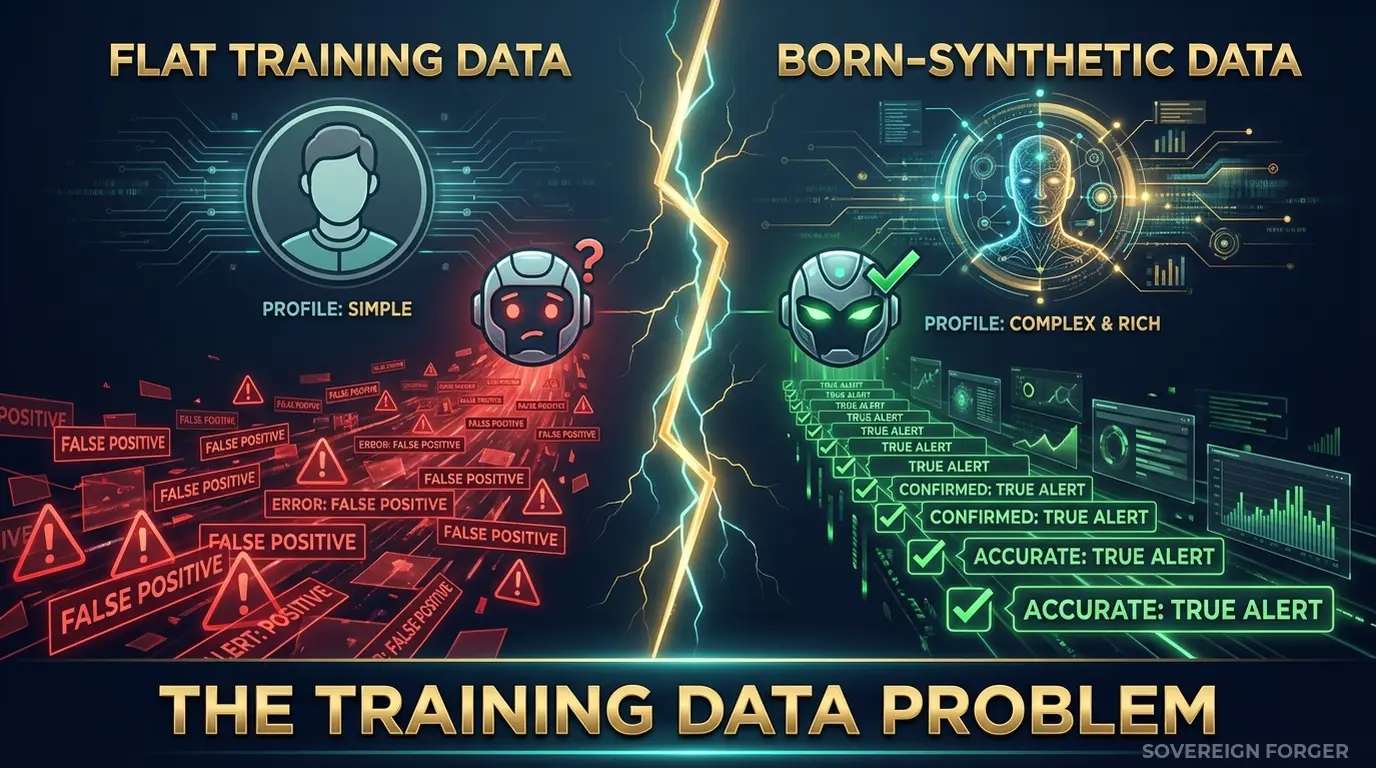
The AML model has never seen anything like this. It has two options, and both are wrong. It flags the entire profile as suspicious — because every structural element deviates from the simple patterns it learned — generating a false positive that consumes hours of analyst time. Or it misses the genuine risk signals buried within the structural complexity, because it cannot distinguish between “legitimately complex wealth” and “complexity designed to obscure illicit flows.”
This is the core failure mode I see across the insurance sector. It is not that the AML models are poorly built. It is that they were trained on data that does not contain the structural complexity of the clients who actually trigger regulatory scrutiny.
The insurance-specific problem is worse than banking. Banks have spent two decades building AML infrastructure. Insurance companies are being asked to reach the same standard in two years. EIOPA’s guidelines on AML/CFT supervision now explicitly require insurers to apply risk-based due diligence at the same level as credit institutions. National regulators — BaFin, ACPR, the FCA — are following suit. The Fifth Anti-Money Laundering Directive already brought life insurance firmly within scope. The Sixth is extending it further.
And the product structures make it harder, not easier. Life insurance policies are long-duration instruments — a money laundering scheme embedded in a 20-year whole life policy may not surface for years. Premium financing adds a layer of opacity that has no direct analogue in banking. Single-premium policies above €10,000 trigger CDD requirements, but the thresholds were designed for retail — a UHNWI purchasing a €5M policy through a corporate vehicle does not trigger the same retail-oriented flags.
The regulatory math: if your AML model was trained on data that contains zero trust beneficiaries, zero offshore premium financing structures, zero PEP-adjacent policyholders, and zero cross-border assignment clauses, it has never learned to distinguish legitimate complexity from genuine laundering risk. You are not detecting money laundering — you are detecting deviation from simplicity. Those are not the same thing.
Three Approaches That Leave Your AML Model Blind
The insurance sector faces a specific challenge that makes the standard solutions even less adequate than they are in banking. Insurance AML is newer, less mature, and the product structures are fundamentally different from deposit accounts and wire transfers. Every workaround I have evaluated fails in the same way — it trains the model on data that does not reflect the complexity of the clients who actually matter.
Training on internal policy data. Most insurers start here. They extract policyholder records, premium histories, and claims data into a training set. The problem is twofold. First, this is real client data — personal data in a training environment creates an immediate GDPR Article 25 violation, and the August 2026 EU AI Act enforcement under Article 10 requires documented governance of all training data provenance. Second, and more fundamentally, your internal data reflects your current client base. If your onboarding has been filtering out complex UHNWI clients (because your existing KYC could not process them), your training data contains a survivorship bias. The model learns from the clients who got through, not from the clients who should have been flagged.
Training on anonymized policyholder data. Stripping names and policy numbers from UHNWI insurance clients does not eliminate re-identification risk. The global UHNWI population is approximately 265,000 people. When your training data contains a profile with a specific net worth tier, a Liechtenstein trust beneficiary structure, premium financing through a Cayman vehicle, and a philanthropic focus on marine conservation — that combination may describe exactly one person on earth. A regulator can argue, correctly, that your “anonymized” training data is pseudonymized at best, and GDPR applies in full. The fact that it is in a training pipeline rather than a test environment does not reduce your exposure — it may increase it under the AI Act.
Using generic synthetic data generators. I have evaluated every major platform — Mostly AI, Tonic, Syntho, Gretel. They are built for retail financial services. They generate policyholders with single jurisdictions, simple beneficiary structures, and regular premium schedules. They produce the insurance equivalent of a checking account holder with a bigger balance. Your AML model trains on these profiles and learns that insurance clients are structurally simple. Then a real client arrives with a private placement life insurance policy, three layers of corporate beneficiaries, and premium financing from an offshore jurisdiction — and the model has no training basis for evaluating whether this is legitimate wealth management or a laundering structure. It either flags everything or flags nothing. Both outcomes are regulatory failures.
Real Data vs. Anonymized vs. Born-Synthetic
| Dimension | Real Policyholder Data | Anonymized | Born-Synthetic |
|---|---|---|---|
| PII present | Yes | Residual | None |
| Re-identification risk | Certain | Probable (UHNWI) | Impossible |
| GDPR Art. 25 compliant | No | Disputed | Yes |
| EU AI Act Art. 10 | Violation | Unclear | Compliant |
| Certifiable for auditors | No | No | Yes (Certificate of Origin) |
| Structural complexity | Limited to current book | Limited to current book | Full UHNWI spectrum |
| Fine exposure | Up to 4% global revenue | Up to 4% global revenue | Zero |
Born-Synthetic AML Training Data Built for Insurance Compliance
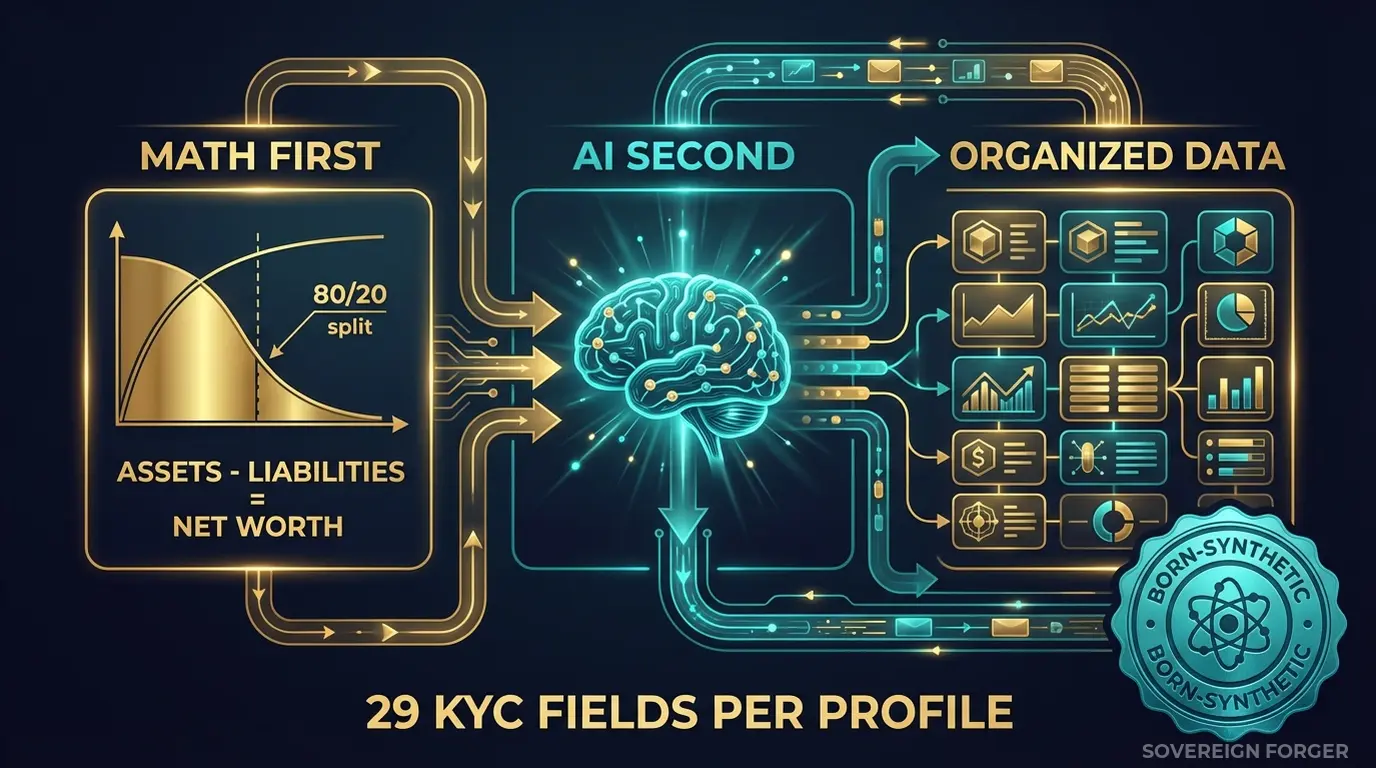
Every profile in the Sovereign Forger KYC dataset is generated from mathematical constraints — not derived from any real policyholder, not scraped from any client database, not anonymized from any source. There is no lineage to any real person. This is what Born-Synthetic means: compliant by construction, not by anonymization.
The generation pipeline I built works in two stages, and the sequence matters:
Math First. Net worth follows a Pareto distribution — because that is how real wealth is distributed. Not a bell curve, not a uniform distribution, not a random number generator with a floor and ceiling. A Pareto tail, calibrated to match the empirical distribution of UHNWI wealth globally. Asset allocations are computed within algebraic constraints: Assets minus Liabilities equals Net Worth, by construction. Property values, core equity, cash liquidity, offshore vehicle allocations — all interlocked mathematically. Every balance sheet balances on every record. Zero exceptions. This is not a claim — it is a verifiable property. Run the arithmetic on any record.
AI Second. After the financial figures are locked and immutable, a local AI model running entirely offline adds narrative context — biography, profession, philanthropic focus, education history. The AI never touches the numbers. It enriches the profile with culturally coherent details that match the geographic niche and wealth archetype. A Zurich-based private banker gets a different biography than a Singapore-based commodity trader, because the wealth structures and career trajectories are different.
Why This Matters for Insurance AML Training
The 29 fields in every KYC-Enhanced profile map directly to the risk factors your AML model needs to learn:
Identity & Geography: full_name, residence_city, residence_zone, tax_domicile — multiple jurisdictions per profile, because UHNWI clients do not live in one country. Your model learns to handle multi-jurisdictional identity from the first training batch.
Wealth Structure: net_worth_usd, total_assets, total_liabilities, property_value, core_equity, cash_liquidity, assets_composition, liabilities_composition — these are not flat numbers. The composition fields contain detailed breakdowns: real estate portfolios across countries, equity stakes in private companies, alternative investments. Your model learns the difference between a concentrated single-asset position (higher risk for premium financing) and a diversified multi-asset portfolio (different risk profile entirely).
Professional Context: profession, education, narrative_bio, philanthropic_focus — because source-of-wealth verification in insurance depends on understanding how the wealth was generated. A tech founder’s wealth trajectory looks different from a third-generation family office beneficiary’s. Your model needs both.
Offshore Exposure: offshore_jurisdiction, offshore_vehicle — the fields that matter most for insurance AML. Trust structures, foundation vehicles, SPVs in BVI, Cayman, Delaware, Luxembourg, Liechtenstein. When a policyholder names a Cayman LP as beneficiary of a $10M whole life policy, your AML model needs to have seen this pattern thousands of times in training — not for the first time in production.
KYC Signals: kyc_risk_rating, pep_status, pep_position, pep_jurisdiction, sanctions_screening_result, sanctions_match_confidence, adverse_media_flag, source_of_wealth_verified, sow_verification_method, high_risk_jurisdiction_flag — every field deterministically derived from the profile’s archetype, niche, net worth, and jurisdiction. A Middle Eastern sovereign family member gets different PEP signals than a Swiss private banker, because the underlying risk profiles are structurally different.
What your AML model learns from this data: the difference between structural complexity and genuine risk. A tech founder with $200M in net worth, offshore vehicles in Delaware and Cayman, and a clean sanctions screening result is a different risk profile than a PEP-adjacent individual with $50M, offshore vehicles in the same jurisdictions, and an adverse media flag. Both are complex. Only one is a genuine AML concern. Your model needs to learn this distinction from training data — not discover it the first time a real policyholder triggers an alert.
Built for Insurance AML at Scale
6 Geographic Niches: Silicon Valley, Old Money Europe, Middle East, LatAm, Pacific Rim, Swiss-Singapore — each with culturally coherent wealth patterns that reflect the actual UHNWI populations purchasing high-value insurance products across these regions.
31 Wealth Archetypes: Tech founders, private bankers, commodity traders, family office managers, real estate developers, sovereign family members, inheritance trustees — the actual policyholder profiles your AML system encounters in production. Not “wealthy person variant A through D.”
Realistic KYC Signal Distribution: Risk ratings, PEP statuses, sanctions screening results, and source-of-wealth verification methods distributed with frequencies that vary by niche. The Middle East niche has higher PEP rates than Silicon Valley — because it reflects reality. LatAm has higher risk ratings — because the jurisdiction mix drives that outcome. Your AML model learns niche-specific baselines, not a uniform random distribution that teaches it nothing.
Deterministic Reproducibility: Every KYC field is derived from a SHA-256 hash of the profile UUID. Same input, same output, every time. This means your model training is reproducible — a requirement under EU AI Act Article 10 for documented governance of training data.
Pricing
| Tier | Records | Price | Best For |
|---|---|---|---|
| Compliance Starter | 1,000 | $999 | AML model proof of concept, initial training |
| Compliance Pro | 10,000 | $4,999 | Full model training + validation split |
| Compliance Enterprise | 100,000 | $24,999 | Production-scale AML training + stress testing |
No SDK. No API key. No platform subscription. No sales call. Download JSONL and CSV files, load them into your training pipeline, and start training. If you use Python, you can have data flowing into your model in five minutes.
Why This Matters Now for Insurers
Insurance is the next enforcement frontier. Banking AML infrastructure took two decades to mature. Regulators are not giving insurers the same runway. EIOPA’s guidelines on AML/CFT supervision already require risk-based due diligence equivalent to banking standards. The Fifth Anti-Money Laundering Directive brought life insurance fully within scope. National regulators are moving even faster — BaFin fined insurance intermediaries in 2024 for inadequate AML controls. The FCA has signaled that insurance-specific AML reviews are in its 2026-2027 enforcement pipeline. ACPR in France has already demonstrated willingness to pursue insurers directly, as the AXA €2.3M fine from CNIL showed that data governance failures in insurance carry real financial consequences.
The product structures are AML vulnerabilities. Single-premium life insurance above €10,000 triggers CDD — but the thresholds were designed for retail. Premium financing through corporate vehicles adds opacity that simple transaction monitoring cannot penetrate. Policy surrenders within the free-look period can function as a laundering mechanism. Cross-border assignment clauses allow beneficial ownership to shift jurisdictions without triggering the same alerts as a wire transfer. Your AML model needs to have seen all of these patterns in training to recognize them in production.
The EU AI Act makes training data governance mandatory. Starting August 2026, financial AI is classified as high-risk under Annex III. Article 10 requires documented governance of training data — including provenance, bias assessment, and GDPR compliance proof. If your AML model trains on real or anonymized policyholder data, you need to demonstrate compliance with both GDPR and the AI Act simultaneously. Born-Synthetic data eliminates this entire compliance surface: zero PII by construction, documented provenance via the Certificate of Sovereign Origin, and deterministic reproducibility for audit purposes.
The balance sheet test is open source. Every Sovereign Forger record passes algebraic validation: Assets minus Liabilities equals Net Worth. Run the Balance Sheet Test on our data, then run it on whatever training data your AML model currently uses. If the current data fails basic algebraic consistency, your model learned from financially incoherent profiles. That is not a training dataset — it is noise.
Every dataset ships with a Certificate of Sovereign Origin — documenting the born-synthetic methodology, zero PII lineage, and regulatory alignment with GDPR Article 25 and EU AI Act Article 10. When EIOPA, BaFin, or the FCA asks your compliance team “what data did you train your AML model on?”, you hand them the certificate. That question becomes a non-event instead of a crisis.
Train Your AML Model on Data That Reflects Reality
Download 100 free KYC-Enhanced UHNWI profiles. Feed them into your AML pipeline. Check whether your model can distinguish structural complexity from genuine risk signals — multi-jurisdictional identities, offshore beneficiary structures, PEP-adjacent connections, high-risk jurisdiction flags.
If your current training data does not contain these patterns, your model has never learned to evaluate them. That gap is not a technical limitation — it is an enforcement risk.
No credit card. No sales call. Just your work email.
Related reading: DORA Synthetic Data Requirements for Resilience Testing — how DORA Article 24-25 mandates synthetic data for threat-led penetration testing.
Frequently Asked Questions
How does synthetic AML training data help insurance carriers detect suspicious activity in complex policy structures?
Insurance carriers face unique AML exposure through single-premium life policies, annuities, and premium financing arrangements that can conceal illicit funds. Sovereign Forger generates synthetic policyholder profiles embedding offshore beneficial ownership chains, cross-border premium flows, and layering indicators calibrated to real-world typologies. Models trained on this data learn to flag structuring patterns across 29 interlocked fields without ever touching live customer records, directly supporting the risk management governance requirements under Solvency II Pillar II and EIOPA guidelines on internal control frameworks.
Which AML red flags specific to insurance underwriting are represented in the synthetic training profiles?
The synthetic profiles include indicators specific to insurance sector exposure: round-dollar premium payments inconsistent with declared income, frequent policy surrenders shortly after inception, third-party premium payers with no insurable interest, PEP status combined with high-value whole-life products, and source-of-wealth declarations that conflict with cross-border transaction patterns. Each profile interlocks risk rating, sanctions screening status, and beneficial ownership depth across shell jurisdictions, giving AML detection models the adversarial diversity needed to reduce false-negative rates in production underwriting pipelines.
How does synthetic AML training data support DORA compliance for insurance firms conducting resilience testing?
DORA, in force January 2025, requires insurance entities under Art.24-25 to conduct ICT risk and resilience testing without exposing live operational data. Sovereign Forger synthetic AML profiles provide statistically realistic financial crime scenarios — including stress-case offshore structures and high-velocity cross-border flows — that can populate test environments at scale. This satisfies DORA resilience testing obligations while keeping the firm compliant with GDPR Art.25 data minimisation requirements and the EU AI Act Art.10 mandate for high-quality, representative training datasets in high-risk AI systems.
What does born-synthetic mean and why does it matter specifically for insurance AML model training?
Born-synthetic means the data was generated entirely from mathematical distributions — including Pareto-distributed wealth curves and stochastic transaction graphs — with zero lineage to any real person or live data source. No anonymisation, tokenisation, or masking of real records is involved. For insurance AML training this matters because re-identification risk is structurally impossible, making the data GDPR Art.25 compliant by construction rather than by process control. Regulators and internal audit functions can verify compliance without inspecting source data, reducing governance overhead while satisfying EU AI Act Art.10 training data quality requirements for high-risk models.
How can an insurance data science team get started with AML training data from Sovereign Forger?
Teams can download 100 free synthetic KYC profiles instantly with a work email address and no credit card required. Each profile contains 29 interlocked fields covering risk ratings, PEP status, sanctions screening results, source of wealth declarations, and beneficial ownership structures. The sample set is immediately usable for model prototyping, feature engineering benchmarks, or compliance demonstrations. Full production datasets scale to millions of profiles with configurable red-flag prevalence rates, offshore jurisdiction distributions, and cross-border transaction densities suited to insurance carrier AML programme requirements.
Learn more about insurance AML training data synthetic and how Born Synthetic data addresses this in our glossary and comparison guides.