
Born-synthetic data is financial profile data generated entirely from mathematical distributions, algebraic constraints, and domain-specific archetypes — without any real individual’s personal data as input at any stage of the process. Unlike anonymized or pseudonymized data, born-synthetic data has zero lineage to real persons. There is no original dataset to trace back to, no re-identification risk to mitigate, and no residual privacy exposure to manage. The data is compliant with GDPR Article 25, EU AI Act Article 10, and CCPA not because identifying information has been removed — but because no identifying information was ever involved. Born-synthetic data is compliant by construction, not by anonymization.
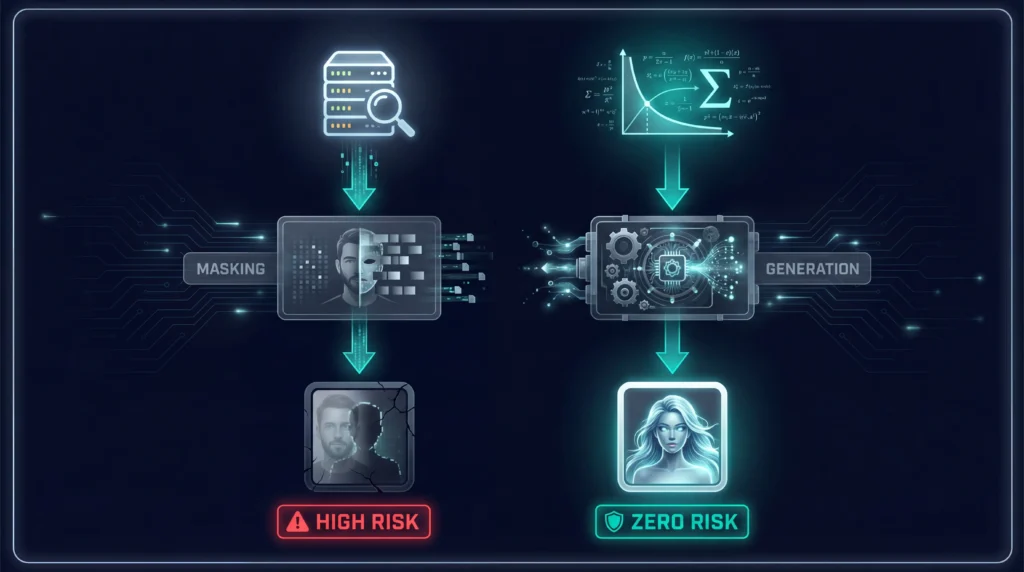
Step 1: Mathematical Foundation (Zero AI)
The generation process starts with pure mathematics. Net worth values are drawn from Pareto distributions calibrated to real-world wealth concentration patterns — not Gaussian bell curves that produce unrealistic uniform distributions. Once net worth is set, total assets and total liabilities are computed through algebraic constraints so that Assets minus Liabilities equals Net Worth for every single record, with zero exceptions. Asset composition is then allocated according to archetype-specific rules: a Silicon Valley tech founder has a fundamentally different portfolio structure than a Middle Eastern sovereign family member or a Swiss private banking client.
Step 2: AI Enrichment (Offline, Local)
Only after the financial figures are mathematically locked does a local, offline large language model add biographical context: professions, educational backgrounds, philanthropic interests, and narrative biographies. The AI never touches the numbers. It enriches the profile with human-readable context that makes the data useful for compliance testing and AI training — but the financial integrity established in Step 1 is never compromised.
Step 3: Integrity Audit
Every record passes an automated audit before delivery. The balance sheet test (Assets – Liabilities = Net Worth) is verified with zero tolerance. Ghost names, placeholder leaks, first-person voice artifacts, and character encoding issues are caught and eliminated. Only records that pass all checks are included in the final dataset.

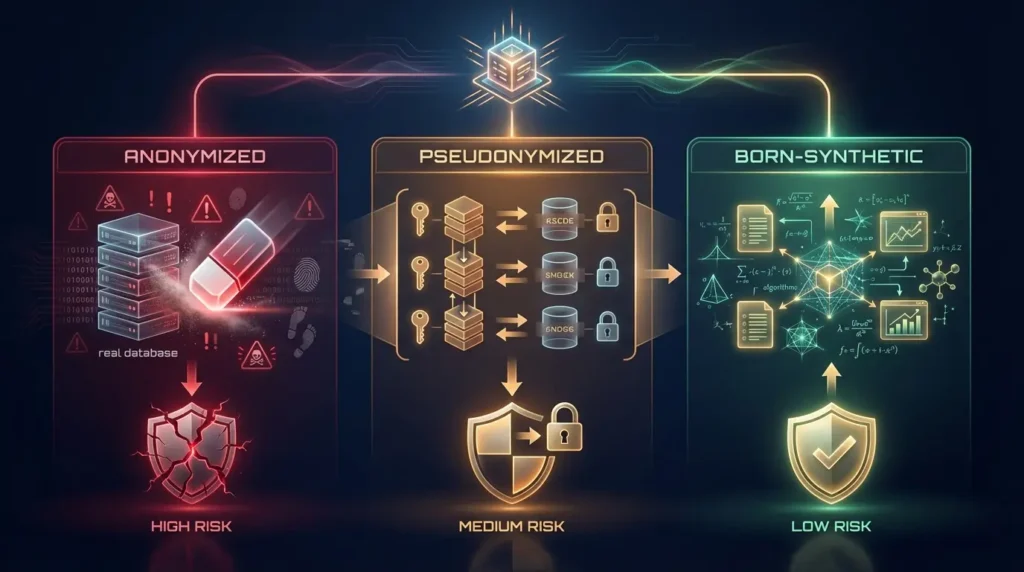
| Criterion | Anonymized | Pseudonymized | Born-Synthetic |
|---|---|---|---|
| Requires real data as input | Yes | Yes | No |
| GDPR personal data | Possibly | Yes | No |
| Re-identification risk | High | Medium | Zero |
| Lineage to real persons | Direct | Direct | None |
| EU AI Act Art. 10 compliant | Partial | Partial | Full |
| DORA resilience testing | Risk of breach | Risk of breach | Safe |
| PCI DSS 4.0 compliant | No | No | Yes |
| Balance sheet integrity | Destroyed | Destroyed | 100% verified |
GDPR Article 25 — Data Protection by Design
Article 25 requires data protection to be built into systems from the start — not bolted on after the fact. Using real customer data in test environments, even anonymized, creates a gap between the production safeguards and the test environment. Born-synthetic data closes that gap entirely: there is no personal data to protect because none was ever used. This is data protection by design in its purest form.
EU AI Act Article 10 — Training Data Governance
Article 10 mandates governance over training data including documentation of data sources, quality measures, and bias examination. Born-synthetic data provides a clean governance trail: every parameter is documented, every distribution is calibrated, and no real individual’s data enters the training pipeline. The EU AI Act becomes fully enforceable in August 2026 — organizations training AI models on financial data must demonstrate compliant data governance by then.
DORA — Digital Operational Resilience Act
DORA explicitly mentions synthetic data as a tool for threat-led penetration testing (TLPT) under Articles 24-25. Financial institutions in the EU must conduct resilience testing with data that reflects realistic scenarios without exposing real customer information. Born-synthetic profiles with offshore structures, multi-jurisdictional holdings, and complex ownership chains provide exactly the edge cases that resilience testing requires.
PCI DSS 4.0 — Payment Card Industry
PCI DSS 4.0 (Requirement 6.5.4) explicitly prohibits the use of real payment card data — including PANs — in test and development environments. Born-synthetic financial profiles eliminate this risk entirely: no real card numbers, no real account data, no real transaction histories are involved at any stage.

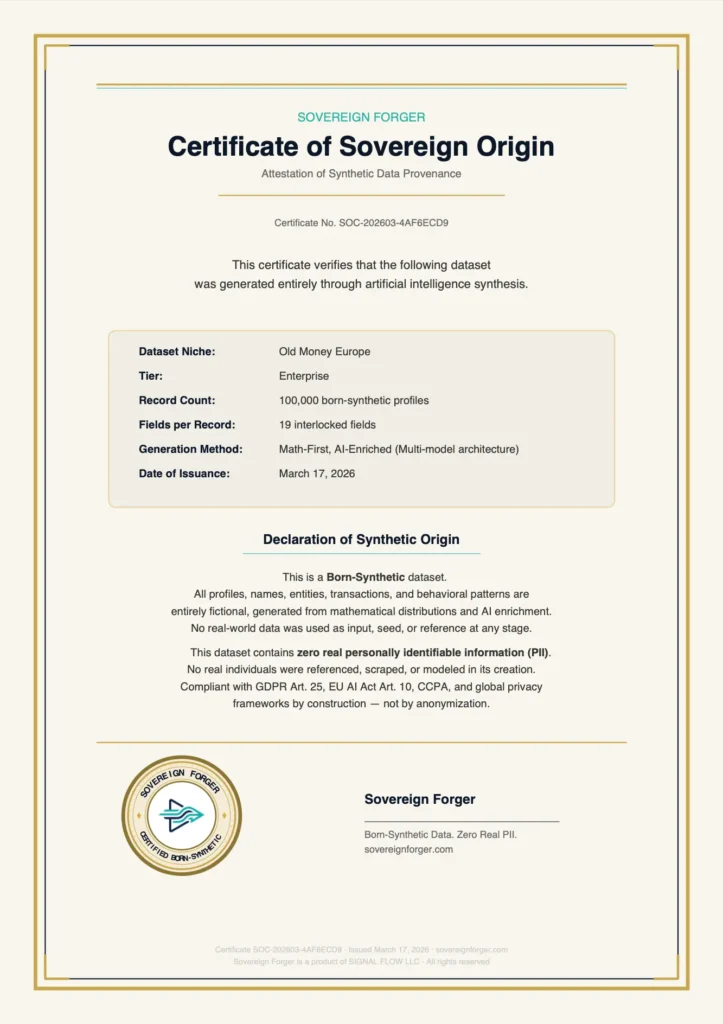
Certificate of Sovereign Origin
Every Sovereign Forger dataset ships with a Certificate of Sovereign Origin — a formal attestation documenting pipeline version, generation mode, Pareto parameters, geographic niche, record count, field schema, and DIAMOND Standard audit results. This is not a marketing badge. It is the audit trail your compliance officer will ask for.
DIAMOND Standard: 666,000 Records. Zero Errors.
Every record passes the DIAMOND Standard audit. The balance sheet test is absolute: Assets minus Liabilities must equal Net Worth, with zero tolerance. Across 666,000 records produced to date, the error count is zero. Ghost names, placeholder leaks, encoding issues, and schema violations are caught and rejected — they never reach the final dataset.
Verify It Yourself
You do not need to take our word for it. Download the free sample — 100 KYC-enhanced profiles with all 29 fields — and run your own checks:
For every record, verify that total_assets − total_liabilities = net_worth. Zero tolerance. Zero exceptions.
Search any name in the dataset against public records. You will find zero matches — because no real person was used as input.
Plot the net worth values. They follow a Pareto distribution — not a Gaussian bell curve. Real wealth patterns, synthetic identities.
The free sample ships with its own Certificate of Sovereign Origin — the same provenance document included with every paid dataset.
Compliance & Risk Teams
Enhanced due diligence systems need realistic UHNWI profiles to test against — not simplified QA records with $100K net worth and a single bank account. Born-synthetic profiles with offshore structures, PEP flags, and multi-jurisdictional holdings stress-test screening systems the way production traffic does.
Data Engineers & Platform Teams
Development and staging environments need data that behaves like production without carrying production risk. Born-synthetic datasets slot directly into existing pipelines as JSONL files with consistent schemas, deterministic UUIDs, and documented field relationships.
QA & Testing Teams
Test coverage gaps emerge when QA data does not represent the complexity of real-world clients. Born-synthetic profiles cover 31 archetypes across 6 geographic niches, ensuring edge cases that generic test data never reaches.
AI/ML Research Teams
Training data governance under the EU AI Act requires documented provenance, bias examination, and representativeness. Born-synthetic datasets arrive with a Certificate of Sovereign Origin documenting every generation parameter — ready for regulatory audit.

What does “born-synthetic” mean?
Born-synthetic data is generated entirely from mathematical distributions and cultural models — no real person’s data is used as input at any stage. Unlike anonymized or pseudonymized data, there is no original dataset to trace back to and no re-identification risk to manage.
Is born-synthetic data compliant with GDPR?
Yes. Because no personal data is processed at any stage of generation, born-synthetic data falls outside the scope of GDPR entirely. Compliance is achieved by construction, not by anonymization.
How is the data generated?
The pipeline follows a three-stage process: (1) mathematical foundation using Pareto distributions and algebraic constraints, (2) AI enrichment using a local, offline language model for biographical context, (3) integrity audit verifying every record passes the balance sheet test with zero tolerance.
Can I test the data before purchasing?
Yes. Download 100 free KYC-enhanced profiles with all 29 fields — including PEP flags, risk ratings, and sanctions screening results. No registration required.
What formats are available?
All datasets are delivered as JSONL files with consistent schemas and deterministic UUIDs. Each delivery includes a Certificate of Sovereign Origin documenting generation parameters and audit results.