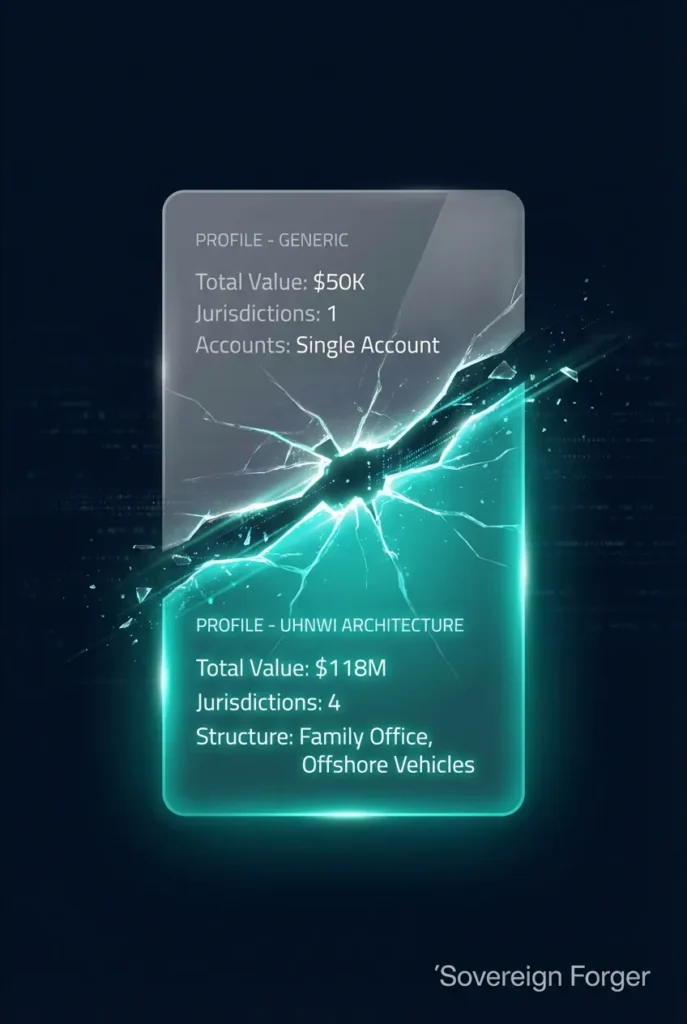
I found this in a competitor’s sample file: a tech founder in Palo Alto with generational inheritance wealth and a Swiss private bank as the primary custody relationship. The profession says Silicon Valley. The wealth origin says old European money. The custody arrangement says neither. It describes a person who has never existed.
This is what happens when synthetic data ignores cultural and geographic wealth patterns. The fields are individually plausible. Together, they describe a person who does not exist in any recognizable wealth ecosystem.
Wealth Is Not Geographically Neutral
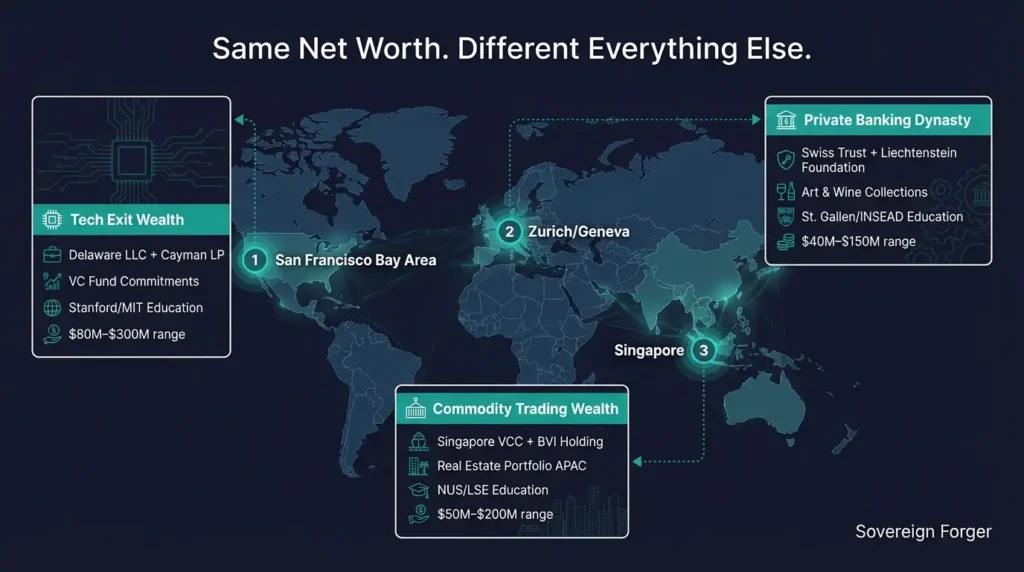
The way wealth is created, structured, and managed varies dramatically by region. These patterns are not arbitrary cultural preferences. They are driven by tax law, regulatory environments, financial infrastructure, and professional ecosystems that differ from one jurisdiction to another
In Silicon Valley, wealth is overwhelmingly created through technology — startup exits, IPO proceeds, venture capital carry, stock option exercises. The typical offshore structure is a Delaware LLC feeding into a Cayman Exempted Limited Partnership. The education profile skews toward Stanford, MIT, Carnegie Mellon. Philanthropy follows the Silicon Valley playbook: donor-advised funds, climate tech grants, education initiatives.
In Zurich and Geneva, wealth creation follows different paths — private banking, commodity trading, luxury goods, pharmaceutical holdings, and multi-generational family wealth. The offshore structure is more likely a Swiss trust combined with a Liechtenstein foundation. Education backgrounds include St. Gallen, INSEAD, and the London School of Economics. Philanthropic patterns reflect European traditions: cultural institutions, medical research, and historical preservation.
In Singapore, the wealth ecosystem centers on commodity trading, shipping, real estate development, and increasingly fintech. Offshore vehicles include Singapore Variable Capital Companies and BVI holding structures. Education profiles span NUS, NTU, and international institutions. Philanthropy leans toward healthcare, education in Southeast Asia, and disaster relief.
These are not minor details. They are the structural signatures that distinguish one wealth ecosystem from another. An AI model trained on data that ignores these patterns will produce outputs that no wealth professional would recognize as realistic.
Why This Matters for AI Training
If your AI model sees 10,000 UHNWI profiles where all of them have the same generic structure — random profession, random jurisdiction, random offshore vehicle — it learns that wealth structure is essentially random. It finds no signal in the geographic or cultural fields because there is no signal to find.

But in the real world, these correlations are strong. A compliance officer who sees a Silicon Valley tech founder with a Cayman LP immediately understands the context. A Swiss private banker with a Liechtenstein foundation follows a well-established pattern. These are expected structures — not red flags.
An AI system that cannot distinguish between expected and unexpected structures at the UHNWI level will generate noise instead of insight. It will flag normal arrangements as suspicious and miss genuinely unusual combinations that warrant attention.
This is one reason why scaling retail profiles to UHNWI levels does not work — even if the numbers are big enough, the cultural and structural signals are absent.
How Sovereign Forger Models Cultural Wealth Patterns
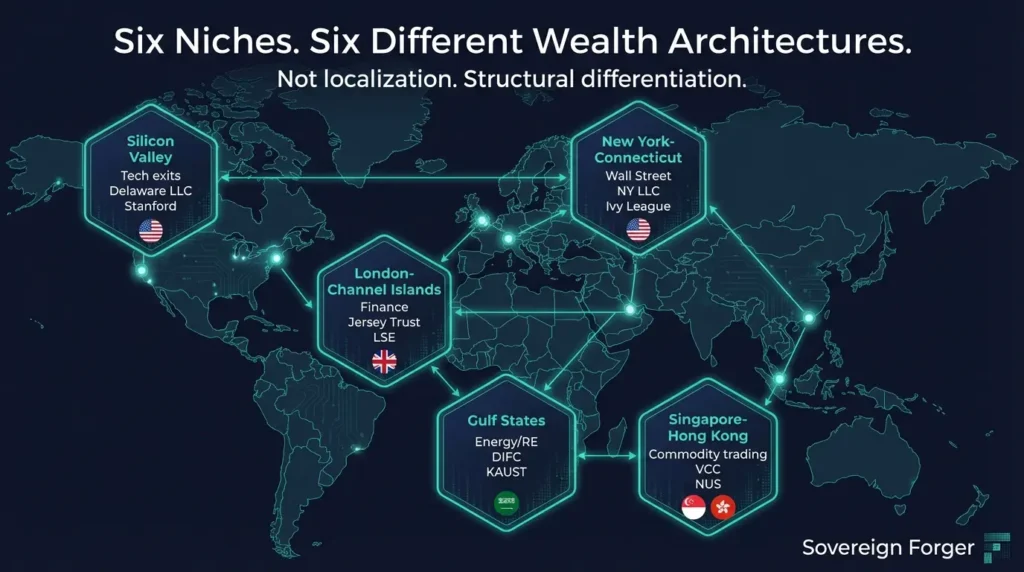
Each Sovereign Forger dataset is born synthetic for a specific geographic niche. The Silicon Valley niche produces profiles consistent with West Coast tech wealth. The professions, education backgrounds, offshore structures, asset allocations, and even neighborhood references are coherent with that particular wealth ecosystem — not because I localized a generic template, but because the entire generation model is niche-specific.
This is not cosmetic localization — changing the city name while keeping everything else the same. The entire profile architecture changes by niche. Asset class distributions shift. Offshore vehicle types change. Liability structures reflect different lending markets. Philanthropic footprints follow regional patterns.
The result is synthetic data where every field reinforces every other field. A downstream model trained on this data learns the real correlations between geography, profession, wealth structure, and entity architecture — because those correlations exist in the training data, just as they exist in the real world.
Cultural coherence you can evaluate by reading the profiles. Financial integrity you can verify mathematically — the open-source Balance Sheet Test checks every record’s algebraic consistency in seconds.
Compare for Yourself
While you examine cultural coherence, also verify the financial integrity with The Balance Sheet Test and check whether the wealth distribution follows a Pareto curve, not a bell curve.
Download 100 free Silicon Valley UHNWI profiles and examine the internal coherence yourself. Check whether the professions match the geography. Whether the offshore vehicles match the jurisdiction. Whether the education backgrounds match the wealth creation pathway. Six niches. 31 archetypes. Every profile culturally coherent.
Frequently Asked Questions
Why do cultural patterns matter in synthetic financial data?
Wealth structures vary significantly across cultures. A Silicon Valley tech founder’s portfolio looks nothing like a Middle Eastern merchant dynasty or a Swiss private banking client. If synthetic data lacks this cultural specificity, compliance systems trained on it will not recognize legitimate wealth patterns from specific regions, leading to both missed risks and discriminatory false positives.
How many cultural niches does Sovereign Forger cover?
Six geographic niches with culturally specific archetypes: Silicon Valley (Founders and VC), Old Money Europe (Dynasties and Private Banking), Middle East (Sovereign Families and Merchant Houses), LatAm Barons (Agribusiness and Infrastructure), Pacific Rim (Semiconductor and Shipping Dynasties), and Swiss-Singapore (Offshore Wealth and Multi-Family Offices).
How does cultural specificity affect naming in synthetic profiles?
Sovereign Forger uses culturally authentic onomastics for each niche. Middle Eastern profiles use Arabic naming conventions with patronymics. Pacific Rim profiles use Chinese, Korean, Japanese, and Southeast Asian naming patterns. European profiles reflect Germanic, Francophone, and Mediterranean traditions. This prevents the common synthetic data problem of culturally mismatched names.
Do cultural wealth patterns affect KYC risk assessments?
Yes, significantly. Middle Eastern profiles naturally have higher PEP rates due to the concentration of wealth around sovereign and government-connected families. LatAm profiles show higher risk ratings due to jurisdiction-specific factors. These patterns must be present in test data for KYC systems to be properly calibrated across all client demographics.
Can I get synthetic data for a specific geographic niche?
Yes. Sovereign Forger sells each of the six niches separately. You can purchase 1,000, 10,000, or 100,000 profiles from any single niche, or combine multiple niches. A free sample of 100 profiles from any niche is available with no credit card required.