
I have seen EDD systems pass every test in QA with perfect scores. Then the first real UHNWI profile walks in — Emirati trust, four jurisdictions, PEP-adjacent — and three rules break that nobody tested for.
This is the compliance blind spot. Your EDD system is only as good as the data you tested it against. And if that data did not include the structural complexity of ultra-high-net-worth clients, you tested nothing.
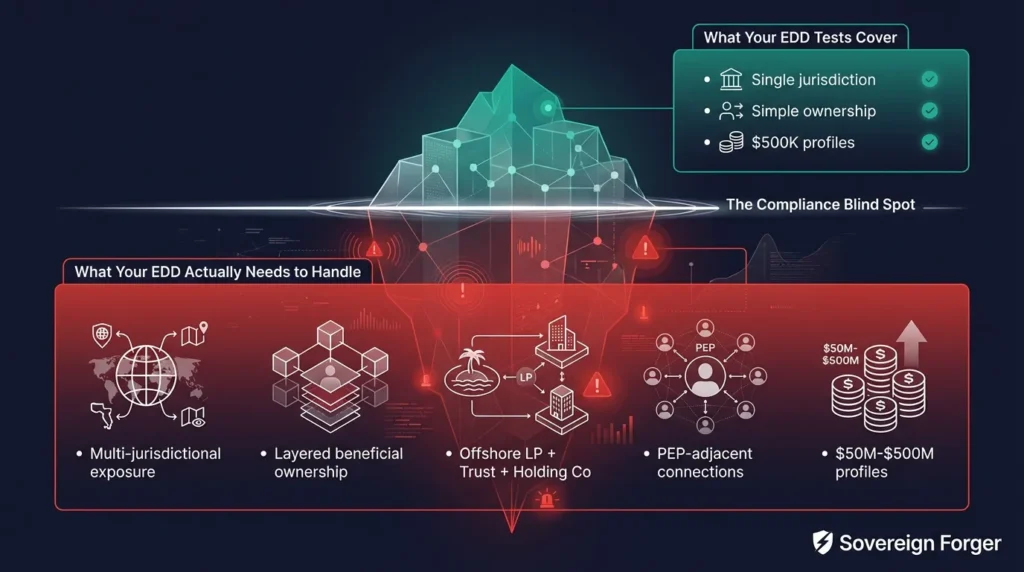
What EDD Actually Needs to Handle
Enhanced Due Diligence is triggered when a client presents elevated risk — politically exposed persons, complex beneficial ownership, high-value transactions, or connections to high-risk jurisdictions. In practice, almost every UHNWI triggers at least one EDD criterion simply by having the wealth structure that comes with their net worth.
A client with $80 million in assets will typically have holdings across multiple jurisdictions. They may have a Delaware LLC, a Cayman limited partnership, a Swiss private bank account, and real estate in three countries. They may be the beneficial owner of a chain of entities where the ultimate ownership requires three levels of look-through to identify.
This is normal for the wealth tier. It is not suspicious. But your EDD system needs to process it correctly — distinguishing between the structural complexity that is standard at this level and the red flags that genuinely warrant escalation.
If your test data never includes this baseline complexity, your system has no way to learn the difference.
The Testing Gap in Numbers
Consider what a typical RegTech QA dataset looks like versus what production traffic actually contains.
A standard synthetic test set might include 10,000 profiles with net worth ranging from $100,000 to $5 million. Perhaps 2% have offshore exposure. Perhaps 1% have multi-entity ownership. The jurisdiction spread covers the domestic market and perhaps two or three foreign countries.
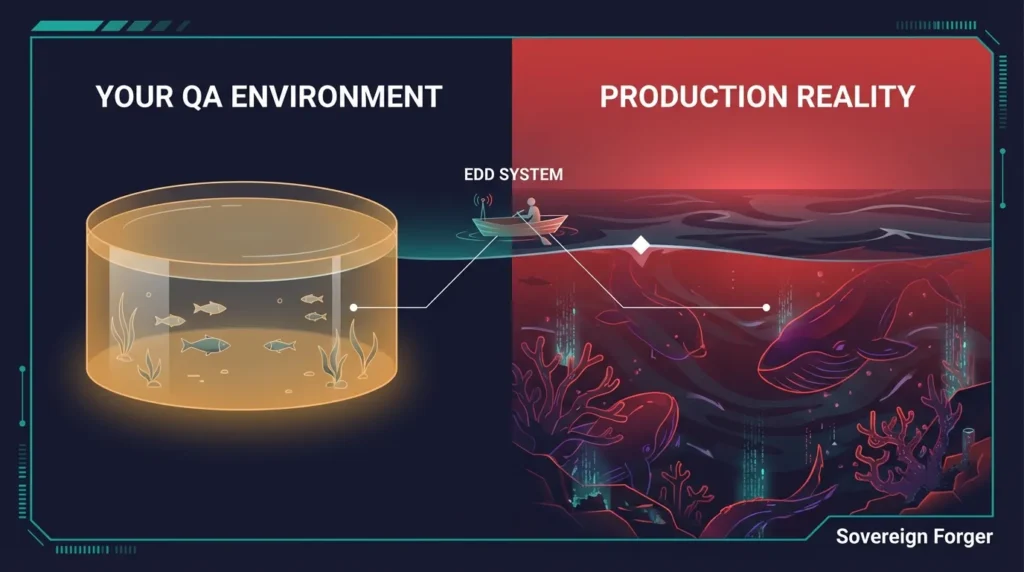
Now consider the first 100 UHNWI clients your platform onboards in production. Net worth ranges from $10 million to $500 million. Offshore exposure is not 2% — it is 87%. Multi-entity ownership is not 1% — it is 94%. The jurisdiction count is not three — it is twelve or more. Every single one of these clients triggers EDD.
Your QA covered none of these scenarios. I have seen this pattern repeat at multiple institutions — not because teams were careless, but because the test data made it impossible to cover them.
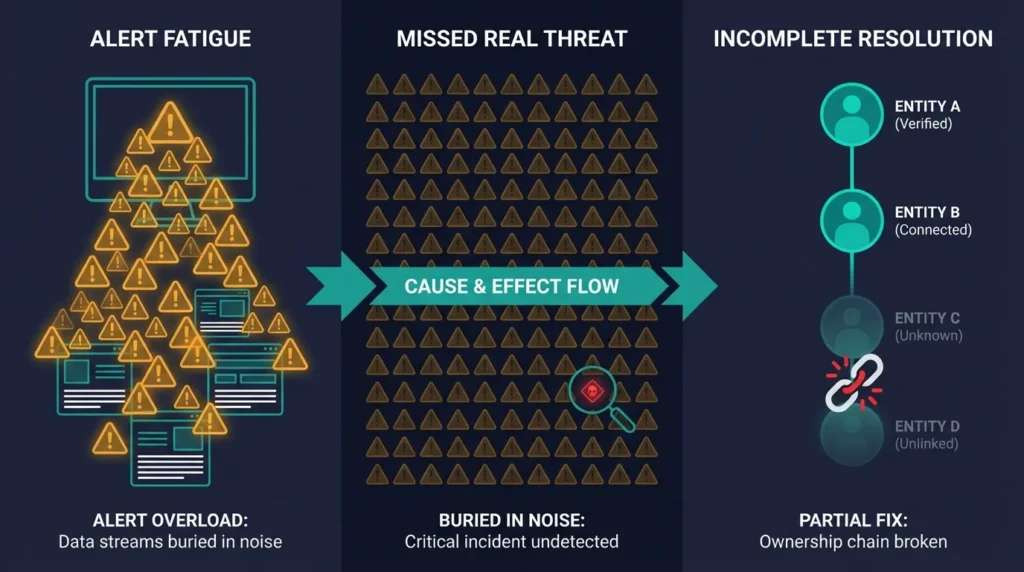
Three Failure Modes
False positive overload. The system flags structural complexity as suspicious because it has never seen it in a non-suspicious context. Multi-jurisdictional holdings trigger alerts. Offshore vehicles trigger alerts. Entity layering triggers alerts. The compliance team drowns in false positives and either burns out or starts dismissing alerts — which defeats the entire purpose of the system.
Missed true positives. The system has no calibrated sense of what “unusual” looks like at the UHNWI level. A structure that is genuinely anomalous — say, a newly formed BVI entity receiving a large transfer from a sanctioned jurisdiction — may not score significantly higher than the baseline noise of legitimate UHNWI complexity. The real risk gets lost in the false positive volume.
Incomplete entity resolution. The system cannot correctly trace beneficial ownership through three or four layers of entities because it was never tested against that depth. It identifies the first-level entity owner but fails to look through to the natural person — which is the entire point of beneficial ownership analysis.
These failures trace back to the same root cause described in Why Generic Synthetic Data Fails for Wealth Management AI — the test data never included the structural complexity your system needs to handle.
What Purpose-Built UHNWI Test Data Solves
When your EDD test suite includes synthetic profiles that mirror real UHNWI complexity — multiple jurisdictions, layered entity ownership, offshore vehicles, diversified asset classes — your system learns what normal looks like at this wealth tier. It can then calibrate its thresholds to flag genuine anomalies rather than structural features.
Every profile in the Sovereign Forger dataset includes the offshore jurisdictions, vehicle types, entity structures, and asset decompositions that UHNWI compliance scenarios require. The balance sheet balances on every record. The narrative fields match the structured data exactly. And because every profile is born synthetic — generated from mathematical constraints, not derived from real clients — there is no re-identification risk to manage.
You do not have to take my word for it. The Balance Sheet Test is open source — run it on the data, and on your current test data, before it reaches your EDD pipeline.
The born-synthetic approach also eliminates the GDPR complication — see Born Synthetic vs Anonymized for why this matters for compliance teams specifically.
Test Your Own System
Download 100 free Silicon Valley UHNWI profiles. Run them through your EDD pipeline. Count how many trigger alerts that your current test data never generated. That count is the size of your compliance blind spot.
Related: Neobank EDD Simulation with Born-Synthetic Data
Frequently Asked Questions
What is the EDD blind spot in compliance testing?
Most Enhanced Due Diligence systems are tested with simple profiles that lack the complexity of real UHNWI structures — no offshore jurisdictions, no multi-entity ownership, no cross-border wealth flows. When these systems encounter a real UHNWI with four jurisdictions and a family office, they have never seen this pattern in testing and may fail to flag genuine risks or generate excessive false positives.
Why do EDD systems fail on UHNWI profiles?
EDD systems are typically trained and tested on domestically simple profiles. UHNWI profiles present unique challenges: multiple beneficial ownership layers, cross-border fund flows through legitimate offshore structures, politically exposed person connections, complex trust and foundation structures, and cultural naming patterns that standard systems may not handle correctly.
How can synthetic UHNWI data improve EDD testing?
Born-synthetic UHNWI profiles with 29 KYC-enhanced fields provide the edge cases that EDD systems must handle: high-risk jurisdictions, PEP status with specific positions, complex ownership chains, varied source-of-wealth verification methods, and sanctions screening scenarios. Testing with these profiles reveals blind spots before they cause regulatory failures.
What compliance regulations require realistic EDD testing?
GDPR Article 25 requires data protection by design in all processing environments. The EU AI Act Article 10 mandates representative training data governance. DORA requires realistic resilience testing for financial entities. Together, these regulations create a compliance obligation to test with data that reflects real-world complexity — not simplified profiles.
What KYC fields are included in Sovereign Forger’s enhanced profiles?
29 fields per profile including: kyc_risk_rating, pep_status with position and jurisdiction, sanctions_screening_result with confidence scores, adverse_media_flag, source_of_wealth_verified with verification method, and high_risk_jurisdiction_flag. All fields are deterministically derived from the profile’s archetype and geographic niche.