

Credit Suisse: billions in cumulative fines. UBS: $5.1B in France alone. Julius Baer: $79.7M to the DoJ. Every one of these failures started in the same place — Enhanced Due Diligence procedures that were tested against profiles too simple to trigger them.
Your EDD Procedures Have Never Been Tested Against Your Actual Client Base
I have spent years working with financial data in wealth management environments, and there is one pattern I have seen more than any other: EDD procedures that work perfectly in testing and fail catastrophically in production. Not because the procedures were badly designed — but because the test data bore no resemblance to the clients who actually trigger Enhanced Due Diligence.
WealthTech is different from retail banking. Your platforms — whether you are Broadridge processing portfolio analytics, FNZ managing custody infrastructure, Avaloq running private banking systems, or Masttro consolidating multi-family office data — exist specifically to serve high-net-worth and ultra-high-net-worth clients. These are not edge cases in your business. They are your entire business.
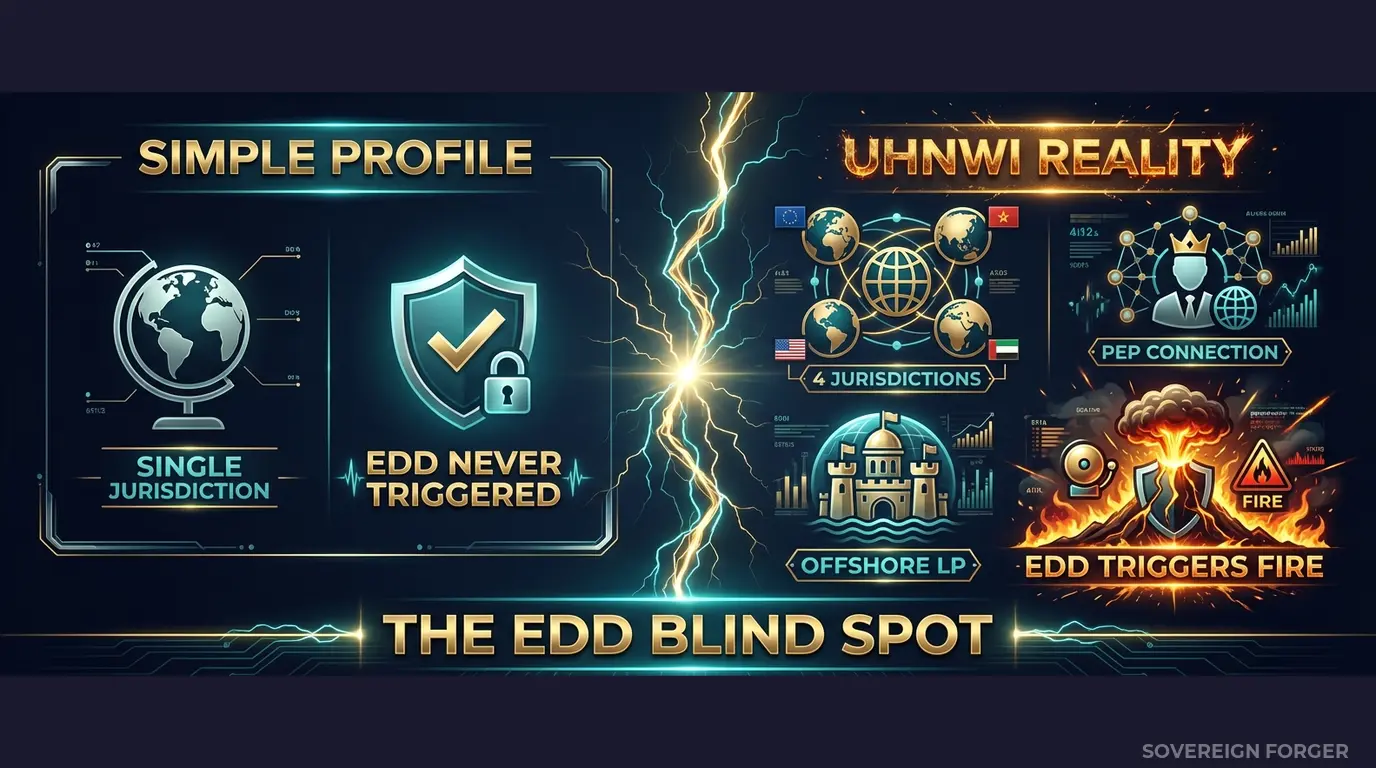
And yet, every EDD simulation I have audited at wealth management technology firms uses test profiles that look like retail banking customers with inflated balances. Single jurisdiction. One bank account. No trusts. No family foundation. No PEP connections. No offshore vehicles. A $50M net worth number pasted onto a profile that structurally resembles someone with $50K in a savings account.
Here is what an actual UHNWI client looks like when they walk into your platform:
– Multi-generational wealth held through a lattice of trusts, holding companies, and family offices spanning three or four jurisdictions
– PEP connections — not the client themselves, but a cousin who served as a minister of finance, or a brother-in-law on the board of a state-owned enterprise
– Tax domicile in one country, residency in another, passport from a third, with offshore vehicles registered in a fourth
– Source of wealth that traces through thirty years of corporate acquisitions, real estate holdings across six countries, and a private equity portfolio with stakes in regulated industries
This is the profile that is supposed to trigger your Enhanced Due Diligence. This is the profile your EDD procedures exist to handle. And this is the profile that your test data has never contained — because generating this level of structural complexity from scratch is genuinely hard, and copying it from production data creates an immediate GDPR violation.
The result is predictable. Your EDD simulation runs against 10,000 test profiles. Maybe 2% trigger enhanced review — and those 2% are triggered by a single simple flag, like a net worth above a threshold. The multi-jurisdictional complexity, the layered offshore structures, the PEP adjacency, the combination of factors that should activate EDD in production? None of it exists in the test data, so none of it gets tested.
The regulatory consequence is specific and measurable. FINMA, the FCA, and the SEC are not fining wealth managers for having bad EDD procedures. They are fining them for having EDD procedures that were never stress-tested against realistic client complexity. Julius Baer did not lack an EDD policy — they lacked evidence that the policy worked against the clients it was designed for. That is a test data problem, and it is the most expensive one in WealthTech.
Three Approaches That Leave Your EDD Untested
WealthTech platforms face a harder version of the test data problem than any other financial sector. Your clients are, by definition, the most complex profiles in the financial system. Every shortcut that retail banks can get away with fails immediately when applied to wealth management.
Using copies of production client data. I have seen this approach defended by CTOs who argued that “our clients already consented to data processing.” They are wrong. GDPR Article 25 requires data protection by design — which means personal data should not exist in test environments with broader access controls. When your QA team can browse real UHNWI profiles to test EDD triggers, you have created a data breach waiting to happen. With only 265,000 UHNWIs globally, every profile is a re-identification risk. And the August 2026 EU AI Act enforcement adds a second layer: if your EDD models train on this data, Article 10 requires documented provenance that you cannot provide for production copies.
Using anonymized client data. This is the approach most wealth management firms default to, and it is the most dangerous. Stripping the name from a profile that includes $380M net worth, a Zurich tax domicile, a Cayman Islands trust, and a board seat at a Swiss pharmaceutical company does not anonymize it — it merely pseudonymizes it. The UHNWI population is small enough that the combination of wealth tier, jurisdiction, offshore structure, and professional background can uniquely identify individuals even without direct identifiers. A regulator — or a determined attacker — can cross-reference against Forbes lists, Companies House filings, and public foundation disclosures. Your “anonymized” EDD test data is one LinkedIn search away from being personal data again.
Using generic synthetic data generators. Platform-based synthetic data tools generate profiles by sampling from statistical distributions learned from input datasets. The problem is structural: these tools produce profiles that are statistically plausible in aggregate but structurally flat at the individual level. A synthetic UHNWI from a generic generator has a single jurisdiction, a single wealth source, and no entity layering. There is no trust chain, no multi-generational transfer, no offshore SPV nested under a family office. Your EDD procedures need to detect complexity — and generic generators do not produce complexity, because complexity requires domain-specific architectural knowledge about how wealth is actually structured.
Real Data vs. Anonymized vs. Born-Synthetic
| Dimension | Real Data | Anonymized | Born-Synthetic |
|---|---|---|---|
| PII present | Yes | Residual | None |
| Re-identification risk | Certain | Probable (UHNWI) | Impossible |
| GDPR Art. 25 compliant | No | Disputed | Yes |
| EU AI Act Art. 10 | Violation | Unclear | Compliant |
| EDD triggers realistic | Yes | Partially (structure degraded) | Yes (31 archetypes) |
| Certifiable for auditors | No | No | Yes (Certificate of Origin) |
| Fine exposure | Up to 4% global revenue | Up to 4% global revenue | Zero |
Born-Synthetic EDD Simulation Data Built for Wealth Management Complexity
I built Sovereign Forger specifically because I watched EDD procedures fail against UHNWI complexity — and I knew the failure started in the test data. Every profile in the KYC-Enhanced dataset is generated from mathematical constraints and domain-specific wealth architecture, not derived from any real person.
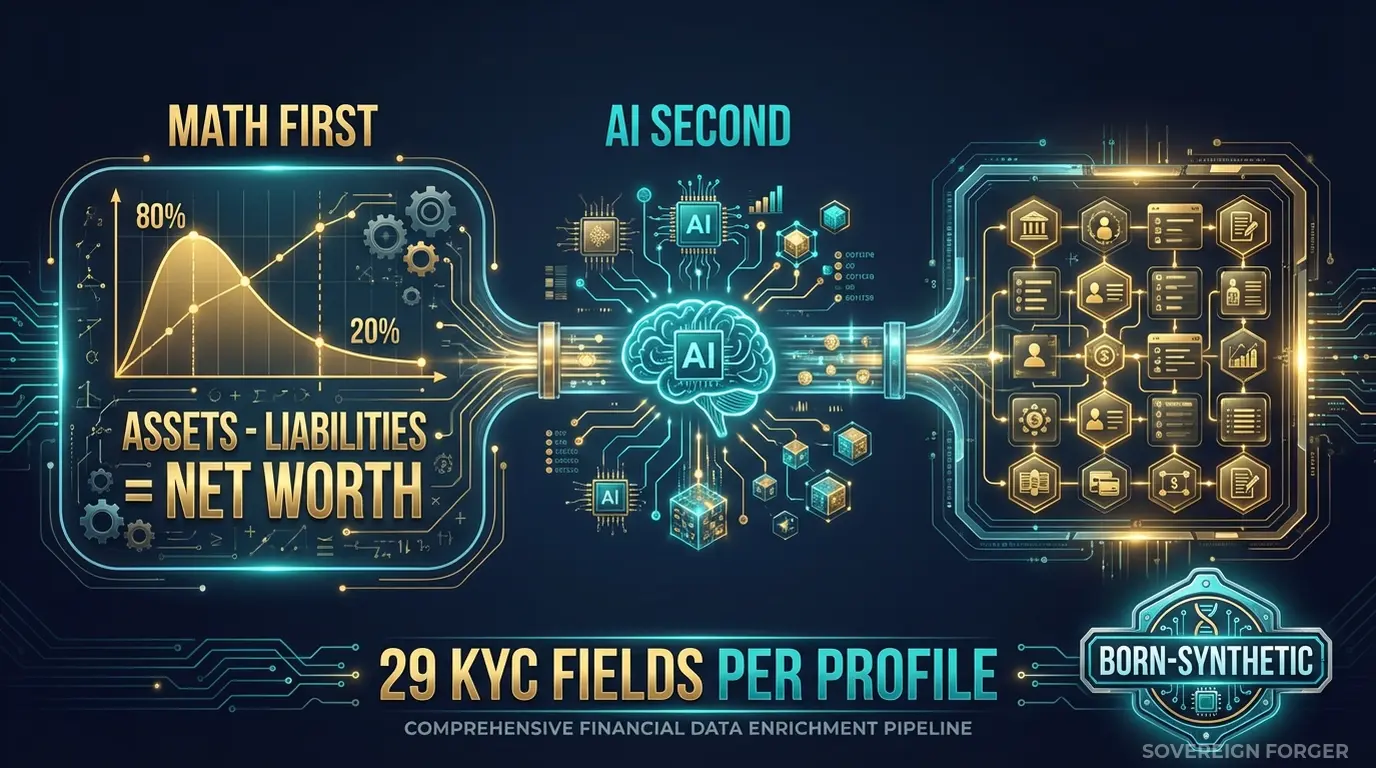
The generation pipeline works in two stages:
Math First. Net worth follows a Pareto distribution — the way real wealth is actually distributed. This is not a bell curve with bigger numbers. It is a power-law distribution where 80% of wealth concentrates in 20% of profiles, producing the extreme tail that defines UHNWI wealth. Asset allocations are computed within algebraic constraints: Assets – Liabilities = Net Worth, by construction. Property values, core equity, cash liquidity, and offshore holdings are derived from the archetype and niche — not randomly assigned. Every balance sheet balances on every record. Zero exceptions.
AI Second. A local AI model, running entirely offline, adds narrative context — biography, profession, philanthropic focus — after the financial figures are locked. The AI never touches the numbers. It enriches the profile with culturally coherent details that match the geographic niche and wealth archetype. A third-generation Swiss private banker gets a different biography than a first-generation Singapore shipping magnate, because their wealth paths are fundamentally different.
Why This Matters for EDD Simulation
Enhanced Due Diligence is triggered by structural complexity — not by a single field exceeding a threshold. Your EDD procedures need test data where multiple risk factors co-occur in realistic patterns:
PEP-adjacent profiles. The KYC-Enhanced dataset includes `pep_status` (none, domestic, foreign, international_org), `pep_position`, and `pep_jurisdiction` — derived deterministically from archetype and niche. Middle East sovereign family profiles carry PEP connections at realistic rates (~29%). Silicon Valley tech founders almost never do. Your EDD procedures need to detect these patterns at the correct frequencies, and the test data must reflect the niche-specific distribution.
High-risk jurisdiction exposure. Every profile with an `offshore_jurisdiction` in a FATF-flagged or high-risk jurisdiction gets `high_risk_jurisdiction_flag: true`, with the specific jurisdictions listed. This is not a random boolean — it is derived from the profile’s wealth structure. A LatAm agribusiness baron with a BVI holding company triggers a different EDD path than a Swiss private banker with a Liechtenstein trust. Both should activate enhanced review, but for different reasons and through different procedural routes.
Multi-jurisdictional complexity. Each profile has a `residence_city`, `residence_zone`, `tax_domicile`, and `offshore_jurisdiction` — and these are frequently in different countries. A profile might reside in London, hold tax domicile in Monaco, and own an offshore vehicle in the Cayman Islands. This is exactly the kind of multi-jurisdictional layering that triggers EDD in production — and it is structurally absent from generic synthetic data.
KYC risk ratings with realistic distributions. The `kyc_risk_rating` field (low, medium, high) is not uniformly distributed. LatAm profiles carry high-risk ratings at ~84% — reflecting the actual regulatory treatment of that region. European profiles are closer to 48% low-risk. Your EDD simulation needs these distributions to match production patterns, because the volume and mix of EDD triggers affect your team’s capacity planning, not just your rule accuracy.
Source of wealth verification. Every profile includes `source_of_wealth_verified`, `sow_verification_method` (tax_returns, bank_statements, third_party, self_declared), and the full `narrative_bio` that provides the qualitative context your EDD analysts actually read. The verification method correlates with the archetype: old money dynasties tend toward third-party verification; first-generation entrepreneurs tend toward self-declared with supporting documentation.
29 Fields Designed for EDD Workflows
Every KYC-Enhanced profile includes the fields your EDD pipeline needs to process end-to-end:
Identity & Geography: full_name, residence_city, residence_zone, tax_domicile
Wealth Structure: net_worth_usd, total_assets, total_liabilities, property_value, core_equity, cash_liquidity, assets_composition, liabilities_composition
Professional Context: profession, education, narrative_bio, philanthropic_focus
Offshore Exposure: offshore_jurisdiction, offshore_vehicle
KYC Signals: kyc_risk_rating, pep_status, pep_position, pep_jurisdiction, sanctions_screening_result, sanctions_match_confidence, adverse_media_flag, source_of_wealth_verified, sow_verification_method, high_risk_jurisdiction_flag
Every KYC field is deterministically derived from the profile’s archetype, niche, net worth, and jurisdiction — using a SHA-256 hash of the UUID for reproducible pseudo-randomness. Same UUID always produces the same KYC signals. This means your EDD simulation is repeatable: run it today, run it in six months, get the same triggers on the same profiles. Audit trail by construction.
Built for WealthTech EDD Simulation at Scale
6 Geographic Niches: Silicon Valley, Old Money Europe, Middle East, LatAm, Pacific Rim, Swiss-Singapore — each with culturally coherent wealth structures that reflect how UHNWI wealth is actually organized in that region. An Old Money Europe profile has dynastic trust structures and private banking relationships. A Pacific Rim profile has semiconductor holdings and multi-generational shipping interests. Your EDD procedures encounter all of these patterns.
31 Wealth Archetypes per Niche: Tech founders, private bankers, commodity traders, family office principals, real estate developers, sovereign family members, hedge fund managers — the actual client profiles that WealthTech platforms onboard. Each archetype has a distinct wealth structure that produces different EDD trigger patterns.
Realistic EDD Trigger Rates: PEP connections, high-risk jurisdiction exposure, sanctions screening results, and adverse media flags are distributed by niche at frequencies that match the regulatory reality of each region. Your EDD simulation will surface the actual volume and mix of enhanced reviews that your team should expect in production.
Certificate of Sovereign Origin: Every dataset ships with a PDF certificate documenting the born-synthetic methodology, zero PII lineage, GDPR Art.25 alignment, EU AI Act Art.10 compliance, and CCPA coverage. When your auditor — or your regulator — asks where the test data came from, you hand them the certificate. It documents what no anonymized dataset can: proof that no real person’s data was involved, by construction, not by assertion.
Pricing
| Tier | Records | Price | Best For |
|---|---|---|---|
| Compliance Starter | 1,000 | $999 | EDD procedure validation, proof of concept |
| Compliance Pro | 10,000 | $4,999 | Full EDD regression suite |
| Compliance Enterprise | 100,000 | $24,999 | AI model training + production-scale EDD simulation |
No SDK. No API key. No sales call. Download a file, open it in Python or Excel, and feed it into your EDD pipeline. Every record is delivered in JSONL and CSV, with a README documenting the full schema.
Why This Matters Now for WealthTech
Regulators are targeting wealth management specifically. FINMA’s enforcement actions against Credit Suisse and Julius Baer focused on inadequate client due diligence — not on missing policies, but on policies that were never tested against the client complexity they were designed for. The FCA’s £29M fine on Starling Bank cited “shockingly lax” financial crime controls. The pattern is consistent: regulators are no longer satisfied that you have EDD procedures. They want evidence that those procedures work against realistic scenarios.
The EU AI Act enforcement window is closing. Full applicability begins August 2026. Financial AI — including KYC risk scoring, EDD triage, and client risk profiling — is classified as high-risk under Annex III. Article 10 requires documented governance of training data, including provenance, bias assessment, and GDPR compliance. If your EDD models were trained or tested on real or anonymized client data, you need to prove compliance on both GDPR and AI Act simultaneously. Born-Synthetic data eliminates this entire category of regulatory exposure.
The cost of $24,999 is not a data purchase — it is an insurance policy. Julius Baer paid $79.7M to the DoJ. UBS paid $5.1B in France. Credit Suisse’s accumulated fines run into the billions. Against these numbers, $24,999 for 100,000 compliance-grade EDD simulation profiles is a rounding error. The alternative — continuing to test EDD procedures against structurally simple profiles and hoping that production complexity does not expose gaps — is the most expensive bet in WealthTech.
The balance sheet test is open source. Every Sovereign Forger record passes algebraic validation: Assets – Liabilities = Net Worth. Run the Balance Sheet Test on our data, then run it on your current test data. If your current data contains balance errors, every analysis built on that data inherits those errors. The difference is measurable and immediate.
Every dataset ships with a Certificate of Sovereign Origin — documenting born-synthetic methodology, zero PII lineage, and regulatory alignment. When FINMA, the FCA, or the SEC asks “how did you test your EDD procedures?”, you hand them the certificate alongside your simulation results. That is the audit trail that no anonymized dataset can provide.
Test Your EDD Procedures Against Real Complexity
Download 100 free KYC-Enhanced UHNWI profiles. Every profile includes the structural triggers that should activate Enhanced Due Diligence — PEP status, high-risk jurisdictions, complex offshore vehicles, multi-jurisdictional tax domiciles.
Run them through your EDD pipeline. Count how many trigger enhanced review that your current test data never surfaced. That number is the size of your compliance blind spot — and it is the gap that regulators will find before you do.
No credit card. No sales call. Just your work email.
Related reading: The Compliance Blind Spot: Why EDD Systems Fail on UHNWI Profiles
Frequently Asked Questions
How does synthetic EDD data help wealth managers simulate due diligence on PEP and UHNWI profiles without exposing real client information?
Synthetic EDD datasets allow wealth managers to stress-test onboarding workflows against high-risk archetypes, including Politically Exposed Persons and Ultra-High-Net-Worth Individuals with layered offshore structures, without touching live client data. Because UHNWI profiles are among the hardest to synthesize realistically, purpose-built generators model complex ownership chains across 3 or more jurisdictions, trust arrangements, and opaque beneficial ownership patterns. Teams can run full MiFID II suitability assessments and EDD checklists against hundreds of edge-case profiles before a single real client enters the pipeline.
Can synthetic KYC profiles accurately reflect the multi-jurisdictional wealth structures that trigger Enhanced Due Diligence in MiFID II-regulated firms?
Yes, when generated at sufficient fidelity, synthetic profiles can embed correlated attributes such as dual citizenship, offshore holding companies, and source-of-wealth narratives that are statistically consistent with real UHNWI patterns. MiFID II requires firms to categorize clients and conduct proportionate suitability assessments, meaning EDD simulation data must include jurisdiction-level risk scores, politically sensitive affiliations, and cross-border asset indicators. Profiles built to these specifications let compliance teams validate risk-scoring models and escalation logic against 50 or more distinct regulatory edge cases without regulatory or GDPR exposure.
How do WealthTech firms use EDD simulation data to validate sanctions screening and adverse media workflows before live deployment?
Compliance teams embed synthetic high-risk profiles, including names matched to fictional PEP lists, fabricated sanctions flags, and constructed adverse media triggers, into staging environments to measure true-positive and false-positive rates before production rollout. Because the EU AI Act Article 10 requires high-quality training and test data for AI-driven risk tools, synthetic datasets with known ground-truth labels allow teams to benchmark screening accuracy against defined thresholds. Firms routinely run 200 or more synthetic profiles through their screening stack to surface logic gaps in escalation rules and reduce manual review backlogs by 30 to 40 percent.
What does born-synthetic mean, and why does it matter specifically for Enhanced Due Diligence simulation in WealthTech?
Born-synthetic means profiles are generated entirely from mathematical distributions, such as Pareto distributions for wealth values, and have zero lineage to any real individual. No anonymization, masking, or tokenization of real records is involved at any stage. For EDD simulation this matters because even pseudonymized data carries re-identification risk under GDPR, particularly for UHNWI profiles where wealth magnitudes and ownership structures are distinctive. Born-synthetic data is GDPR Article 25 compliant by construction, eliminating data-minimization obligations and enabling teams to share EDD test sets freely across engineering, compliance, and vendor evaluation workflows without legal review cycles.
How can a WealthTech compliance team get started with synthetic EDD profiles, and what is included in a free sample dataset?
Sovereign Forger provides 100 free synthetic KYC profiles available for instant download via work email with no credit card required. Each profile contains 29 interlocked fields covering risk ratings, PEP status, sanctions screening flags, and source-of-wealth narratives, with attributes statistically correlated so that, for example, a profile flagged as high-risk also carries consistent jurisdictional and ownership-structure signals. The free dataset is sufficient for an initial integration test of an EDD workflow, allowing teams to validate field mapping, escalation logic, and MiFID II categorization rules against a realistic distribution of low, medium, and high-risk synthetic client archetypes.
Learn more about WealthTech EDD simulation data and how Born Synthetic data addresses this in our glossary and comparison guides.