
This kyc test data is built for exactly this scenario. Starling Bank: £29M. N26: €9.2M. HSBC: £63.9M. Monzo: £21M. Every one of these institutions relied on RegTech products to catch financial crime. The products passed internal QA. They failed in production — because they were validated against test data that looked nothing like the clients who triggered the failures.
Your Product Is Only as Good as the Data You Test It Against
I have spent years watching RegTech companies demo their KYC screening tools to prospective clients. The demos are always impressive. Risk scores light up. PEP matches trigger alerts. Sanctions flags cascade across the dashboard. The product works beautifully.
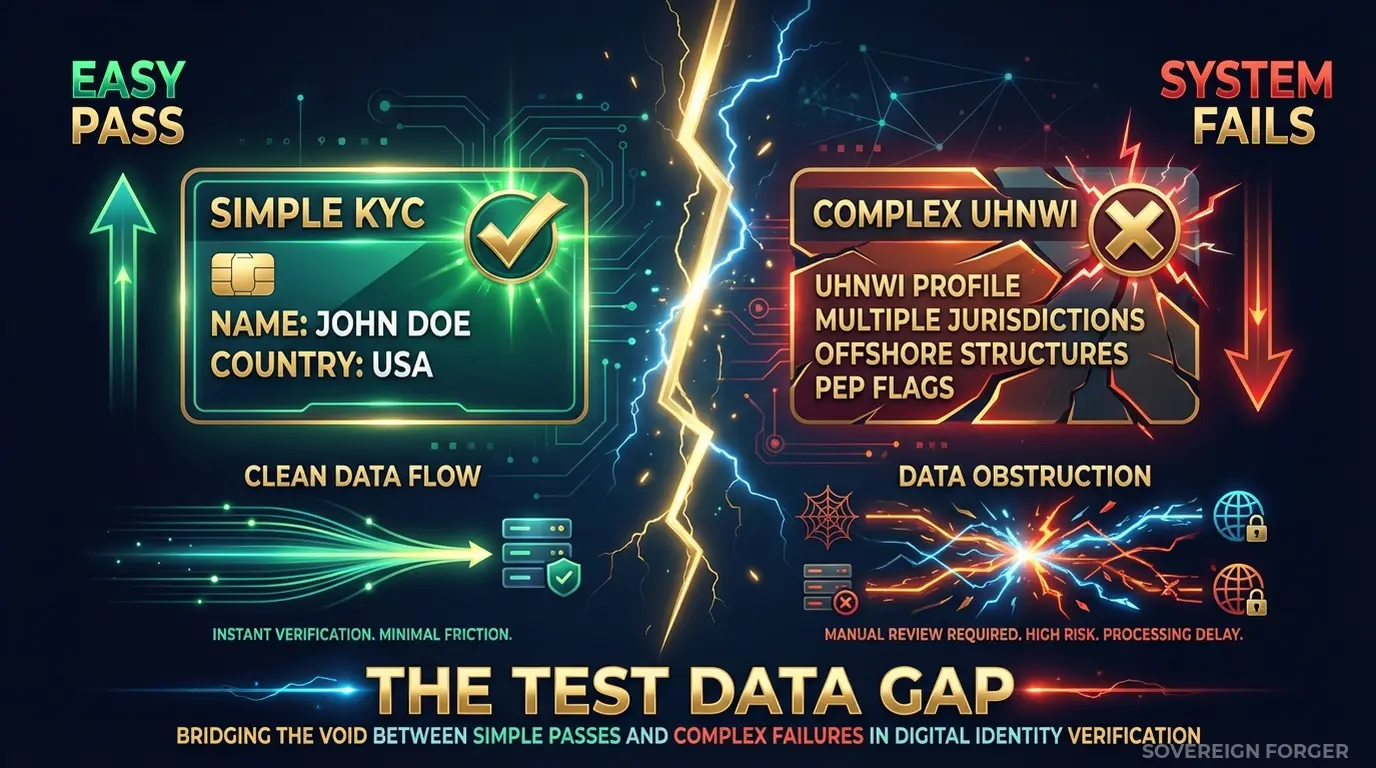
Then the client deploys it. And within six months, a UHNWI with a Cayman LP layered under a Luxembourg holding company walks through the onboarding flow. The KYC system assigns a “low” risk rating because the test profiles that trained the scoring model never contained that kind of structure. The client’s compliance team does not catch it. The regulator does.
The fine lands on your client. But the blame lands on you.
This is the pattern I have seen repeat across the RegTech industry. ComplyAdvantage, Napier AI, Lucinity, Unit21, Flagright, Fenergo, Sumsub, NICE Actimize, WorkFusion — every vendor in this space ships a product that was validated against some form of test data. The question is whether that test data contained the structural complexity that triggers failures in production.
Here is what I mean by structural complexity. A real UHNWI client does not have one jurisdiction and one bank account. They have a tax domicile in Switzerland, property in London, a family trust registered in Jersey, a Cayman LP holding real estate in Miami, and a daughter who is a former government minister in their home country — making the entire family PEP-adjacent. Your KYC system needs to process all of this simultaneously: the multi-jurisdictional exposure, the entity layering, the indirect PEP connection, the source-of-wealth documentation requirements.
If your product was validated against 500 profiles with single jurisdictions, simple names, and no offshore structures, it has never been tested against this scenario. You shipped a product that works in QA and breaks in production. And when it breaks, your client’s regulator does not call you — they call your client. Your client calls you next, and that conversation does not go well.
The indirect liability is real. RegTech vendors do not get fined directly — yet. But when a client receives a £29M fine for inadequate financial crime controls and your screening tool was the control, the commercial consequence is identical. Contract termination. Reputation damage. Lost pipeline. A vendor whose product was in place during a major enforcement action has a marketing problem that no amount of case studies can fix.
The product validation gap is measurable. Take your current test dataset and count: how many profiles have offshore exposure across two or more jurisdictions? How many have PEP connections? How many have net worth above $50M with complex entity structures? If the answer is zero or near-zero, your product has never been tested against the profiles that actually trigger Enhanced Due Diligence. You do not have a product problem — you have a test data problem.
Three Approaches That Don’t Work for RegTech Product Validation
I have consulted with RegTech engineering teams about their test data pipelines. The same three patterns appear everywhere, and each one creates a different kind of failure.
Using client data for product testing. Some RegTech vendors receive anonymized data from prospective clients during proof-of-concept phases. This creates two problems simultaneously. First, the data is bound by NDA and data processing agreements that restrict its use beyond the specific POC. Second, it introduces GDPR liability — if the “anonymized” UHNWI profiles are re-identifiable (and with only 265,000 UHNWIs globally, they often are), the vendor is now processing personal data without a valid legal basis. One data subject access request from a client’s client unravels the entire arrangement.
Using anonymized data from public sources. Stripping names and identifiers from publicly available financial profiles does not eliminate re-identification risk for high-net-worth individuals. The combination of net worth tier, city of residence, offshore jurisdiction, and professional background can uniquely identify a person even without their name attached. A regulator reviewing your product validation methodology can argue — correctly — that your test data is pseudonymized, not anonymized, and that GDPR applies in full. Your product validation process itself becomes a compliance liability.
Using generic synthetic generators. Platform-based synthetic data tools produce structurally flat profiles. They generate the statistical shape of retail banking customers — normally distributed income, single jurisdiction, no entity layering — and scale the numbers up. A $200M net worth profile from a generic generator looks like a bank teller who won the lottery, not like a third-generation shipping magnate in Singapore with a family office in Zurich and a trust in Liechtenstein. Your KYC screening tool trains on these profiles and learns that wealth is structurally simple. Then production happens.
Real Data vs. Anonymized vs. Born-Synthetic
| Dimension | Real/Client Data | Anonymized | Born-Synthetic |
|---|---|---|---|
| PII present | Yes | Residual | None |
| Re-identification risk | Certain | Probable (UHNWI) | Impossible |
| GDPR Art. 25 compliant | No | Disputed | Yes |
| EU AI Act Art. 10 | Violation | Unclear | Compliant |
| Certifiable for auditors | No | No | Yes (Certificate of Origin) |
| NDA/DPA restrictions | Typically yes | Often yes | None |
| Reusable across clients | No | Rarely | Yes — unlimited |
| Fine exposure | Up to 4% global revenue | Up to 4% global revenue | Zero |
For a RegTech vendor, the last three rows matter most. Client data is locked behind NDAs. Anonymized data carries re-identification risk that compounds with every new client engagement. Born-Synthetic data has zero restrictions — you can use the same dataset for product development, QA, demos, and client POCs without any data governance overhead.
Born-Synthetic KYC Data Built for RegTech Product Validation

I built Sovereign Forger because I watched the test data problem destroy product credibility from the inside. Every profile in the dataset is generated from mathematical constraints — not derived from any real person, not anonymized from any client’s data, not subject to any NDA or data processing agreement.
The generation pipeline works in two stages:
Math First. Net worth follows a Pareto distribution — the actual statistical shape of real wealth concentration, not a bell curve. Asset allocations are computed within algebraic constraints: Assets – Liabilities = Net Worth, by construction. Property values, equity holdings, cash liquidity, and offshore exposure are allocated proportionally based on archetype and geographic niche. Every balance sheet balances on every record. Zero exceptions. Zero manual corrections.
AI Second. A local AI model running entirely offline adds narrative context — biography, profession, philanthropic focus — after the financial figures are locked. The AI never touches the numbers. It enriches the profile with culturally coherent details that match the geographic niche and wealth tier. A Silicon Valley founder gets a bio that reads differently from an Old Money European dynasty heir, because the underlying wealth architecture is different.
Why This Matters for RegTech KYC Products
Your KYC screening tool needs to handle complexity gradients — not just simple-versus-complex, but the specific patterns of complexity that vary by geography, wealth tier, and archetype. A Middle Eastern sovereign family has different KYC signals than a LatAm agribusiness baron. Both are high-net-worth. Both trigger EDD. But the specific combination of jurisdictions, entity types, PEP exposure, and source-of-wealth patterns is different.
Generic test data treats all UHNWI profiles as interchangeable. Sovereign Forger does not. Each of the 31 wealth archetypes across 6 geographic niches produces a distinct pattern of KYC complexity — the same kind of variation your product will encounter in production.
29 Fields Designed for KYC/AML Systems
Every KYC-Enhanced profile includes the fields your screening pipeline actually needs to process:
Identity & Geography: full_name, residence_city, residence_zone, tax_domicile
Wealth Structure: net_worth_usd, total_assets, total_liabilities, property_value, core_equity, cash_liquidity, assets_composition, liabilities_composition
Professional Context: profession, education, narrative_bio, philanthropic_focus
Offshore Exposure: offshore_jurisdiction, offshore_vehicle
KYC Signals: kyc_risk_rating, pep_status, pep_position, pep_jurisdiction, sanctions_screening_result, sanctions_match_confidence, adverse_media_flag, source_of_wealth_verified, sow_verification_method, high_risk_jurisdiction_flag
Every KYC field is deterministically derived from the profile’s archetype, niche, net worth, and jurisdiction — not randomly assigned. A tech founder in Silicon Valley gets different risk signals than a commodity trader in the Middle East, because the underlying wealth structures produce different KYC patterns. PEP rates in the Middle East niche (~29%) are higher than in Swiss-Singapore (~5%), because the real-world distribution of politically exposed persons varies by region. Your product validation reflects this — or it does not.
What This Means for Your Product Team
For QA: run your full regression suite against 10,000 profiles with realistic complexity gradients. Count how many edge cases surface that your current test data never triggered.
For product demos: show prospective clients a screening run against profiles that look like their actual customer base — offshore structures, PEP connections, multi-jurisdictional exposure. Not 500 “John Smith” profiles with $1M in a single account.
For client POCs: deliver the dataset as part of your proof-of-concept. Your client runs their existing system against the same data your product screens. The comparison is apples-to-apples, and the structural complexity is identical.
For AI model training: if your product uses machine learning for risk scoring, the training data needs to contain the full spectrum of KYC complexity. Sovereign Forger’s Pareto-distributed wealth profiles with deterministic KYC signals provide that spectrum — Born-Synthetic, zero PII, EU AI Act Article 10 compliant by construction.
Built for RegTech Product Validation at Scale
6 Geographic Niches: Silicon Valley, Old Money Europe, Middle East, LatAm, Pacific Rim, Swiss-Singapore — each with culturally coherent wealth patterns, distinct KYC signal distributions, and regionally accurate offshore structures. Not localized templates — structurally different wealth architectures.
31 Wealth Archetypes: Tech founders, private bankers, commodity traders, family office managers, real estate developers, shipping magnates, sovereign family members — the actual client profiles that trigger EDD in production. Each archetype produces a distinct combination of entity structures, jurisdictional exposure, and risk signals.
KYC Signal Distribution: Risk ratings, PEP statuses, sanctions screening results, and source-of-wealth verification methods distributed with realistic frequencies by niche. The Middle East niche has ~29% PEP exposure. LatAm has ~84% high-risk ratings. These are not arbitrary numbers — they reflect the structural patterns your product needs to handle correctly.
No Restrictions on Use: every dataset is Born-Synthetic with zero lineage to real persons. Use it for product development, QA, demos, client POCs, AI training, and marketing collateral. No NDA. No DPA. No data governance overhead. One purchase, unlimited use cases.
Pricing
| Tier | Records | Price | Best For |
|---|---|---|---|
| Compliance Starter | 1,000 | $999 | Product QA, demo environments |
| Compliance Pro | 10,000 | $4,999 | Full regression suites, client POCs |
| Compliance Enterprise | 100,000 | $24,999 | AI model training + enterprise validation |
No SDK. No API key. No sales call. Download a file, open it in Python or any data tool, and feed it into your screening pipeline. JSONL and CSV formats included.
Why This Matters Now
Your clients are getting fined, and the scrutiny is increasing. Starling Bank paid £29M for inadequate financial crime controls. HSBC paid £63.9M. Monzo paid £21M. N26 paid €9.2M. Block paid $120M. In every case, the institution had RegTech products in place. In every case, the products were validated against test data that did not reflect the complexity of real-world clients. When the regulator investigates, they look at the controls — and the controls include the tools you sold them.
The EU AI Act changes the equation for RegTech vendors directly. If your KYC screening product uses machine learning — and most modern RegTech products do — the EU AI Act classifies it as high-risk AI under Annex III (creditworthiness assessment, financial crime detection). Article 10 requires documented governance of training data, including provenance, bias assessment, and GDPR compliance. If your product’s risk scoring model was trained on real or anonymized data, you need to prove compliance on both GDPR and AI Act simultaneously. Born-Synthetic training data eliminates both requirements at once.
Enforcement is not future tense. The EU AI Act becomes fully applicable in August 2026. Financial AI providers must demonstrate compliance by that date. RegTech vendors who cannot document their training data provenance face the same enforcement framework as their clients. The time to fix the test data pipeline is before the first audit, not after.
The balance sheet test is open source. Every Sovereign Forger record passes algebraic validation: Assets – Liabilities = Net Worth. Run the Balance Sheet Test on our data, then run it on your current test data. If your test profiles do not pass this basic consistency check, your KYC screening product is being validated against internally inconsistent data. The difference is measurable, and your engineering team can verify it in five minutes.
Every dataset ships with a Certificate of Sovereign Origin — documenting the born-synthetic methodology, zero PII lineage, and regulatory alignment. When your client’s auditor asks where the test data came from, you hand them the certificate. When your own compliance team reviews your product validation methodology, the certificate documents that zero personal data was involved. This is not a marketing artifact — it is an audit document.
Test Your KYC Pipeline Today
Download 100 free KYC-Enhanced UHNWI profiles. Run them through your screening product. Count how many trigger alerts, edge cases, or classification failures that your current test data never generated.
That number is the gap between what your product handles in QA and what it will face in production. Your next client’s regulator will find that gap. The question is whether you find it first.
No credit card. No sales call. Just your work email.
Frequently Asked Questions
How does synthetic KYC data help neobanks avoid the AML compliance failures that cost Starling £29M and N26 €9.2M?
Neobanks were fined because their KYC verification systems failed under real transaction pressure — gaps that adequate pre-launch testing would have surfaced. Synthetic KYC profiles with all 29 interlocked fields, including risk ratings, PEP status, and source of wealth verification, allow compliance teams to stress-test onboarding pipelines against edge cases — high-risk nationals, dual PEP exposure, flagged sanctions hits — before a single real customer is processed. Catching one misconfigured risk-rating rule in testing costs nothing; missing it in production can cost eight figures.
Can RegTech vendors legally use synthetic KYC test data in client demos and platform validation without triggering GDPR obligations?
Yes. Synthetic KYC data generated from mathematical distributions carries no lineage to real individuals, which means it falls outside the definition of personal data under GDPR Art.4(1). RegTech vendors can share demo datasets with prospective bank or insurer clients, embed profiles in sandbox environments, and run public benchmark tests without data processing agreements, subject access obligations, or breach notification risk. This removes a significant legal friction point from enterprise sales cycles, particularly for vendors operating across EU jurisdictions under varying supervisory interpretations.
Which KYC fields are most critical for testing sanctions screening and PEP detection logic in a compliance platform?
Effective sanctions and PEP testing requires correlated field sets, not isolated values. The fields that most frequently expose logic errors are nationality combinations paired with jurisdiction-of-residence, PEP tier classification (direct versus close associate), sanctions list match confidence scores, and source of wealth categorisation. A test profile showing a Tier-1 PEP with a source of wealth flagged as politically exposed but a low aggregate risk rating will immediately reveal miscalibrated scoring models. Sovereign Forger’s KYC dataset covers all 29 of these interlocked fields, generating statistically coherent profiles that surface exactly these contradictions.
What does born-synthetic mean for KYC test data, and why does it matter specifically for RegTech compliance testing?
Born-synthetic means the data was generated entirely from mathematical distributions — including Pareto distributions for wealth and transaction value fields — with no source records, no anonymisation step, and zero lineage to real persons. Unlike pseudonymised or masked real data, born-synthetic profiles cannot be re-identified, which makes them GDPR Art.25 compliant by construction rather than by process. For RegTech KYC testing, this distinction matters because EU AI Act Art.10 requires that training and validation data for high-risk AI systems, including automated KYC decisioning, be demonstrably free from personal data contamination. Born-synthetic satisfies that requirement at the data-generation level.
How quickly can a RegTech team get started with synthetic KYC test data, and what is included in the free tier?
Sovereign Forger provides 100 synthetic KYC profiles available for instant download with no credit card required, accessible via a work email address. Each profile includes all 29 interlocked KYC fields: risk ratings, PEP status, sanctions screening results, source of wealth verification, nationality, jurisdiction of residence, and associated transactional indicators. The profiles are statistically coherent across fields, meaning a high-risk rating correlates appropriately with PEP flags and source of wealth categories. Teams can load the dataset directly into their compliance platform or sandbox environment and begin validation testing within minutes of registration.
Learn more about RegTech KYC test data and how Born Synthetic data addresses this in our glossary and comparison guides.