
HSBC: £63.9M. Danske Bank: ~$2B. ABN AMRO: €480M. ING: €775M. Standard Chartered: $1.1B. The stress testing frameworks that were supposed to catch these risks ran on data that assumed wealth follows a bell curve. It does not. Wealth follows a Pareto distribution — and the tail is where the systemic risk lives.
Your Stress Tests Are Missing the Tail
I spent years inside financial data environments, and the thing that kept me up at night was not the models — it was what we fed them. Every stress testing framework I encountered ran scenarios against portfolio distributions that looked reasonable on a slide deck and bore no resemblance to reality.
Here is what I mean. A traditional bank holds 50,000 private banking clients. The bottom 49,000 have relatively straightforward wealth structures — domestic assets, a mortgage, liquid savings, maybe a rental property. The models handle these clients well. Stress scenarios play out predictably. Risk reports come back green.
Then there are the top 1,000 clients. They hold 60% of the bank’s assets under management. Their wealth is concentrated in illiquid positions — a $400M real estate portfolio in three jurisdictions, $200M in private equity that cannot be marked to market in a crisis, a core equity stake in a family conglomerate that represents 70% of their total net worth. Their liabilities are leveraged against these illiquid assets. When a market shock hits, these portfolios do not decline linearly — they gap down, because the assets cannot be sold and the margin calls come anyway.
This is the structural problem with traditional bank stress testing: the synthetic data used in scenarios does not contain these concentration patterns. Standard generators produce profiles with diversified asset allocations — 30% equities, 25% bonds, 20% real estate, 15% cash, 10% alternatives. A neat, balanced pie chart that has never existed in a single UHNWI portfolio I have ever analyzed.
Real UHNWI wealth is lumpy. It is concentrated. It is illiquid. And it behaves nonlinearly under stress.
The gap in practice. When the European Banking Authority runs its annual stress test, it publishes adverse scenarios: GDP contraction, equity drawdown, credit spread widening, real estate correction. Banks apply these scenarios to their portfolios. But the portfolio data feeding these models is often synthetic — and the synthetic data assumes diversified allocations that smooth out exactly the tail risk the stress test is supposed to capture.
I have seen a bank run a severe real estate correction scenario against a test portfolio where no single client had more than 15% in property. Their actual UHNWI book had clients with 80% property concentration in a single city. The stress test passed. The real portfolio would not have survived the scenario. The model was fine. The data was wrong.
The concentration problem is compounded by cross-border exposure. A UHNWI client with a tax domicile in the UK, property in Dubai, core equity in a Singapore-listed company, and a trust in the Cayman Islands creates correlation risk across four regulatory jurisdictions simultaneously. A local market shock in one jurisdiction cascades through the entire structure. Standard stress testing data generates single-jurisdiction profiles — so the cascade is never modeled.
The regulatory expectation is explicit. The EBA’s Guidelines on Stress Testing (EBA/GL/2018/04) require banks to use data that captures “material concentrations” and “significant exposures.” The ECB’s TRIM exercise found that many internal models underestimate tail risk precisely because the calibration data lacks extreme but plausible portfolio compositions. Using synthetic data that omits concentrated, illiquid, multi-jurisdictional wealth structures means your stress test is structurally incapable of identifying the scenarios regulators are asking about.
Three Approaches That Leave the Tail Unmodeled
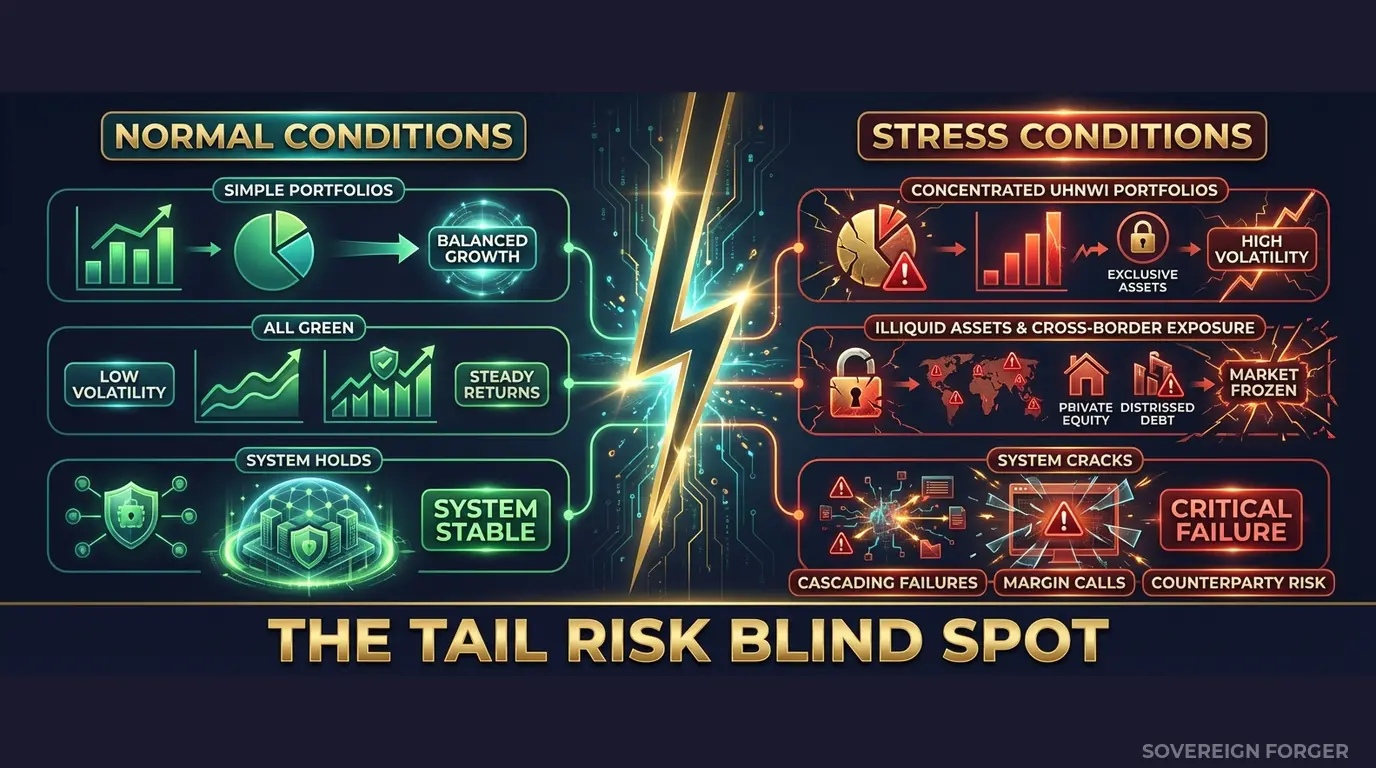
Traditional banks have been running stress tests for decades. The frameworks are mature. The models are sophisticated. But the data feeding those models has not evolved at the same pace — and every approach currently in use has a fundamental limitation when it comes to UHNWI tail risk.
Using historical client data. The most common approach: extract real client portfolio data, apply scenario shocks, measure the impact. Two problems. First, GDPR Article 25 requires data protection by design — running real client data through stress testing environments that have broader access, weaker controls, and different retention policies is a compliance risk. Second, and more fundamentally, historical data only contains scenarios that have already happened. The 2008 financial crisis, the 2020 COVID shock, the 2022 rate cycle — these are in the data. The next crisis, which will have a different correlation structure, is not. Stress testing is supposed to model what has not happened yet. Historical data, by definition, cannot do that.
Using anonymized portfolio data. Stripping client identifiers from real UHNWI portfolios does not eliminate re-identification risk. With approximately 265,000 UHNWIs globally, the combination of net worth tier, asset concentration pattern, jurisdiction mix, and offshore structure type can uniquely fingerprint individuals. A $900M net worth with 75% concentration in Singapore real estate and a Cayman Islands trust narrows the population to perhaps a dozen people worldwide. A regulator — or a plaintiff’s attorney — can make a credible re-identification argument, and GDPR still applies to pseudonymized data.
Using standard synthetic generators. Platform-based generators produce balanced portfolios because they sample from normal distributions. Every profile gets a diversified allocation, moderate leverage, single-jurisdiction exposure. This is structurally the wrong distribution for stress testing. Real wealth follows a Pareto distribution — a small number of clients hold the vast majority of assets, and those clients have concentrated, illiquid, cross-border structures. A synthetic generator that produces 100,000 profiles with bell-curve wealth distributions has just generated 100,000 profiles that are irrelevant to the tail scenarios your stress test is designed to capture.
Historical Data vs. Anonymized vs. Born-Synthetic
| Dimension | Historical Data | Anonymized | Born-Synthetic |
|---|---|---|---|
| PII present | Yes | Residual | None |
| Re-identification risk | Certain | Probable (UHNWI) | Impossible |
| GDPR Art. 25 compliant | No | Disputed | Yes |
| EU AI Act Art. 10 | Violation | Unclear | Compliant |
| Wealth distribution | Historical only | Historical only | Pareto (configurable) |
| Concentration patterns | Reflects past | Reflects past | Extreme + moderate |
| Cross-border exposure | Limited to book | Limited to book | 6 niches, multi-jurisdiction |
| Certifiable for auditors | No | No | Yes (Certificate of Origin) |
| Tail risk coverage | Only known events | Only known events | Synthetic extremes included |
Born-Synthetic Data Built for Stress Testing UHNWI Portfolios

Every profile in the Sovereign Forger dataset is generated from mathematical constraints that produce the wealth distributions, concentration patterns, and cross-border structures your stress testing framework needs to model tail risk accurately.
Math First — Pareto, Not Gaussian. This is the single most important design decision in the pipeline, and it is the reason the data works for stress testing. Real wealth follows a Pareto distribution: a small number of individuals hold disproportionately large portfolios, and those portfolios have disproportionate concentration risk. I set the shape parameter (alpha) per geographic niche to match observed UHNWI wealth distributions. The result is a dataset where the top 1% of profiles hold a realistic share of total net worth — not a uniform spread that flattens the tail.
Standard synthetic generators sample net worth from a normal or log-normal distribution. This produces a bell curve where most profiles cluster around the mean and extreme values are rare. In practice, this means your stress test never encounters a profile with $800M in a single illiquid asset class — because the generator considers that an outlier and suppresses it. In reality, that profile exists in every major bank’s private banking book.
Algebraic Constraints — Every Balance Sheet Balances. Total Assets minus Total Liabilities equals Net Worth, by construction. This is not a validation check applied after generation — it is an algebraic constraint enforced during generation. The asset composition (property_value, core_equity, cash_liquidity, and the detailed assets_composition breakdown) and the liabilities_composition are computed so that the balance identity holds exactly. Zero rounding errors. Zero exceptions.
For stress testing, this matters because you can apply scenario shocks to individual asset classes and observe the cascading impact on net worth and leverage ratios with confidence that the arithmetic is correct at the record level. When you write down property values by 30% and mark core equity to a crisis valuation, the resulting balance sheet is still internally consistent.
AI Second — Contextual Enrichment After the Numbers Are Locked. A local AI model (running offline, on local hardware) adds narrative context — biography, profession, philanthropic focus — after all financial figures are finalized. The AI never touches the numbers. It enriches the profile with culturally coherent details that match the geographic niche and wealth archetype. A real estate dynasty in the Middle East gets a different biography and professional context than a semiconductor executive in the Pacific Rim — because the underlying wealth structures are different, and the narrative should reflect that.
What This Means for Your Stress Testing Framework. You can feed these profiles directly into your scenario engine. Apply a 40% real estate correction and observe which profiles breach leverage thresholds. Model a cross-border contagion where Singapore equities crash and observe the cascade through clients whose core equity is concentrated in that market. Run a liquidity stress where cash_liquidity drops to zero and measure how many profiles become technically insolvent when illiquid assets cannot be marked down gracefully.
The data supports these scenarios because the wealth structures are realistic — concentrated, illiquid, cross-border, and Pareto-distributed. Not balanced, diversified, and bell-curved.
29 Fields Designed for Wealth Stress Scenarios
The KYC-Enhanced dataset includes the fields your stress testing models actually need:
Wealth Structure (core stress testing fields): net_worth_usd, total_assets, total_liabilities, property_value, core_equity, cash_liquidity, assets_composition, liabilities_composition
These eight fields give you the full balance sheet: total position, leverage, liquidity buffer, and the granular breakdown of what the assets and liabilities actually are. You can decompose assets_composition to isolate real estate concentration, private equity illiquidity, or single-stock risk. You can decompose liabilities_composition to identify margin exposure, mortgage leverage, or contingent liabilities.
Identity & Geography: full_name, residence_city, residence_zone, tax_domicile
Four jurisdictional data points per profile. A client can reside in London, belong to the Old Money Europe wealth zone, and hold a tax domicile in Switzerland — creating cross-border correlation that your stress model needs to capture.
Offshore Exposure: offshore_jurisdiction, offshore_vehicle
The type and jurisdiction of offshore structures. A BVI holding company creates different stress transmission than a Cayman Islands trust. Your scenario engine can filter by offshore jurisdiction and model jurisdiction-specific regulatory actions.
KYC Signals (for combined stress + compliance scenarios): kyc_risk_rating, pep_status, pep_position, pep_jurisdiction, sanctions_screening_result, sanctions_match_confidence, adverse_media_flag, source_of_wealth_verified, sow_verification_method, high_risk_jurisdiction_flag
These fields enable combined stress-and-compliance scenarios: what happens when a market shock coincides with a regulatory action? Which high-risk clients are most exposed to a simultaneous drawdown and sanctions escalation? The KYC fields are deterministically derived from the profile’s archetype, niche, and wealth structure — not randomly assigned.
Professional Context: profession, education, narrative_bio, philanthropic_focus
Context fields that enable sector-specific stress scenarios. A portfolio concentrated in tech equity (profession: tech founder, core_equity: $500M in a single company) responds differently to a tech correction than a diversified industrialist.
Built for Traditional Bank Stress Testing at Scale
Pareto-Distributed Wealth. The dataset does not contain 100,000 profiles with similar net worth. It contains a realistic power-law distribution: many profiles in the $30M-$100M range, fewer in the $100M-$500M range, and a realistic tail of $500M+ profiles with extreme concentration. This is the distribution your stress models need — not a uniform spread that averages away the tail.
6 Geographic Niches: Silicon Valley, Old Money Europe, Middle East, LatAm, Pacific Rim, Swiss-Singapore — each with distinct asset concentration patterns, offshore structures, and cross-border exposure. European old money concentrates in real estate and private banking. Pacific Rim wealth concentrates in semiconductor and shipping equity. Middle Eastern wealth concentrates in sovereign-adjacent structures and real estate. Your stress scenarios can model region-specific shocks and observe cross-niche contagion.
31 Wealth Archetypes: Tech founders with single-stock concentration. Real estate dynasties with 80% property exposure. Commodity traders with leveraged positions. Private bankers managing family office assets. Each archetype has a distinct asset composition pattern that produces different stress test outcomes under the same scenario — which is exactly how real UHNWI portfolios behave.
Concentration Patterns That Trigger Tail Events. Unlike standard generators that produce diversified allocations, these profiles contain the concentration patterns that cause nonlinear losses: single-asset dominance (core_equity > 60% of total_assets), illiquid property concentration (property_value > 50% of total_assets), high leverage against illiquid collateral (total_liabilities > 40% of total_assets with low cash_liquidity). These are the profiles your stress test should be finding.
Pricing
| Tier | Records | Price | Best For |
|---|---|---|---|
| Compliance Starter | 1,000 | $999 | Scenario prototyping, proof of concept |
| Compliance Pro | 10,000 | $4,999 | Full stress testing suite |
| Compliance Enterprise | 100,000 | $24,999 | Enterprise-wide model calibration + regulatory submission |
No SDK. No API key. No sales call. Download a file, open it in Python or your risk engine, and run your stress scenarios on data that actually contains the tail risk you are testing for.
Why This Matters Now
The EBA stress test cycle is tightening. The 2025 EU-wide stress test expanded scope to include climate risk and concentration risk scenarios. The ECB’s TRIM exercise explicitly flagged underestimation of tail risk in internal models due to calibration data that lacks extreme but plausible portfolio compositions. If your stress testing data does not contain concentrated, illiquid, multi-jurisdictional portfolios, your internal model is calibrated to the wrong distribution — and the ECB will find it.
Enforcement is accelerating across jurisdictions. HSBC: £63.9M (FCA, financial crime controls). Danske Bank: approximately $2B (money laundering failures across multiple regulators). ABN AMRO: €480M (AML compliance). ING: €775M (structural compliance failures). Standard Chartered: $1.1B (sanctions and AML). These fines reflect systemic failures in risk and compliance frameworks — frameworks that depend on the quality of the data they are tested against.
The EU AI Act adds a new dimension. Banks increasingly use AI models for credit risk, portfolio optimization, and scenario generation. The EU AI Act, fully applicable from August 2026, classifies financial AI as high-risk under Annex III. Article 10 requires documented governance of training data — including provenance, representativeness, and GDPR compliance. If your AI-driven stress testing models are calibrated on real or anonymized client data, you need to prove compliance on both GDPR and the AI Act simultaneously. Born-Synthetic data eliminates both risks by construction.
The balance sheet test is open source. Every Sovereign Forger record passes algebraic validation: Assets – Liabilities = Net Worth. Run the Balance Sheet Test on our data, then run it on your current stress testing inputs. If the balance identity does not hold on your current data, your stress scenarios are propagating arithmetic errors through every downstream calculation.
Every dataset ships with a Certificate of Sovereign Origin — documenting the born-synthetic methodology, Pareto distribution parameters, zero PII lineage, and regulatory alignment. When your model validation team or external auditor asks “where did you source this stress testing data?”, you hand them the certificate. It documents that the data is compliant by construction — not by anonymization.
Stress-Test With Realistic Wealth Distributions
Download 100 free UHNWI profiles with Pareto-distributed wealth, realistic asset concentrations, and cross-border exposure. Feed them into your stress testing framework. Run your standard adverse scenario.
Count how many profiles breach thresholds that your current synthetic data never triggered. That number tells you how much tail risk your stress test has been missing.
No credit card. No sales call. Just your work email.
Related reading: DORA Synthetic Data Requirements for Resilience Testing — how DORA Article 24-25 mandates synthetic data for threat-led penetration testing.
Frequently Asked Questions
How does born-synthetic financial data support Basel III/IV capital adequacy stress testing in traditional banks?
Traditional banks must demonstrate capital resilience under adverse macroeconomic scenarios as required by Basel III/IV Pillar 2 frameworks. Sovereign Forger produces statistically coherent synthetic portfolios where credit risk ratings, exposure-at-default values, and loss-given-default parameters align across thousands of profiles simultaneously. This coherence allows stress test models to run correlated shock scenarios without distorting portfolio-level distributions, satisfying the OCC SR 11-7 requirement that model inputs be fit-for-purpose and statistically representative of real-world conditions.
Why do traditional banks face higher regulatory scrutiny than neobanks when validating stress test models, and how does synthetic data address that?
Traditional banks operate under supervisory frameworks including EBA model risk guidelines and OCC SR 11-7, which require independent model validation and documented evidence that training data is free from bias and data quality deficiencies. Supervisors apply materially stricter review standards to incumbent institutions than to neobanks. Sovereign Forger generates synthetic profiles with documented distributional provenance, enabling validation teams to audit statistical properties directly rather than relying on masked or anonymised production data that may carry hidden sample biases.
Can synthetic stress testing data satisfy the EU AI Act Article 10 data governance requirements that become enforceable in August 2026?
EU AI Act Article 10 classifies credit risk and capital assessment models as high-risk AI systems, requiring training and testing datasets to meet documented data governance standards from August 2026. Sovereign Forger synthetic profiles are generated with traceable mathematical parameters, allowing compliance officers to demonstrate dataset composition, representativeness across demographic segments, and absence of prohibited personal data processing. This positions stress testing pipelines for audit-ready certification well ahead of the Article 10 enforcement deadline.
What does born-synthetic mean in the context of traditional bank stress testing data, and why does it matter?
Born-synthetic means every financial profile is generated entirely from mathematical distributions, including Pareto-distributed wealth concentrations, rather than derived or transformed from any real customer record. There is zero lineage to real persons at any point in the data pipeline. For traditional bank stress testing this is material because it renders GDPR Article 25 privacy-by-design compliance automatic rather than procedural. Stress teams can share scenario datasets across jurisdictions and with third-party model validators without triggering data transfer restrictions or requiring anonymisation audits.
How can a traditional bank’s stress testing team evaluate Sovereign Forger before committing to a full data procurement process?
Sovereign Forger provides 100 synthetic KYC profiles at no cost, with no credit card required, available for instant download using a work email address. Each profile contains 29 interlocked fields covering credit risk ratings, PEP status, sanctions screening outcomes, and source-of-wealth classifications, all generated with internal consistency across fields. This allows model validation teams and stress testing analysts to immediately assess distributional properties and field coherence against their scenario requirements before any commercial engagement.
Learn more about bank stress testing synthetic data and how Born Synthetic data addresses this in our glossary and comparison guides.