
This transaction monitoring data is built for exactly this scenario. HSBC: £63.9M. Danske Bank: $2B. ABN AMRO: €480M. ING: €775M. Standard Chartered: $1.1B. Every one of these fines traces back to transaction monitoring systems that could not distinguish legitimate multi-jurisdictional wealth flows from suspicious activity — because they were never calibrated against data that contained both.
Your Transaction Monitoring System Is Calibrated Against the Wrong Clients
I spent years watching transaction monitoring teams at traditional banks tune their alert thresholds. The process was always the same: take historical transaction data from the domestic retail book, run it through the monitoring engine, count the alerts, adjust the rules until the false positive rate drops below some internal target — usually 95% or 97%.
Then the system goes live against the wealth management division.
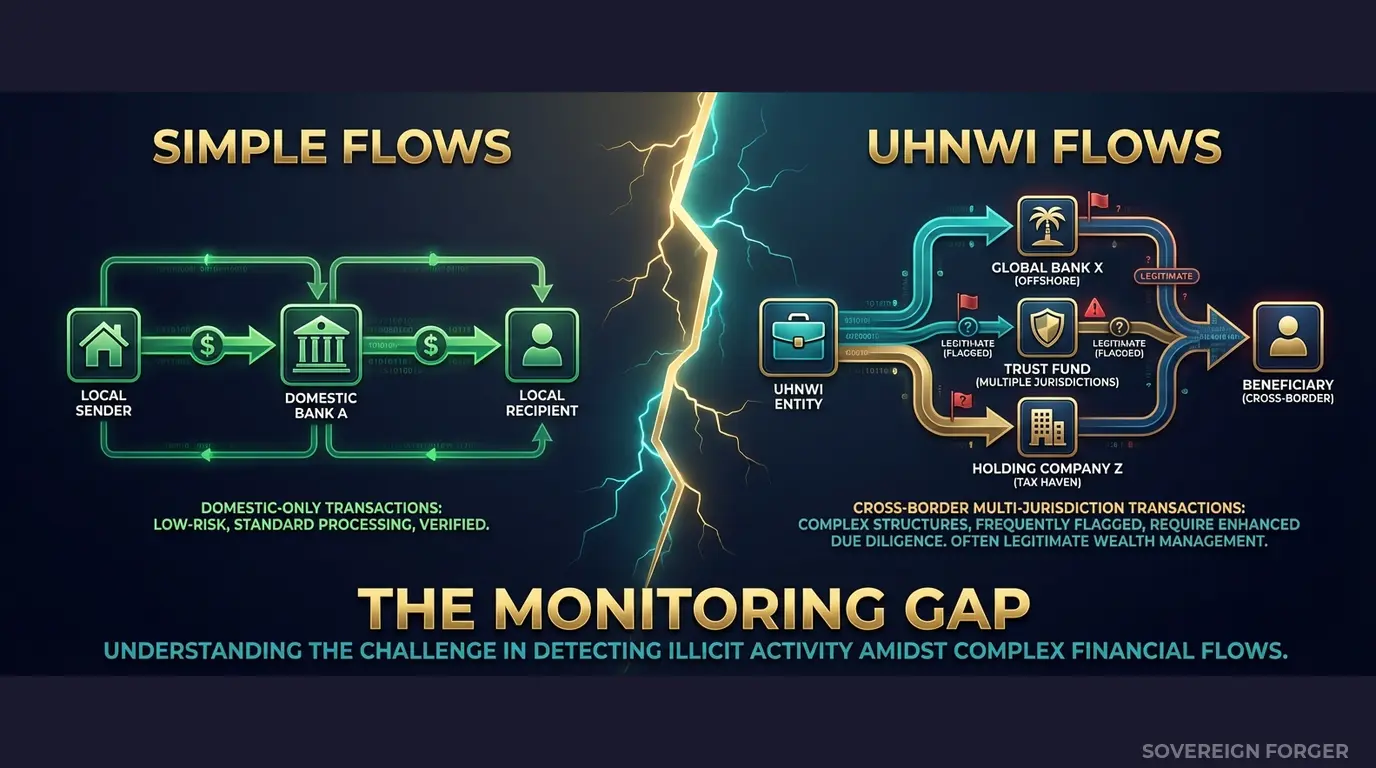
A client in Zurich sends $4.2M to a family office in Singapore. The family office distributes $1.8M to a trust in the Cayman Islands. The trust pays a management fee to a Delaware LLC. The LLC transfers $600K back to the client’s UK property holding company. Four jurisdictions, four entities, one client, one legitimate wealth management operation that happens every quarter.
The transaction monitoring system flags all four transfers. Because it was tuned on domestic retail flows — salary deposits, mortgage payments, utility bills — it has no model for what legitimate cross-border UHNWI activity looks like. Every multi-jurisdictional transfer is an anomaly. Every offshore entity triggers a rule. Every wealth flow that does not look like a salary payment generates an alert.
I have seen the result of this calibration failure at three different institutions. The false positive rate on UHNWI transactions runs between 85% and 95%. Compliance analysts spend their days closing alerts they know are false, because the monitoring thresholds were set using data that looked nothing like the client base generating the alerts.
This is not an efficiency problem. It is a regulatory problem. When your analysts close 90% of alerts as false positives, they develop alert fatigue. They start pattern-matching — “another Cayman transfer, probably fine” — and the one genuinely suspicious transaction that arrives at 4:47 PM on a Friday gets the same two-minute review as the 200 false positives that preceded it. That is the transaction that ends up in a regulator’s enforcement action.
The Danske Bank case made this explicit. €200 billion in suspicious transactions flowed through the Estonian branch over nine years. The transaction monitoring system generated alerts. Analysts, drowning in false positives from legitimate correspondent banking flows, could not distinguish signal from noise. The system was not broken — it was miscalibrated. It had been tuned on data that did not represent the actual transaction patterns it was monitoring.
The calibration problem has a specific cause: traditional banks’ transaction monitoring systems are trained and tuned on retail banking data, then deployed against a global client base with fundamentally different transaction patterns. The test data contains zero multi-jurisdictional flows, zero offshore entity structures, zero cross-border wealth transfers between related parties. The system has never seen what normal looks like for the clients it is actually monitoring.
Three Approaches That Make the Problem Worse
I have evaluated the transaction monitoring calibration process at institutions ranging from regional banks to global systemics. The test data problem shows up in three forms, and none of the standard solutions fix it.
Using production transaction data for calibration. Some teams extract real client transactions into development environments to tune monitoring rules. This creates two problems simultaneously. First, it is a GDPR Article 25 violation — real transaction data containing counterparty names, account numbers, and jurisdictional flows sitting in environments with developer access, weaker controls, and insufficient audit trails. Second, and more practically, the production data reflects the current client mix. If your UHNWI book is 3% of your client base, 3% of your calibration data contains the complexity you are trying to monitor. You are tuning a system with 97% irrelevant data.
Using anonymized transaction histories. Stripping client identifiers from real UHNWI transaction flows does not eliminate re-identification risk. With approximately 265,000 UHNWIs globally, the combination of transaction amounts, jurisdiction pairs, entity types, and timing patterns can uniquely identify individuals — especially in wealth management, where transaction patterns are distinctive by definition. A regulator examining your calibration data can argue, correctly, that pseudonymized UHNWI transaction data is personal data under GDPR, and your development environment is non-compliant.
Using generic synthetic transaction generators. Platform-based generators produce structurally flat transaction profiles — single-currency domestic transfers between two parties. They cannot generate the multi-entity, multi-jurisdictional, multi-currency flows that characterize real UHNWI banking activity. When you calibrate your monitoring rules against these flat profiles, you are training the system to treat any structural complexity as suspicious. The result: every legitimate UHNWI transaction triggers an alert, every alert gets dismissed, and your monitoring system becomes operationally useless for the clients that carry the highest regulatory risk.
Real Data vs. Anonymized vs. Born-Synthetic
| Dimension | Real Data | Anonymized | Born-Synthetic |
|---|---|---|---|
| PII present | Yes | Residual | None |
| Re-identification risk | Certain | Probable (UHNWI) | Impossible |
| GDPR Art. 25 compliant | No | Disputed | Yes |
| EU AI Act Art. 10 | Violation | Unclear | Compliant |
| Multi-jurisdictional complexity | Yes, but 97% retail | Some, if not stripped | Full UHNWI depth |
| Certifiable for auditors | No | No | Yes (Certificate of Origin) |
| Fine exposure | Up to 4% global revenue | Up to 4% global revenue | Zero |
Born-Synthetic KYC Profiles That Reflect How UHNWI Wealth Is Actually Structured

The transaction monitoring calibration problem is a data problem. Your monitoring system needs to learn what legitimate multi-jurisdictional wealth flows look like before it can identify which ones are suspicious. That requires test profiles with the structural complexity of real UHNWI clients — offshore vehicles, cross-border tax domiciles, multi-entity asset compositions — without any connection to real individuals.
That is what I built.
Every profile in the Sovereign Forger KYC dataset is generated from mathematical constraints — not derived from any real person, not anonymized from any real dataset. The generation pipeline works in two stages:
Math First. Net worth follows a Pareto distribution — the way real wealth is actually distributed, not a Gaussian bell curve. Asset allocations are computed within algebraic constraints: Assets – Liabilities = Net Worth, by construction. Property values, core equity, cash liquidity, and offshore holdings are proportioned according to archetype-specific templates derived from publicly available wealth research. Every balance sheet balances on every record. Zero exceptions.
AI Second. A local AI model, running entirely offline, adds narrative context — biography, profession, philanthropic focus — after the financial figures are locked. The AI never touches the numbers. It enriches the profile with culturally coherent details that match the geographic niche and wealth tier. No data leaves the machine. No API calls. No cloud processing.
Why This Solves the Transaction Monitoring Problem
Transaction monitoring systems fail on UHNWI clients because the test data does not contain the structural features that drive legitimate cross-border flows. Sovereign Forger profiles contain exactly those features:
Offshore jurisdiction and vehicle type. Each profile includes `offshore_jurisdiction` and `offshore_vehicle` — the specific entity structures (BVI company, Cayman LP, Liechtenstein foundation, Singapore trust) that your monitoring system encounters in production. When a profile shows a BVI company held through a Delaware LLC with a tax domicile in Switzerland, your monitoring system can learn what legitimate flows between those jurisdictions look like.
Tax domicile mismatch. The `tax_domicile` field is independent of `residence_city`. A client residing in London with a tax domicile in Monaco generates a different transaction pattern than one residing and domiciled in the same jurisdiction. Your monitoring rules need exposure to both patterns to calibrate correctly.
Asset composition with offshore exposure. The `assets_composition` field breaks down holdings across property, equity, cash, alternatives, and offshore vehicles — with proportions that vary by archetype and niche. A private banker in Zurich holds wealth differently than a tech founder in Palo Alto. Your monitoring system needs profiles across this full spectrum to set thresholds that distinguish structure from suspicion.
KYC risk signals for alert correlation. Each profile includes `kyc_risk_rating`, `pep_status`, `sanctions_screening_result`, `high_risk_jurisdiction_flag`, and `source_of_wealth_verified`. These fields let you test how your monitoring system correlates transaction alerts with underlying KYC risk — the kind of cross-referencing that regulators expect but that you cannot test without profiles that contain both transaction-relevant complexity and KYC signals simultaneously.
29 Fields Designed for Monitoring Calibration
Identity & Geography: full_name, residence_city, residence_zone, tax_domicile
Wealth Structure: net_worth_usd, total_assets, total_liabilities, property_value, core_equity, cash_liquidity, assets_composition, liabilities_composition
Professional Context: profession, education, narrative_bio, philanthropic_focus
Offshore Exposure: offshore_jurisdiction, offshore_vehicle
KYC Signals: kyc_risk_rating, pep_status, pep_position, pep_jurisdiction, sanctions_screening_result, sanctions_match_confidence, adverse_media_flag, source_of_wealth_verified, sow_verification_method, high_risk_jurisdiction_flag
Every KYC field is deterministically derived from the profile’s archetype, geographic niche, net worth tier, and jurisdictional exposure. A commodity baron in São Paulo with $180M in assets and a BVI holding company gets different KYC risk signals than a private banker in Geneva with $45M and a Liechtenstein foundation — because the underlying risk profiles are structurally different. The data reflects that.
Built for Traditional Bank Transaction Monitoring at Scale
6 Geographic Niches: Silicon Valley, Old Money Europe, Middle East, LatAm, Pacific Rim, Swiss-Singapore — each with wealth structures, entity layering patterns, and jurisdictional exposure that reflect how UHNWI clients in that region actually bank. Not localized names on flat profiles. Structurally different wealth architectures.
31 Wealth Archetypes: Hereditary industrialists, sovereign family members, commodity traders, shipping magnates, private bankers, real estate dynasties, tech founders — the actual client profiles that generate the cross-border flows your monitoring system needs to understand. Each archetype has distinct asset composition, offshore exposure, and transaction patterns built into the profile structure.
KYC Signal Distribution: Risk ratings, PEP statuses, sanctions screening results, and source-of-wealth verification methods distributed with realistic frequencies by niche. Middle East profiles show higher PEP concentration. LatAm profiles show higher risk ratings. European profiles show balanced distributions with Swiss-specific regulatory nuance. These are not uniform random assignments — they reflect the actual risk landscape your compliance teams navigate daily.
Multi-Jurisdictional Depth: Unlike generic synthetic data where every profile sits in one country, Sovereign Forger profiles routinely span three or four jurisdictions: residence in one country, tax domicile in another, offshore vehicle in a third, PEP jurisdiction in a fourth. This is the structural complexity that breaks flat-data monitoring systems — and it is present across all 100,000 profiles.
Pricing
| Tier | Records | Price | Best For |
|---|---|---|---|
| Compliance Starter | 1,000 | $999 | Monitoring rule calibration, proof of concept |
| Compliance Pro | 10,000 | $4,999 | Full threshold regression suite |
| Compliance Enterprise | 100,000 | $24,999 | AI model training + production monitoring calibration |
No SDK. No API key. No sales call. Download a file, open it in Python or Excel, and feed it into your monitoring pipeline. Every profile is delivered in JSONL and CSV with a Certificate of Sovereign Origin documenting born-synthetic methodology and zero-PII lineage.
Why This Matters Now
The enforcement trajectory is clear. HSBC: £63.9M for failures in transaction monitoring. Danske Bank: approximately $2B across multiple jurisdictions for the Estonian branch scandal. ABN AMRO: €480M for systematic failures in client due diligence and transaction monitoring. ING: €775M for allowing clients to use accounts for money laundering. Standard Chartered: $1.1B for sanctions and AML violations. These are not one-off events — they are a pattern. Regulators have moved from warnings to billion-dollar penalties, and transaction monitoring is the control they test first.
Multiple regulators are watching simultaneously. Traditional banks operate across jurisdictions. A single client relationship might be overseen by the FCA in London, the ECB in Frankfurt, FinCEN in Washington, and MAS in Singapore. Each regulator has its own expectations for transaction monitoring effectiveness. If your system is calibrated against domestic retail data, it fails in all four jurisdictions simultaneously — and each regulator issues its own fine.
The EU AI Act changes the compliance calculus. Fully applicable from August 2026, the Act classifies financial AI as high-risk under Annex III. Article 10 requires documented governance of training data — provenance, bias assessment, representativeness, and GDPR compliance. If your monitoring model was trained on real client data, you now need to prove compliance under both GDPR and the AI Act. If it was trained on anonymized data, the re-identification risk creates a dual liability. Born-synthetic data eliminates both exposures.
The balance sheet test is open source. Every Sovereign Forger record passes algebraic validation: Assets – Liabilities = Net Worth. Run the Balance Sheet Test on our data, then run it on your current test profiles. The difference is measurable — and it tells you exactly how structurally realistic your calibration data is.
Every dataset ships with a Certificate of Sovereign Origin — documenting the born-synthetic methodology, zero PII lineage, and regulatory alignment. When your auditor asks “where did you source the data for your monitoring calibration?”, you hand them the certificate. When a regulator asks whether your training data contains personal information, the answer is documented: zero real persons, by construction.
Calibrate Your Transaction Monitoring
Download 100 free KYC-Enhanced UHNWI profiles with realistic multi-jurisdictional exposure, offshore structures, and wealth composition. Use them to baseline your monitoring thresholds.
Feed them into your transaction monitoring pipeline. Count the alerts. Compare the false positive rate to what you see with your current test data. Count how many profiles trigger rules that your existing calibration data never exercised — cross-border flows between related entities, PEP-adjacent connections, high-risk jurisdiction exposure combined with legitimate wealth structures.
That gap between what your system flags and what it should flag is the size of your monitoring blind spot.
No credit card. No sales call. Just your work email.
Related reading: DORA Synthetic Data Requirements for Resilience Testing — how DORA Article 24-25 mandates synthetic data for threat-led penetration testing.
Frequently Asked Questions
How does synthetic transaction data help traditional banks validate AML monitoring systems without exposing real customer records?
Traditional banks operate under stricter supervisory scrutiny than neobanks, with OCC SR 11-7 requiring documented model validation before deployment. Synthetic transaction profiles from Sovereign Forger generate realistic cross-border payment flows, structuring patterns, and layering sequences that trigger alert logic without containing any real customer data. Banks can stress-test threshold calibration across thousands of synthetic accounts, reducing false positive rates by validating detection rules against statistically representative behaviour before touching production systems.
What specific transaction patterns does Sovereign Forger synthesize to support Basel III-compliant risk model testing in traditional banks?
Sovereign Forger generates correlated behavioural sequences including round-dollar structuring below reporting thresholds, high-velocity correspondent banking flows, and PEP-linked wire transfers across jurisdictions with elevated FATF risk ratings. These patterns are calibrated to match empirical distributions observed in typology guidance from FATF and FinCEN advisories. Basel III capital requirement models that depend on accurate risk-weighted asset calculations benefit from stress scenarios where synthetic counterparties exhibit concentrated cross-border exposure across 40-plus country codes.
How can traditional banks use synthetic KYC profiles to satisfy EBA guidelines on ML model validation for transaction monitoring systems?
EBA guidelines on ML model validation require banks to demonstrate that training and testing datasets are representative, unbiased, and free from data leakage. Sovereign Forger produces 29 interlocked KYC fields per profile, including source of wealth, beneficial ownership chains, and sanctions screening status, ensuring that ML classifiers are evaluated against internally consistent synthetic identities. Validation teams can generate holdout sets of 10,000 or more profiles with known risk labels, satisfying documentation requirements without exposing real customer data to model development pipelines.
What does born-synthetic mean for transaction monitoring data, and why does it matter specifically for traditional banks?
Born-synthetic data is generated entirely from mathematical distributions, including Pareto-distributed wealth concentrations and Zipf-distributed transaction frequencies, with zero lineage to any real person. No anonymisation, masking, or tokenisation of real records is involved at any stage, making the data GDPR Art.25 compliant by construction rather than by remediation. For traditional banks facing EU AI Act Art.10 enforcement from August 2026, using born-synthetic data in transaction monitoring model development eliminates re-identification risk entirely and satisfies data minimisation requirements without legal review cycles that delay deployment.
How can a traditional bank compliance team get started testing transaction monitoring systems with Sovereign Forger profiles?
Sovereign Forger provides 100 free KYC profiles available for instant download via a verified work email address, with no credit card required. Each profile contains 29 interlocked fields covering risk ratings, PEP status, sanctions screening results, and source of wealth narratives, all internally consistent across the record. The starter set is sufficient to validate alert rule logic, run initial model smoke tests, and demonstrate data governance documentation to internal audit teams before scaling to larger synthetic populations for full regression testing.
Learn more about bank transaction monitoring synthetic data and how Born Synthetic data addresses this in our glossary and comparison guides.