
The first time I saw someone multiply a $50K retail profile by 1,000 and call it “UHNWI data,” I thought it was a joke. It was not. It is standard practice across the industry.
This is the UHNWI synthetic data scaling fallacy and it produces training data that teaches your AI wrong patterns about how wealth works.
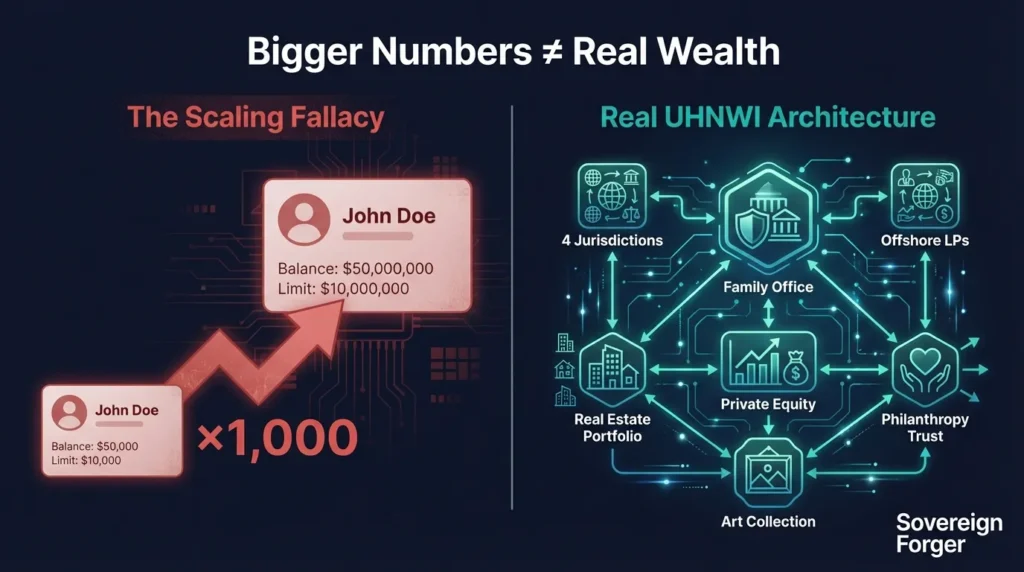
Why Bigger Numbers Are Not Bigger Profiles
A retail banking customer with $50,000 has one checking account, one savings account, perhaps a mortgage, and a 401k. A UHNWI with $50 million has fundamentally different structure: direct private equity, family offices, offshore partnerships, art portfolios, philanthropic vehicles.
When you scale by 1,000x, you get $50 million in a checking account. That person does not exist. No wealth advisor would recognize that profile. No compliance system should accept it as realistic input.
The structural gap goes beyond numbers — it shows up in every dimension from cultural wealth patterns to wealth distribution mathematics.
The Structural Differences That Scaling Misses
Six dimensions of wealth structure change qualitatively as net worth increases past $10 million.
Jurisdiction count: Retail: one. UHNWI with $50M: three to five jurisdictions with onshore and offshore structures.
Asset class diversity: Below $1M: cash, equities, real estate. Above $30M: direct PE, VC commitments, commercial real estate, structured credit, alternatives.
Liability structure: Retail: mortgage. UHNWI: lombard loans, margin facilities, structured lending against illiquid assets, inter-entity obligations.
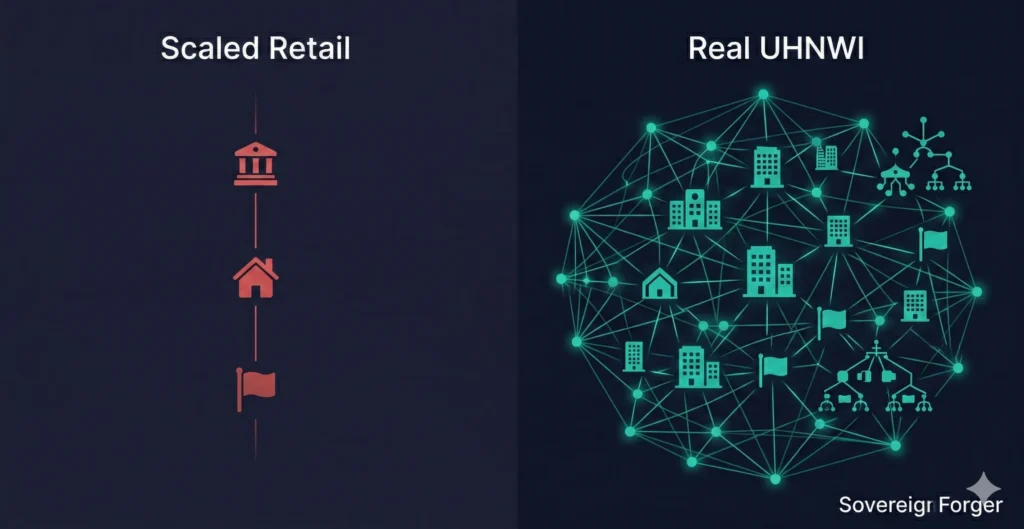
Professional profile: Retail customers span all sectors. UHNWIs cluster in wealth-creation pathways: tech founders, developers, executives, inheritors, traders. Each correlates with specific asset structures.
Philanthropic footprint: Above $20M, charitable structures become standard: DAFs, foundations, trusts. These are structural elements, not optional.
Entity complexity: Retail: single person. UHNWI: multiple entities — trusts, LLCs, partnerships, holdings. This is what KYC systems handle.
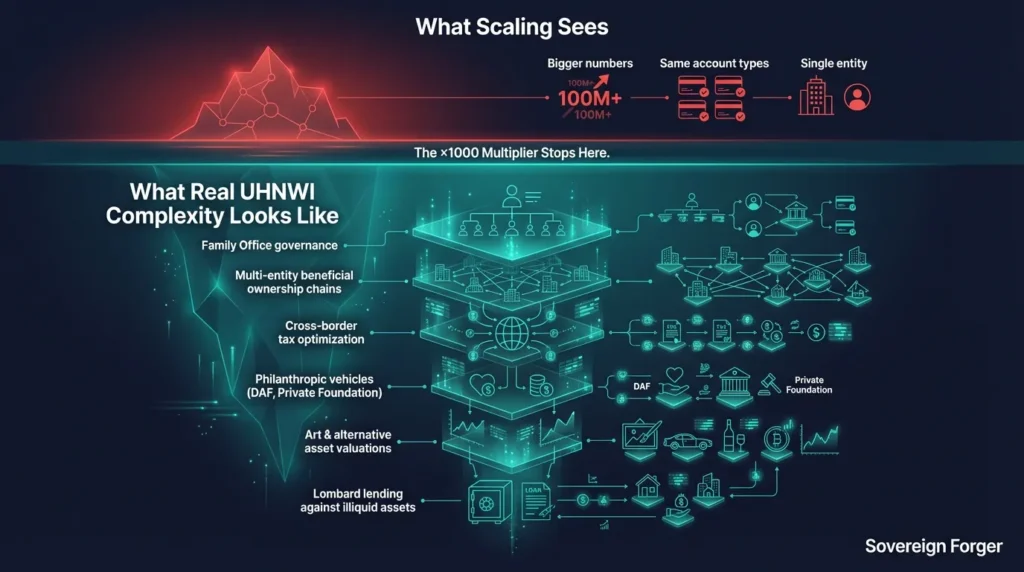
What This Means for Your AI
If your model trains on scaled retail profiles, it learns a simplified version of wealth that does not exist in practice. When it encounters a real UHNWI with four jurisdictions, a family office, and a Cayman LP, it has no frame of reference. The model either misclassifies the profile, flags false positives in compliance checks, or produces outputs that no wealth advisor would trust.
A simple first check: run the open-source Balance Sheet Test on your current dataset. If the math does not add up, the structural problems run deeper than the numbers.
The fix is not to scale harder or add random complexity after the fact. This is exactly why I built Sovereign Forger around born-synthetic generation: profiles that start from UHNWI-specific structural assumptions — the right asset classes, the right jurisdictions, the right entity relationships — with every financial figure computed within algebraic constraints.
See the Difference
Not sure what to look for? Start with The Balance Sheet Test — if the math does not add up, nothing else matters. The test is open source, so you can run it on any dataset.
Download 100 free Silicon Valley UHNWI profiles. Compare the structural complexity of any single record against what your current synthetic data looks like. The difference is not in the numbers. It is in the architecture. That is the entire sales pitch.
Frequently Asked Questions
Why can’t I scale retail banking profiles to create UHNWI test data?
Scaling multiplies quantities but preserves structure. A $50K retail profile multiplied by 1,000 produces $50M in a checking account — a financially impossible scenario. UHNWI wealth is structurally different: distributed across private equity, real estate portfolios, trust structures, and multiple jurisdictions. No multiplication factor can create these structural differences from a retail profile.
What structural differences exist between retail and UHNWI profiles?
At least six dimensions diverge: asset composition (PE, art, trusts vs savings), liability structure (Lombard loans vs mortgages), jurisdiction count (3-5 vs 1), entity complexity (family offices, LLCs vs single person), professional clustering (founders, inheritors vs all sectors), and tax optimization structures (offshore vehicles, treaty networks vs standard filing).
How does Sovereign Forger generate realistic UHNWI profiles?
Sovereign Forger uses Pareto distributions calibrated to real-world wealth concentration, with 31 culturally specific archetypes across 6 geographic niches. Each archetype has distinct asset allocation patterns, offshore jurisdiction preferences, and professional profiles. The Math First approach ensures every profile is internally consistent before AI enrichment adds narrative depth.
What is the Math First approach to synthetic data?
Math First means financial fundamentals are generated using mathematical distributions and algebraic constraints before any AI processing. Pareto distributions model wealth concentration, archetype-specific allocation rules distribute assets, and the constraint Assets minus Liabilities equals Net Worth is enforced algebraically. AI (LLM) only adds narrative biography and context after the numbers are locked.
How many UHNWI archetypes does Sovereign Forger support?
31 archetypes across 6 geographic niches: Silicon Valley (tech founders, VCs), Old Money Europe (dynasties, private banking), Middle East (sovereign families, merchant houses), LatAm (agribusiness, infrastructure), Pacific Rim (semiconductor, shipping), and Swiss-Singapore (offshore wealth, multi-family offices). Each archetype has distinct wealth structures, jurisdiction preferences, and professional profiles.