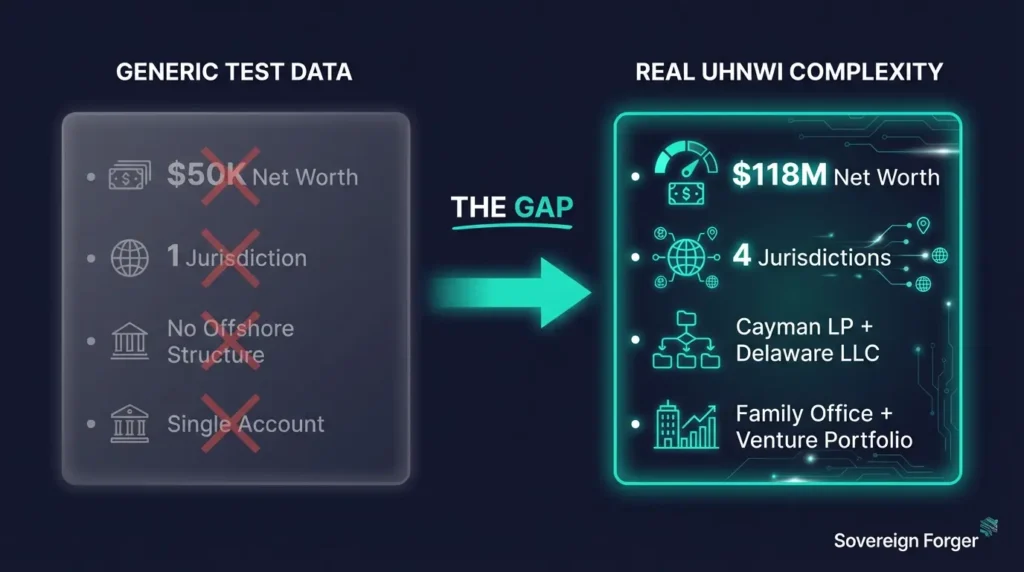
I spent years watching teams build wealth management AI on data that looked nothing like a real client. Profiles with $50,000 net worth, a single bank account, one jurisdiction, no offshore structure. Then the complaints would start: “the model doesn’t work on real HNW clients.” Of course it doesn’t.
This is not a calibration issue. It is a structural problem with how synthetic financial data gets generated — and it affects everything downstream, from risk scoring accuracy to compliance testing reliability.
The $50K Problem
Every synthetic data generator I evaluated — whether rule-based or ML-powered — produces profiles modeled on average financial behavior. Average account balances. Average transaction patterns. Average everything.
But ultra-high-net-worth individuals are not average by definition. A UHNWI with $118 million in net worth does not have “a bigger version” of a retail banking profile. The entire structure is different:
- Property holdings across multiple cities and countries
- Core equity concentrated in family offices, private equity, or venture portfolios
- Cash liquidity spread across multiple positions and currencies
- Offshore vehicles — a Cayman Exempted Limited Partnership, a Delaware Series LLC, a BVI Holding Company
- Professional backgrounds tied to specific wealth-creation patterns (tech exits, commodity trading, generational inheritance)
- Philanthropic commitments that reflect cultural and geographic context
When your test data has none of this complexity, your AI model learns patterns that simply do not exist at the top of the wealth spectrum. The result is a product that works for mass affluent clients but breaks for the clients it was actually built to serve.
Why Existing Tools Don’t Solve This
The synthetic data market has grown rapidly, with platforms like Gretel, Synthesized, Mostly AI, and YData offering powerful generation tools. But they all share one fundamental design assumption: you provide your own real data as input, and the tool generates synthetic versions of it.
This creates a chicken-and-egg problem I saw over and over again. You need UHNWI data to build your product. But you don’t have UHNWI clients yet — because you haven’t built the product. And even if you did have real HNWI data, using it as a seed for synthesis introduces re-identification risks that grow more serious every year.
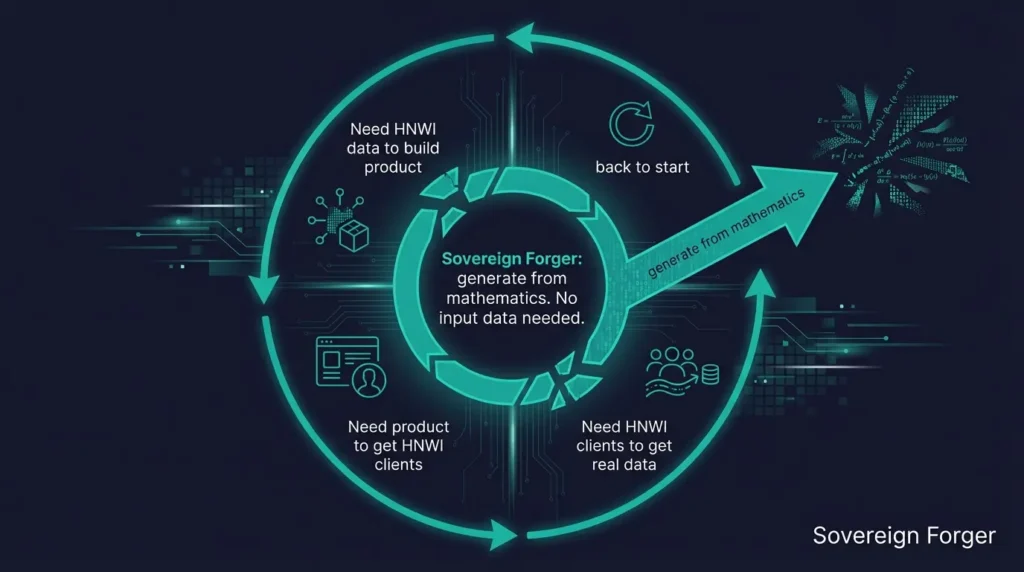
The alternative — generating UHNWI profiles from scratch, without any real data as input — requires a fundamentally different approach. That is why I built Sovereign Forger: starting from the mathematical properties of wealth distribution, not from existing datasets.
What Realistic UHNWI Data Actually Looks Like
Consider this synthetic profile from the Silicon Valley niche:
full_name: Erin Arora
residence_city: Santa Monica
residence_zone: Ocean Avenue
net_worth_usd: $118,789,521
total_assets: $129,871,826
total_liabilities: $11,082,305
property_value: $21,010,082
core_equity: $91,164,801
cash_liquidity: $17,696,943
profession: Quantum Computing — Principal of Family Office
education: Carnegie Mellon
offshore_jurisdiction: Delaware (USA)
offshore_vehicle: Cayman Exempted Limited Partnership
Notice the internal consistency. $129,871,826 minus $11,082,305 equals $118,789,521 — Total Assets minus Total Liabilities equals Net Worth. And $21,010,082 plus $91,164,801 plus $17,696,943 equals $129,871,826 — Property plus Core Equity plus Cash Liquidity equals Total Assets.
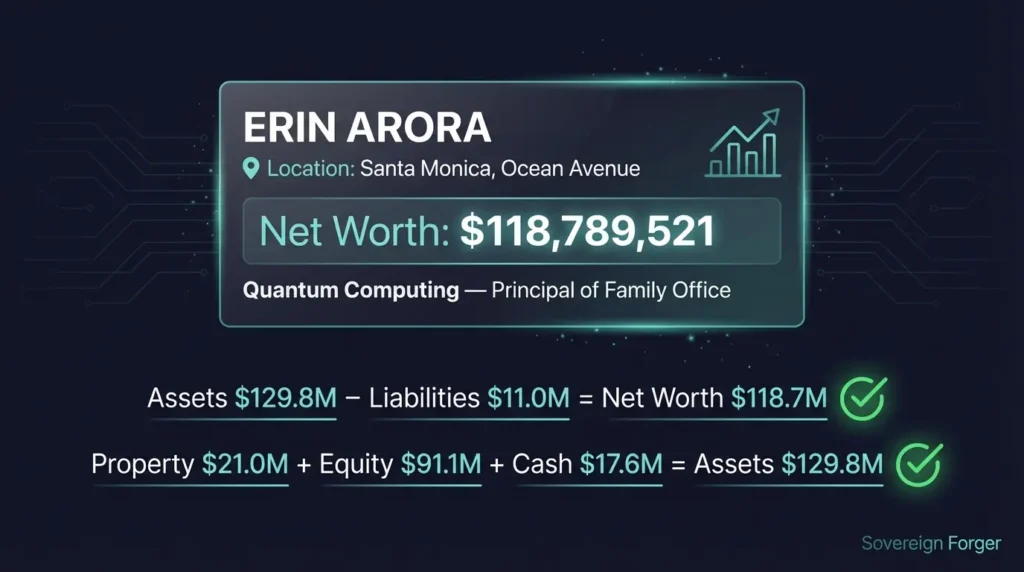
Every field is interlocked. The residence zone (Ocean Avenue, Santa Monica) is consistent with the wealth tier. The offshore vehicle (Cayman Exempted LP) is consistent with the jurisdiction (Delaware). The profession and education are coherent with Silicon Valley wealth patterns.
This is what wealth management AI needs to train on: profiles where the complexity is not an afterthought but the foundation.
How do you verify this integrity yourself? I created the balance sheet test — a simple method to audit any synthetic dataset in under sixty seconds.
The test is open source on GitHub, so you can run it on any provider’s data, including mine.
The Compliance Angle
There is a second reason why generic synthetic data fails in this space, and it matters even more for RegTech teams.
If you are building KYC, EDD, or AML screening tools, your system needs to handle edge cases — complex beneficial ownership, multi-jurisdictional exposure, unusual asset structures. These are precisely the scenarios that generic test data never includes.
I have seen compliance officers test their EDD system against profiles with $500K net worth and a single jurisdiction and call it validated. They had not actually tested it. The real-world cases that trigger enhanced due diligence involve exactly the kind of structural complexity that only purpose-built UHNWI profiles can provide.
What to Look For in Synthetic UHNWI Data
If you are evaluating synthetic data for wealth management or compliance applications, here are the properties that matter:
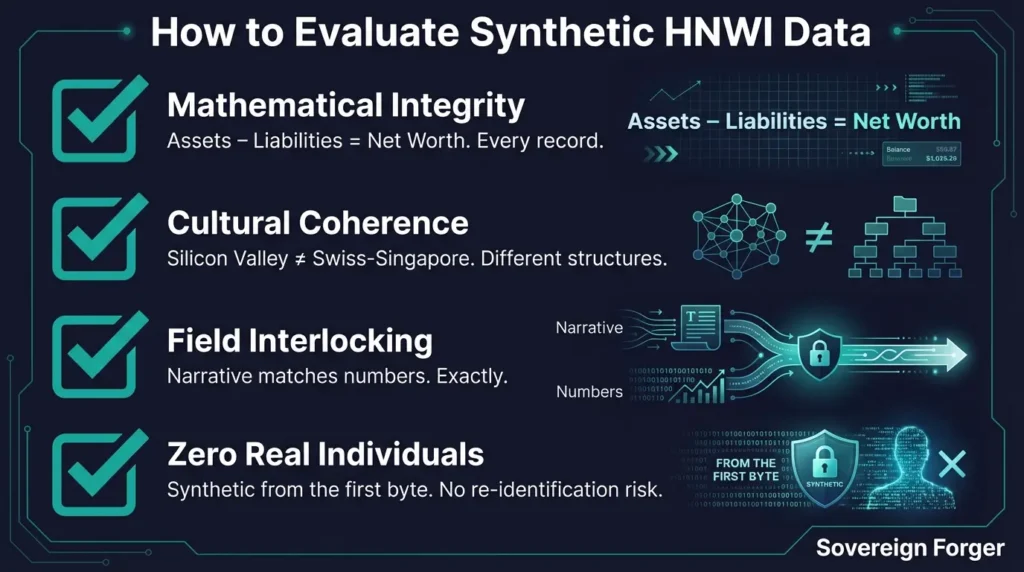
Mathematical integrity. Every balance sheet should balance — not approximately, not most of the time, but on every single record. If Assets minus Liabilities does not equal Net Worth, the data is unreliable.
Cultural and geographic coherence. A Silicon Valley tech founder and a Swiss private banker have completely different wealth structures, even at similar net worth levels. The data should reflect this.
Field interlocking. Narrative fields (biography, asset descriptions) should match structured fields (dollar amounts, jurisdictions) exactly. If the narrative says “$21 million in real estate” but the property_value field says $18 million, the data is internally inconsistent.
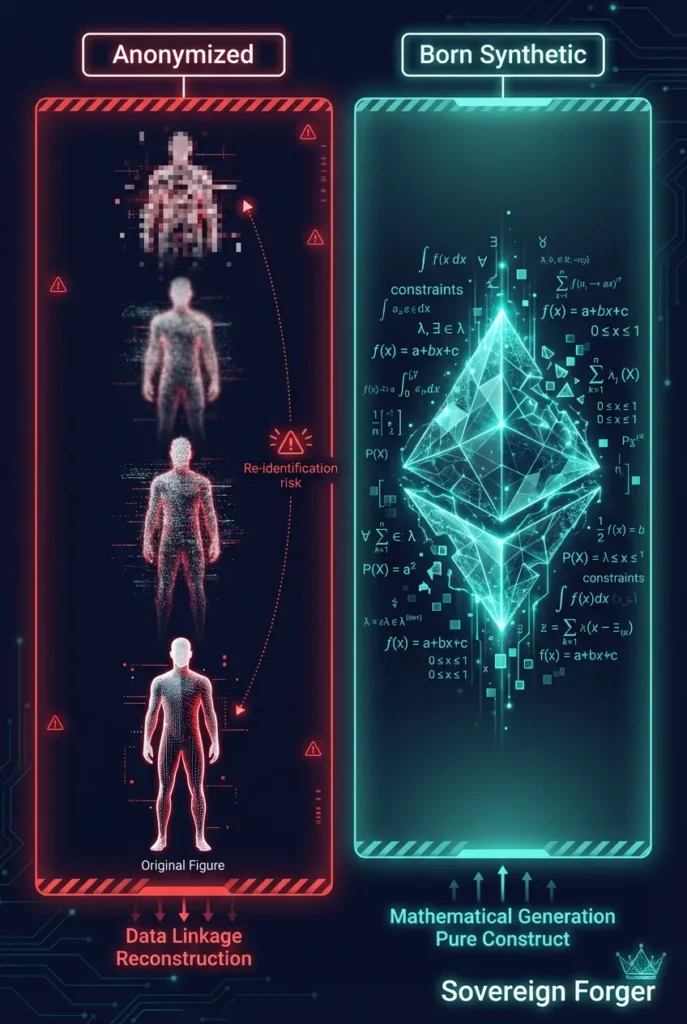
Zero real individuals. The safest synthetic data is born-synthetic data — never derived from real people, never anonymized, never masked. Generated from mathematics, not from anyone’s real records.
For a deeper look at why this distinction matters under GDPR, see Born Synthetic vs Anonymized.
I built Sovereign Forger to meet all four of these requirements — and I publish the methodology in full so you can verify it before spending a dollar.
Download 100 free Silicon Valley UHNWI profiles and run the tests yourself. If the math doesn’t hold up, walk away.
Frequently Asked Questions
Why does generic synthetic data fail for UHNWI compliance testing?
Generic synthetic data generators produce profiles with simple, uniform structures — single bank accounts, standard salary income, one jurisdiction. Ultra-high-net-worth individuals have fundamentally different wealth structures: multi-entity holdings, cross-border jurisdictions, complex asset compositions including private equity, art collections, and trust structures. Generic tools cannot replicate this complexity because they lack the domain-specific distributions and archetypes needed for realistic UHNWI profiles.
What makes UHNWI data structurally different from retail banking data?
UHNWI profiles differ across every dimension: asset composition (direct PE, art, real estate portfolios vs savings accounts), liability structures (Lombard loans, margin facilities vs mortgages), jurisdiction count (3-5 vs 1), entity complexity (trusts, LLCs, family offices vs single person), and professional profiles that cluster in wealth-creation pathways rather than spanning all sectors.
Can I configure a general-purpose synthetic data tool to produce UHNWI profiles?
In theory, yes — but in practice the configuration effort is comparable to building a dedicated system. You need Pareto wealth distributions, culturally accurate naming, archetype-specific asset allocations, realistic offshore structures, and mathematical constraints ensuring Assets minus Liabilities equals Net Worth. Most general-purpose tools use Gaussian distributions and lack these capabilities.
How does Sovereign Forger solve the generic data problem?
Sovereign Forger uses a Math First, AI Second approach. Pareto distributions generate realistic wealth structures with algebraic constraints guaranteeing balance sheet integrity. Then 31 culturally specific archetypes across 6 geographic niches ensure every profile reflects real-world wealth patterns — from Silicon Valley tech founders to Old Money European dynasties.
What is born-synthetic data and why does it matter for compliance?
Born-synthetic data is generated from mathematical distributions and domain knowledge — not derived from real individuals. Unlike anonymized data, there is zero lineage to real persons, eliminating re-identification risk. This makes born-synthetic data compliant with GDPR Article 25, EU AI Act Article 10, and CCPA by construction, not by post-processing.